The retail e-commerce industry is currently confronting a silent margin killer: return rates. With average online apparel return rates hovering between 20% and 35%, retail enterprises are losing billions of dollars annually to reverse logistics, restocking overhead, and carbon penalties.
For years, brands attempted to solve this "fit and style" uncertainty using primitive 3D avatar builders or basic flat 2D image-overlay widgets. These legacy platforms failed. They required users to input tedious physical measurements to build unconvincing digital mannequins, or they produced comical "paper-doll" overlays that ignored fabric physics, lighting conditions, and body posture.
In 2026, the paradigm has fundamentally shifted. Advancements in generative computer vision—specifically Latent Diffusion Models (LDMs), DensePose parsing, and high-fidelity image-to-image warping—have made real-time AI Virtual Try-On (VTON) an enterprise reality.
Today, instead of relying on restrictive third-party SaaS widgets, forward-looking brands are engineering custom, self-hosted try-on pipelines. This transition allows them to deliver photorealistic virtual fitting rooms that respect fabric drape, texture, and complex poses—safeguarding margins and driving digital conversion.
What Is AI Virtual Try-On (VTON)?
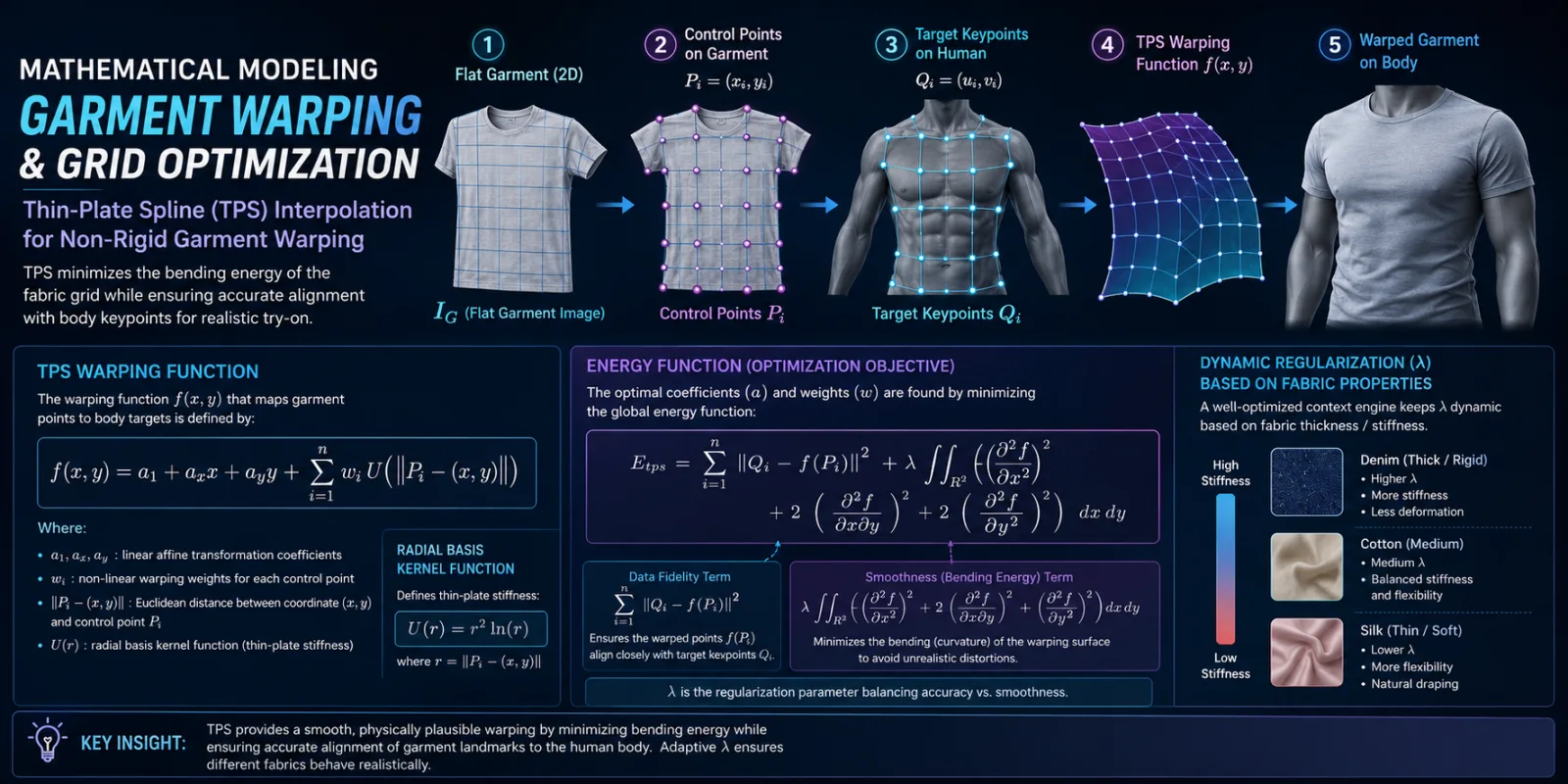
AI Virtual Try-On (VTON) is a programmatic computer vision framework that photorealistically overlays garments, accessories, or footwear onto a user-uploaded image of a human body. Rather than using rigid 3D meshes, modern VTON pipelines use machine learning architectures (such as Diffusion Models and Generative Adversarial Networks) combined with human parsing and warp-flow algorithms to dynamically drape clothing around poses, adjust for physical body dimensions, and preserve fabric texture and lighting.
Analogy: Understanding the Virtual Drape
To understand how modern AI virtual try-on operates, imagine a physical tailor working with a highly advanced, elastic projection system.
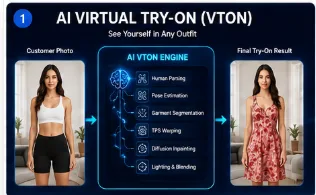
If you hand a traditional, low-tech widget a flat photo of a jacket, it acts like a cardboard cutout—it simply tapes the jacket photo directly over your body picture. If you are standing at an angle, or have your hands in your pockets, the cutout looks absurdly flat and misaligned.
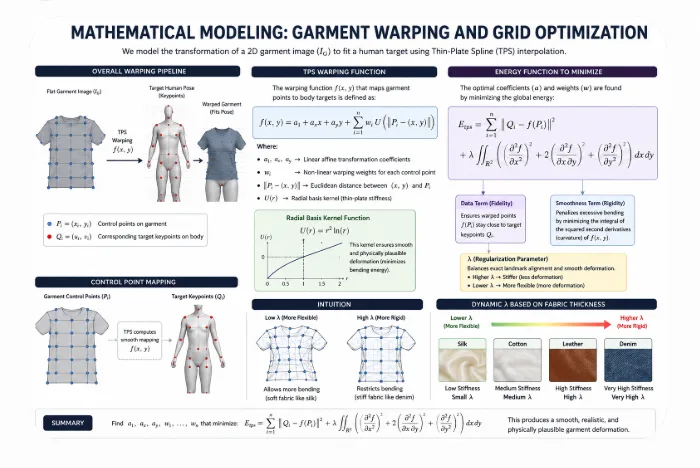
A modern AI Contextual Try-On Engine acts like an elite master tailor. First, it measures your body contours, joints, and pose angles from your photo (using Human Parsing and DensePose). Then, it takes the flat photo of the jacket, calculates how the fabric should stretch and warp to fit your specific posture (using Flow Estimation and Thin-Plate Spline Warping), and seamlessly drapes it over you. Finally, it blends the lighting, shadows, skin tones, and fabric textures (using Latent Diffusion Inpainting) so that the jacket looks physically present in the room with you.
GANs vs. Diffusion Models vs. 3D NeRFs: The Core VTON Technologies
Developing a robust enterprise try-on application requires selecting the optimal machine learning architecture. Modern systems rely on three primary methodologies:
|
Technology |
Architectural Approach |
Pros |
Cons |
Ideal Use Case |
|---|---|---|---|---|
|
Generative Adversarial Networks (GANs) |
Dual-network (Generator/Discriminator) pixel synthesis. |
Sub-second inference latency; highly efficient on low-end hardware. |
Struggles with complex occlusion (e.g., hair over shoulders or hands in pockets). |
High-speed, lower-fidelity mobile try-on applications. |
|
Latent Diffusion Models (LDMs) |
Multi-step noise-to-image reconstruction with conditional inputs. |
Photorealistic fabric drapes, perfect shadow rendering, and flawless skin blending. |
Higher compute latency (typically 1.5 to 3.5 seconds per generation on high-end GPUs). |
Premium, photorealistic apparel and high-fashion virtual fitting rooms. |
|
Neural Radiance Fields (NeRFs) / 3D Gaussians |
Continuous 3D scene representations reconstructed from 2D frames. |
True 360-degree rotation, accurate volume calculations, and dynamic camera angles. |
Requires multi-angle product videos/photos; heavy client-side rendering requirements. |
Luxury eyewear, jewelry, footwear, and interactive 3D product pages. |
Enterprise AI Virtual Try-On in Practice
Enterprise deployment of virtual try-on engines must be tailored to your specific vertical's data, hardware, and performance profiles:
-
Mass-Market Apparel Retailers leverage diffusion-based VTON pipelines to allow customers to instantly see shirts, pants, and dresses on their own bodies. This dramatically lowers cart abandonment and minimizes sizing returns.
-
Luxury Watch and Jewelry Brands deploy high-precision 3D landmark tracking to anchor watches, rings, and necklaces to user body coordinates in real-time. This allows for immersive, interactive product exploration.
-
Eyewear E-commerce Portals utilize web-native face-mesh tracking (e.g., MediaPipe) combined with WebGL rendering to drape glasses seamlessly over users' faces during live video streams.
-
Custom Garment Manufacturers combine predictive sizing APIs with localized warping models to generate exact visual mockups of custom-fit suits or athletic wear before fabrication begins.
To decide whether your enterprise should integrate these advanced visual systems via a rigid off-the-shelf software contract or build a high-performance proprietary pipeline, consult our technical strategic analysis: Custom Software Development vs SaaS: When Businesses Should Build Instead of Buy.
The Production AI Virtual Try-On Pipeline
A production-grade, photorealistic clothing try-on system operates across a sequence of discrete machine-learning microservices.
Step-by-Step Architectural request Flow
Let's break down the system execution layers required to generate a flawless output image:
1. Human Parsing and Keypoint Extraction
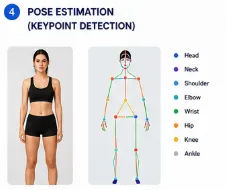
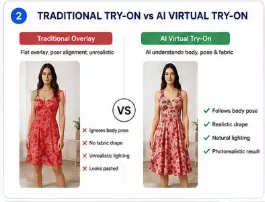
When a user uploads a portrait, the system processes it through a localized body parsing model (such as Segment Anything 2 (SAM 2) or DensePose). This maps the human body into discrete semantic segments (skin, hair, existing shirt, pants, background) and extracts 2D joint coordinates.
2. Garment Alignment (Thin-Plate Spline Warping)
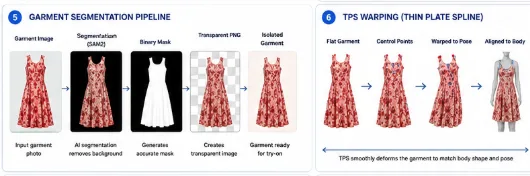
Simultaneously, the flat product image of the target garment is isolated. Using the joint keypoints from the user’s portrait, the system calculates a flow-warping field. A Thin-Plate Spline (TPS) Warping or a deep-neural flow network (such as TryOnGAN's warping module) bends and stretches the garment image to match the target user's pose, torso width, and shoulder tilt.
3. Diffusion-Based Image Inpainting
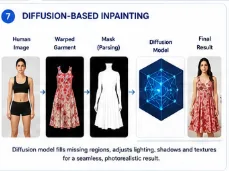
The warped garment is placed onto the target human image, and a semantic mask is generated over the area where the clothing sits. The masked image is passed to a specialized ControlNet-conditioned Stable Diffusion model (such as CatVTON or OOTDiffusion). The diffusion model denoises the masked region, blending the garment's edges, rendering realistic fabric folds, casting natural shadows based on the background lighting, and stitching skin boundaries (like arms and neck) flawlessly.
4. Hardware Optimization for Low Latency
Running standard diffusion models on enterprise servers can take upwards of 5–8 seconds, which destroys user conversion. To run this at scale, we deploy the diffusion pipeline within high-throughput frameworks using TensorRT-LLM optimizations and prefix-caching layers. To see how these infrastructure configurations reduce GPU expenses and optimize execution speeds, see our guide on LLM Inference Optimization: Scaling Performance and Reducing Token Costs in Production.
The Enterprise VTON Tooling Landscape
Building a performant, custom virtual fitting platform requires combining specialized computer vision models and hosting frameworks:
|
Tool / Framework |
Primary Role in Try-On |
Why It Is Chosen |
|---|---|---|
|
Segment Anything (SAM 2) |
High-precision background and garment masking. |
Unmatched zero-shot segmentation of complex apparel edges. |
|
DensePose (Meta) |
Mapping 2D image pixels to 3D human body coordinates. |
Allows the model to understand body volume and posture orientation. |
|
OOTDiffusion / CatVTON |
Open-source, high-fidelity virtual try-on pipelines. |
Specialized latent diffusion models pre-trained specifically for photorealistic fabric draping. |
|
ControlNet (Canny / IP-Adapter) |
Enforcing shape structures and garment patterns. |
Ensures corporate logos, text, and specific textures remain completely undistorted during generation. |
|
Triton Inference Server |
Concurrent GPU pipeline hosting and batching. |
Handles high concurrent user traffic with dynamic model loading. |
Hypothetical Case Studies: Enterprise Try-On in Action
The following case studies represent illustrative, hypothetical scenario models designed to demonstrate real-world systems engineering topologies.
Case Study 1: Fashion eCommerce
Companies like Zalando, ASOS, Amazon Fashion, and H&M are investing heavily in AI-powered virtual fitting experiences to reduce apparel returns and improve customer confidence before checkout.
Common applications include:
- T-shirts
- Dresses
- Jackets
- Jeans
- Footwear
- Accessories
Business benefits
- Lower return rates
- Higher conversion rates
- Better customer engagement
- Increased average order value
Case Study 2:
Lenskart, Warby Parker, and Ray-Ban allow customers to try on glasses using their smartphone camera.
The AI detects:
- Face landmarks
- Head rotation
- Eye position
- Nose bridge
- Lighting
This enables accurate placement of spectacle frames without requiring users to visit a physical store.
Security, Privacy, and Data Governance in VTON
When users upload personal photos of themselves to an online platform, data privacy becomes a paramount concern. If your try-on system caches, leaks, or uses these personal images for training data without consent, your company faces severe regulatory and legal liabilities.
Ephemeral Storage and Stateless Architectures
To ensure compliance with GDPR, CCPA, and evolving consumer data laws, your try-on gateway must operate on a stateless architecture. Once a user photo is uploaded, parsed, and merged with a garment, the original raw input image must be cryptographically deleted from memory. Only the finalized composite output image is sent back to the client browser, with zero permanent storage on backend server nodes.
Protecting Your System from Exploits
Furthermore, because your try-on engine accepts user image uploads, it is a potential vector for malicious payload injections. Protecting your processing pipeline requires implementing strict validation gates at the API Gateway level to sanitize file metadata and block unauthorized script execution. Learn how to design these perimeters in our deep-dive analysis: Enterprise AI Security in 2026: Protecting LLMs, Data, and Business Workflows.
Additionally, connecting these user-facing visual tools to your backend inventory, databases, and customer support channels requires robust multi-agent orchestration layers. To ensure these workflows run safely without manual oversight, explore our framework on AI Governance Explained: Building Responsible Enterprise AI Systems in 2026.
Actionable Implementation Checklist
To build and scale your custom virtual try-on system successfully, follow this structured development roadmap:
-
Define Accuracy Targets: Establish baseline parameters for texture preservation, skin-tone blending, and border resolution.
-
Select Model Precision: Run performance benchmarks comparing 16-bit vs. 8-bit quantized models to optimize GPU VRAM footprints.
-
Implement Strict Sanitization: Deploy zero-trust validation gateways to scan and sanitize all user-uploaded images.
-
Secure Stateless Pipelines: Enforce automated, ephemeral data destruction schedules to ensure strict compliance with global privacy regulations.
-
Deploy GPU Serving Clusters: Set up scalable Kubernetes (K8s) or Triton Inference Server nodes to manage parallelized workloads.
-
Optimize Dynamic Batching: Enable auto-queueing and prefix caching to minimize latencies during traffic surges.
-
Run Continuous Telemetry: Monitor latency, token cost, and image distortion metrics using professional tracing software.
-
Enforce Human-in-the-Loop QA: Run automated regression tests to verify that generated try-on imagery contains zero graphical anomalies before production deployments.
Expert Opinion: Why Virtual Try-On is an Infrastructure Challenge
Many technical directors treat virtual try-on as a frontend marketing gimmick. This is a critical misunderstanding of computer vision systems engineering.
While a sleek mobile UI is important, the true battle is won at the infrastructure layer. If your try-on engine takes five seconds to generate an image, or costs $0.10 in GPU compute per click, the application is economically unviable in high-volume retail environments.
The future of digital commerce belongs to brands that treat prompt space and image-generation grids as high-density, highly optimized computing environments. By building optimized, stateless, self-hosted try-on pipelines, you convert raw generative models into precise, highly efficient operational assets that scale conversion margins and systematically eliminate return liabilities.
To see how optimizing these backend transaction layers directly lowers operational overhead and shapes modern digital customer behavior, read our complete guide: How AI-Powered Customer Support Is Reducing Costs and Improving UX.
Scale Your Custom Visual AI Architecture with TechMamba
Designing, hosting, and optimizing a photorealistic, secure virtual try-on gateway requires extensive, real-world machine learning experience. At TechMamba, we specialize in building highly secure private assistant networks, performant computer vision pipelines, and automated multi-agent environments designed to protect your operational margins and scale your enterprise efficiency.