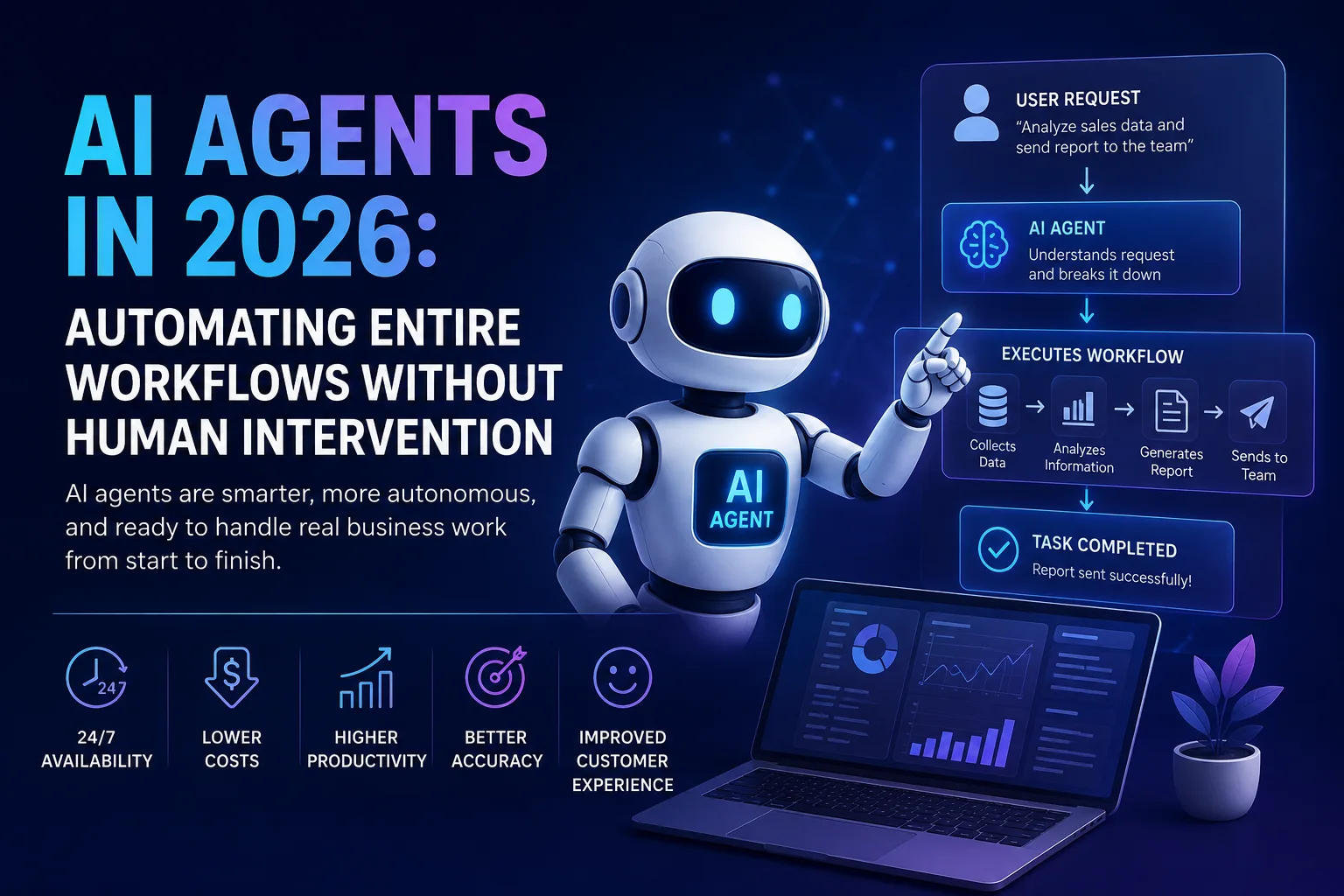
When budgeting for artificial intelligence, enterprise leaders face a vastly different landscape than they did during the initial wave of generative AI. The market has shifted past basic text-generation prompts and informational chatbots. The competitive baseline is now Agentic AI—autonomous software systems engineered to execute end-to-end operational workflows across an enterprise software stack.
Data from the Gartner 2026 AI Spending Forecast highlights this macroeconomic shift: global enterprise spending on AI agent software is projected to hit $206.5 billion this year, expanding by an estimated 82% as organizations pivot aggressively toward autonomous execution. While the McKinsey State of AI Global Survey reveals that 62% of organizations are actively experimenting with AI agents, only 23% have successfully scaled an agentic workflow into full production.
Because an AI agent actively reads and writes data across CRMs, ERPs, and internal databases, calculating its development cost is fundamentally different from pricing a standard software application. This guide provides an engineering-first breakdown of the development costs, operational expenses, and architectural variables dictating AI agent investments in 2026.
1. Quick Summary: 2026 AI Agent Investment Matrix
For organizations actively structuring a fiscal budget, the chart below outlines the stabilized global market benchmarks for enterprise-grade AI agent development, based on project complexity, integrations, and deployment scope.
| Development Tier | Total Capital Investment | Average Timeline | Core Technical Scope |
| 1. Feasibility Prototype (PoC) | $15,000 – $35,000 | 4 – 6 weeks | Sandboxed data, mock APIs, single-turn reasoning loops. Built for technical validation. |
| 2. Minimum Viable Product (MVP) | $35,000 – $75,000 | 6 – 10 weeks | Single production agent, live read-only RAG pipelines, 1-2 stable software APIs. |
| 3. Workflow Automation Agent | $75,000 – $180,000 | 3 – 5 months | Multi-step autonomous reasoning, cross-system writes, deterministic safety guardrails. |
| 4. Multi-Agent Enterprise System | $180,000 – $400,000+ | 6 – 12 months | Orchestrated networks of specialist agents, high concurrency, strict regulatory compliance. |
2. Technical Factors That Dictate Development Cost
An agent's cost is not static; it scales linearly based on its architectural requirements, the structural health of your data, and the scope of its operational authority. When scoping a build with an engineering firm, the following variables exert the highest impact on your total capital expenditure:
| Architectural Factor | Budgetary Impact | Operational Complexity |
| Number of Integrations & Read/Write Depth | High | Legacy systems (SAP/on-premise databases) require custom API wrapping, increasing core engineering time by 40%. |
| Regulatory & Security Compliance | High | Frameworks like HIPAA, SOC 2 Type II, or secure PII scrubbing add significant auditing and data governance layers. |
| Multi-Agent Orchestration Architecture | High | Coordinating multiple specialized sub-agents via a supervisor node requires complex state handling. |
| Enterprise Data Quality & Cleanliness | High | Unstructured, fragmented data requires robust ETL pipelines before an agent can safely reason over it. |
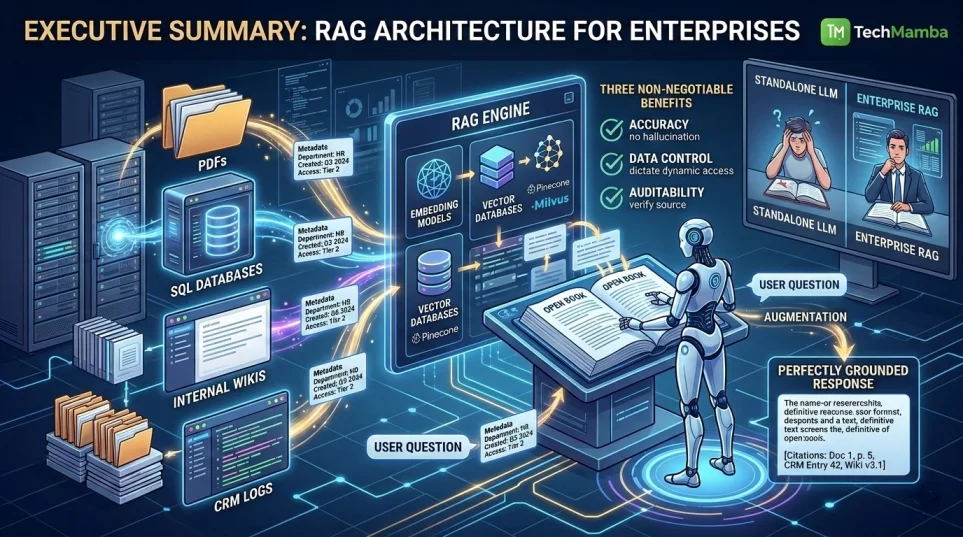
| Retrieval-Augmented Generation (RAG) System | Medium | Setting up advanced chunking, metadata tagging, and production vector databases (Pinecone, Qdrant). |
| Human-in-the-Loop (HITL) Gateways | Medium | Engineering UI review gates for human sign-off before an agent executes high-risk external actions. |
3. Where the Capital Goes: Cost Allocation Breakdown
When budgeting an outsourced project or planning a custom build via our specialized AI Agent Development Service, capital allocation is heavily weighted toward orchestration engineering, data pipelining, and automated evaluation frameworks rather than raw model access. Frontier model token costs have commoditized significantly, making the architectural implementation the primary cost driver.
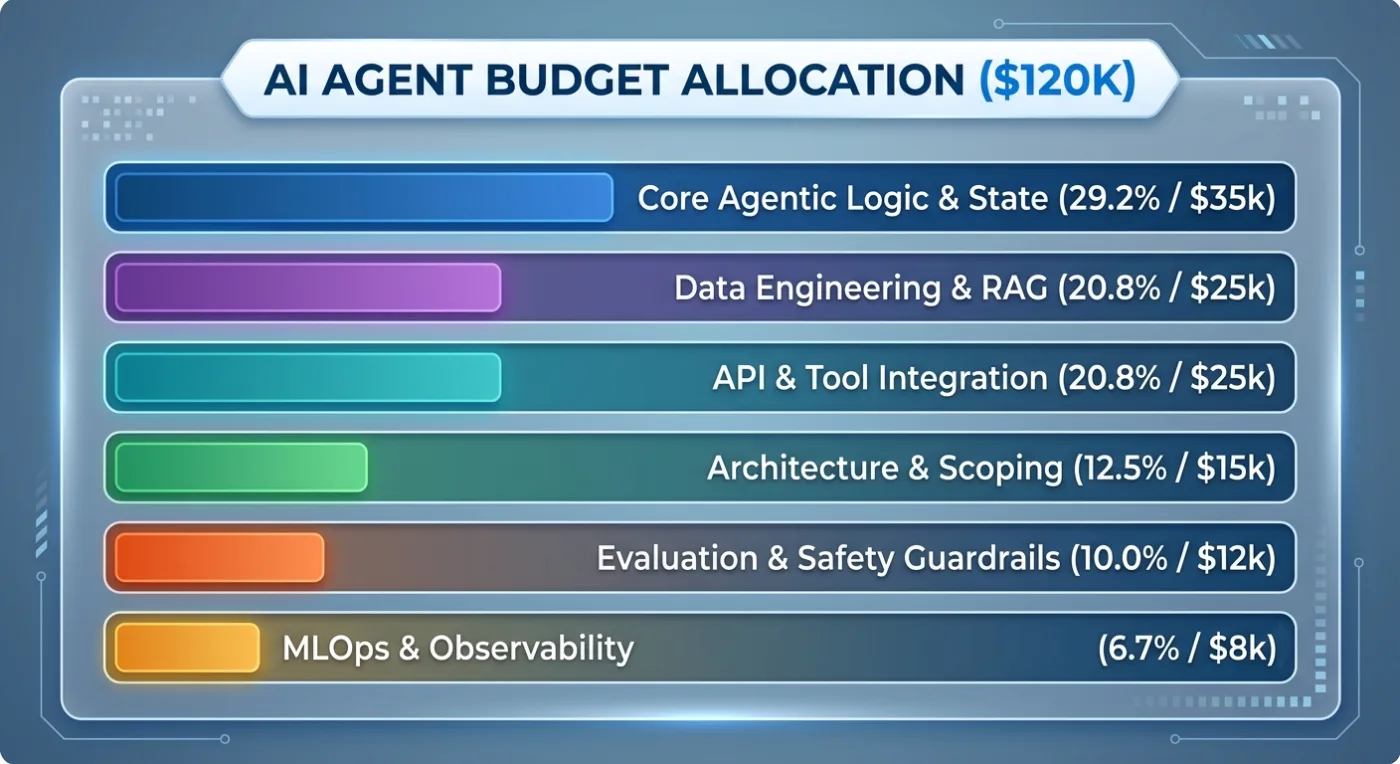
A typical allocation for a $120,000 Tier 3 Workflow Automation Agent scales across these core engineering phases:
-
Core Agentic Logic & State Management (29.2% | $35,000): Developing recursive reasoning loops (via frameworks like LangGraph or CrewAI), coding memory persistence layers (Redis), and establishing orchestration and state handling (the logic that allows the AI to track its progress and preserve context across multi-day workflows).
-
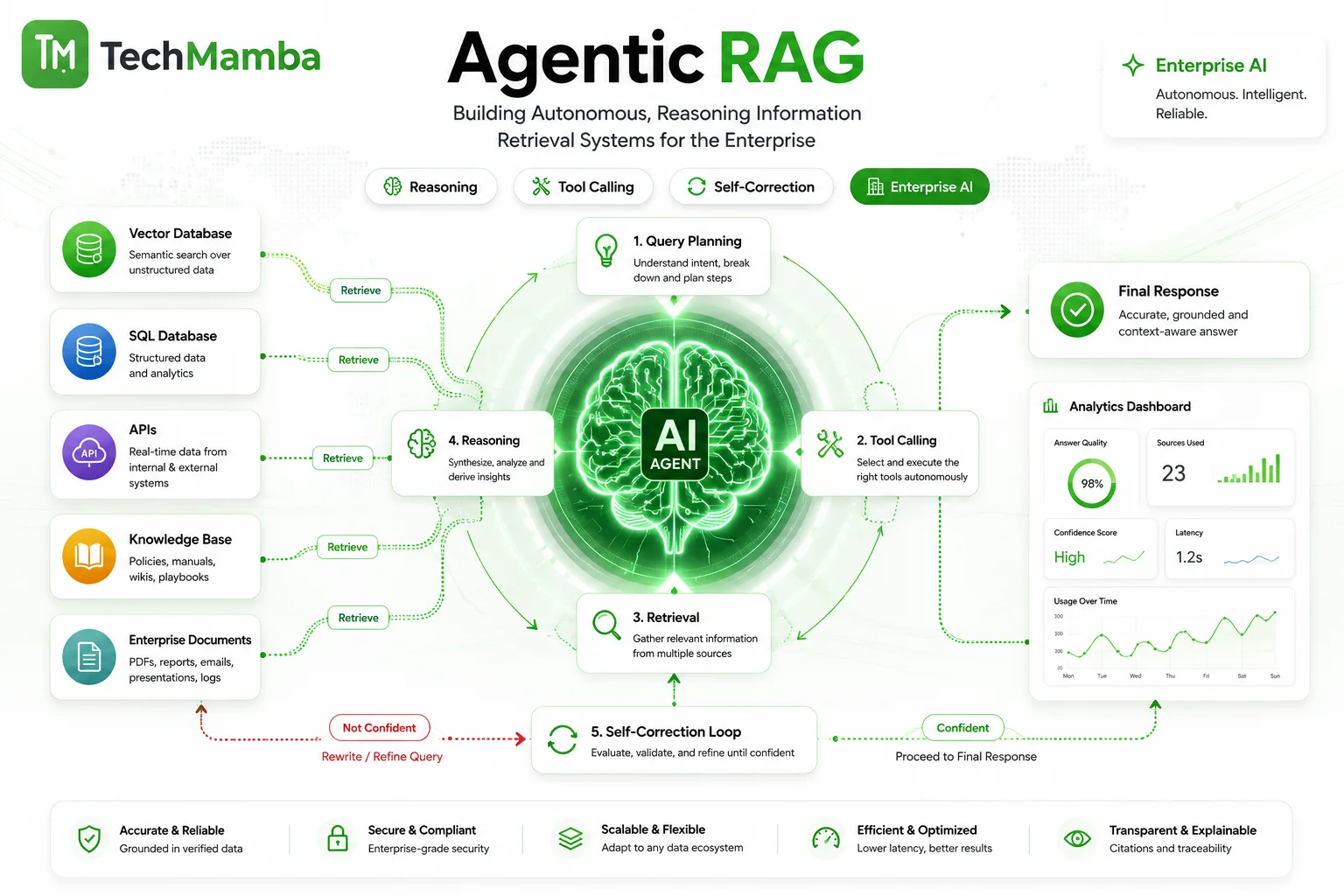
Data Engineering & RAG Architecture (20.8% | $25,000): Constructing automated ETL pipelines, managing vector database indexing, and optimizing semantic chunking strategies. This is detailed comprehensively in our architectural breakdown of Agentic RAG Architecture.
-
API & Tool Integration (20.8% | $25,000): Wrapping enterprise software capabilities into secure execution tools that the model can invoke programmatically, handling authentication, and establishing rate-limiting walls.
-
Architecture & Boundary Scoping (12.5% | $15,000): Mapping human logic pathways, defining explicit system boundaries, and engineering the precise thresholds for human-in-the-loop (HITL) handoffs.
-
Automated Evaluation & Safety Guardrails (10.0% | $12,000): Building synthetic testing harnesses to subject the agent to hundreds of adversarial edge cases, checking for hallucinations, and implementing strict deterministic safety guardrails (hardcoded, rule-based software barriers that keep the AI operating within safe corporate boundaries).
-
MLOps & Observability Setup (6.7% | $8,000): Deploying continuous tracing infrastructure (such as LangSmith or Phoenix) and observability pipelines (the specialized software audit logs used by IT teams to track and trace every background action the AI executes) to monitor runtime reasoning steps.
4. Cost Comparisons: AI Agents vs. Alternatives
To validate an investment in agentic systems, organizations must evaluate them against traditional software, legacy automation, and human labor costs.
AI Agents vs. Legacy RPA (Robotic Process Automation)
Traditional RPA is entirely deterministic. It relies on explicit, rigid rules to click buttons and move data. If an application UI changes by three pixels, or an invoice reformats its text layout, the RPA script breaks.
-
Cost Dynamics: RPA features lower initial development costs ($20k – $50k) but carries high maintenance overhead when operating in dynamic environments.
-
The Agent Advantage: AI agents possess semantic reasoning. They interpret unstructured data and adapt to variable UI layouts or changing API states autonomously, radically dropping long-term system maintenance costs.
AI Agents vs. Traditional Custom Software
Building a traditional enterprise software feature requires coding every single logic branch explicitly via hardcoded rules (if/else loops).
-
Cost Dynamics: For simple, highly structured data routing, traditional software engineering is cheaper and more predictable.
-
The Agent Advantage: When a business process requires reading text, evaluating intent, handling unpredictable document layouts, or making qualitative decisions, traditional software complexity explodes exponentially. An AI agent handles these multi-variable workflows natively using natural language reasoning, compressing hundreds of legacy coding hours into structured prompt chains and tool definitions.
Economic Comparison Matrix
| Attribute | Custom AI Agent | Legacy RPA | Traditional Software |
| Initial Build Cost | High ($75k – $180k) | Low to Medium ($20k – $60k) | Medium to High ($50k – $150k) |
| Handling Unstructured Data | Native (PDFs, Emails, Audio) | Fragile (Requires rigid templates) | Complex (Requires rigid parsing code) |
| Adaptability to System Changes | High (Self-correcting via loops) | Zero (Breaks on minor changes) | Low (Requires manual code updates) |
| Long-Term Maintenance Cost | Low to Medium (Prompt/API tuning) | High (Constant script repairs) | Low (Stable but inflexible) |
5. Build vs. Buy: Custom Agents vs. Commercial Ecosystems
A critical decision point for enterprise buyers is whether to develop custom agent architecture or leverage native, out-of-the-box agent platforms like Salesforce Agentforce or Microsoft Copilot Studio.
The Commercial Platform Route (Buy/Low-Code)
Platforms like Salesforce Agentforce allow organizations with existing deployments to spin up agents quickly using native UI builders.
-
The Cost Structure: Lower upfront development costs, typically requiring system integrators to configure tools rather than write core architecture. However, they carry significant recurring platform seat licensing or transactional token premiums billed directly by the SaaS vendor.
-
The Limitations: Lock-in to the vendor's specific cloud ecosystem. If your workflow requires deep orchestration across AWS, Google Workspace, and a legacy on-premise ERP simultaneously, the configuration complexity and data synchronization fees scale aggressively.
The Custom Open-Orchestration Route (Build)
Developing custom agents using open-source frameworks (LangGraph, CrewAI, Autogen) hosted on private cloud infrastructure (AWS, Azure, GCP).
-
The Cost Structure: Higher initial capital expenditure for specialized engineering talent. However, ongoing operational costs are restricted to raw cloud compute and wholesale LLM token consumption.
-
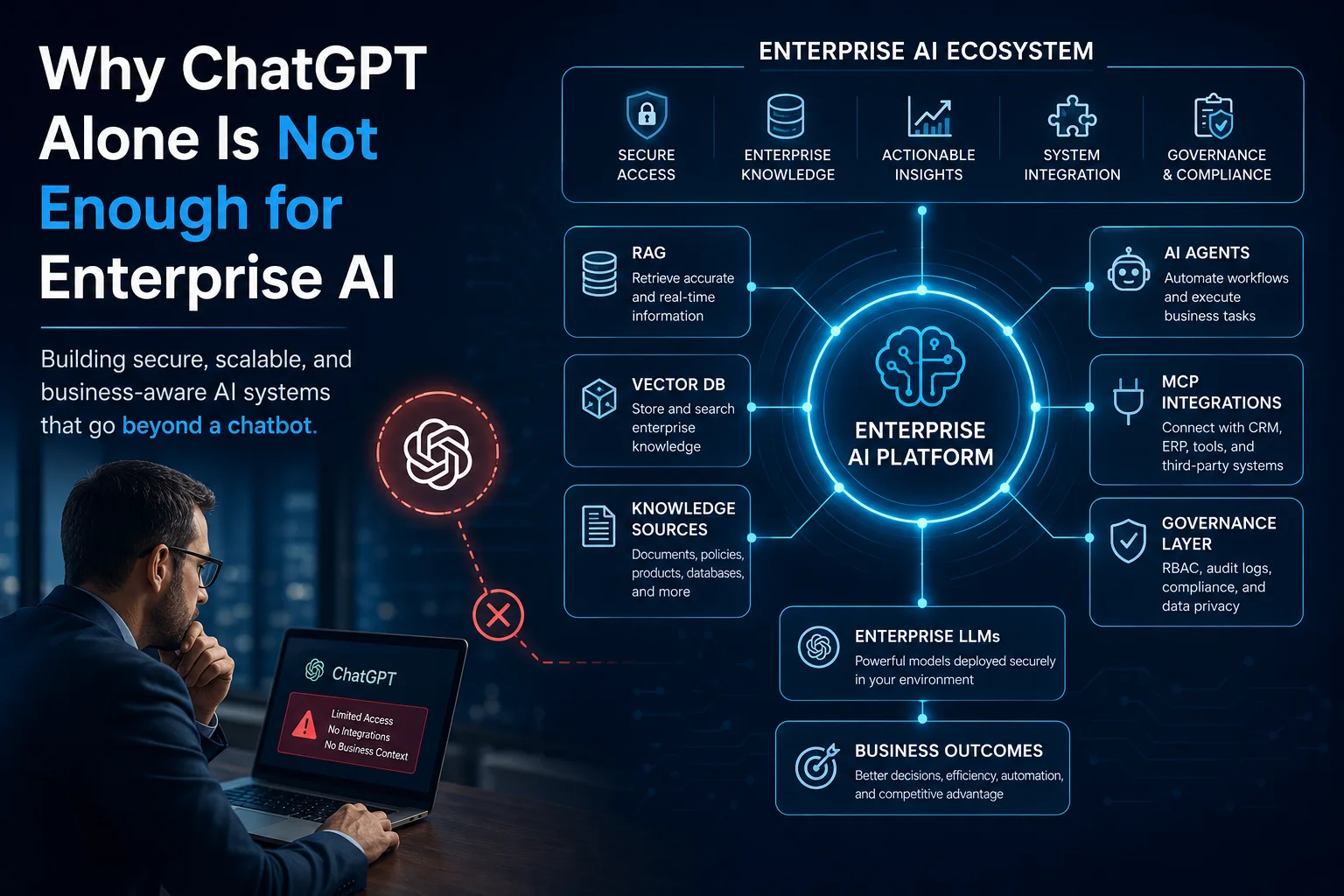
The Leverage: Complete architectural sovereignty. Your intellectual property is baked directly into the custom codebase. The system can be migrated, modified, or re-vectored to cheaper foundation models instantly without vendor licensing penalties. This baseline integration philosophy highlights Why ChatGPT Alone Is Not Enough for scaling automated enterprise workflows.
6. Development Costs Broken Down by Industry
An agent's cost is deeply linked to the underlying data complexity and regulatory restrictions of the domain it operates within.
-
Logistics / Supply Chain Agents ($75,000 – $140,000): Focuses heavily on parsing erratic vendor templates and legacy freight tracking documentation.
-
SaaS Product Native Agents ($90,000 – $160,000): Built for high concurrency, multi-tenant state handling, and interactive user-facing actions.
-
Manufacturing / IoT Agents ($110,000 – $190,000): Interfaces time-series edge sensor streams with massive, unstructured maintenance and machinery catalogs.
-
Financial Services & Banking Agents ($130,000 – $220,000): Requires unalterable, structural transaction logging, fraud detection guardrails, and SOC 2 Type II compliance audits.
-
Healthcare & PHI Agents ($150,000 – $250,000+): Dominated by strict HIPAA compliance frameworks, mandatory Business Associate Agreements (BAAs), and complete end-to-end encryption of Protected Health Information (PHI).
7. Real-World Case Study: Automated Discrepancy Resolution
To ground these figures, consider a production deployment engineered for an international freight forwarding firm managing high-volume cross-border shipping paperwork.
The Operational Bottleneck
The logistics firm was processing thousands of carrier invoices weekly. Discrepancies between quoted rates and final billed amounts (e.g., unexpected detention or demurrage fees) required manual human review. An analyst had to locate the original contract PDF, cross-reference it with email threads, check ocean carrier logs, and manually write a dispute or approve the payout. This manual sequence required an average of 28 minutes per dispute.
The Multi-Agent Architecture
A modular multi-agent system was deployed to run autonomously: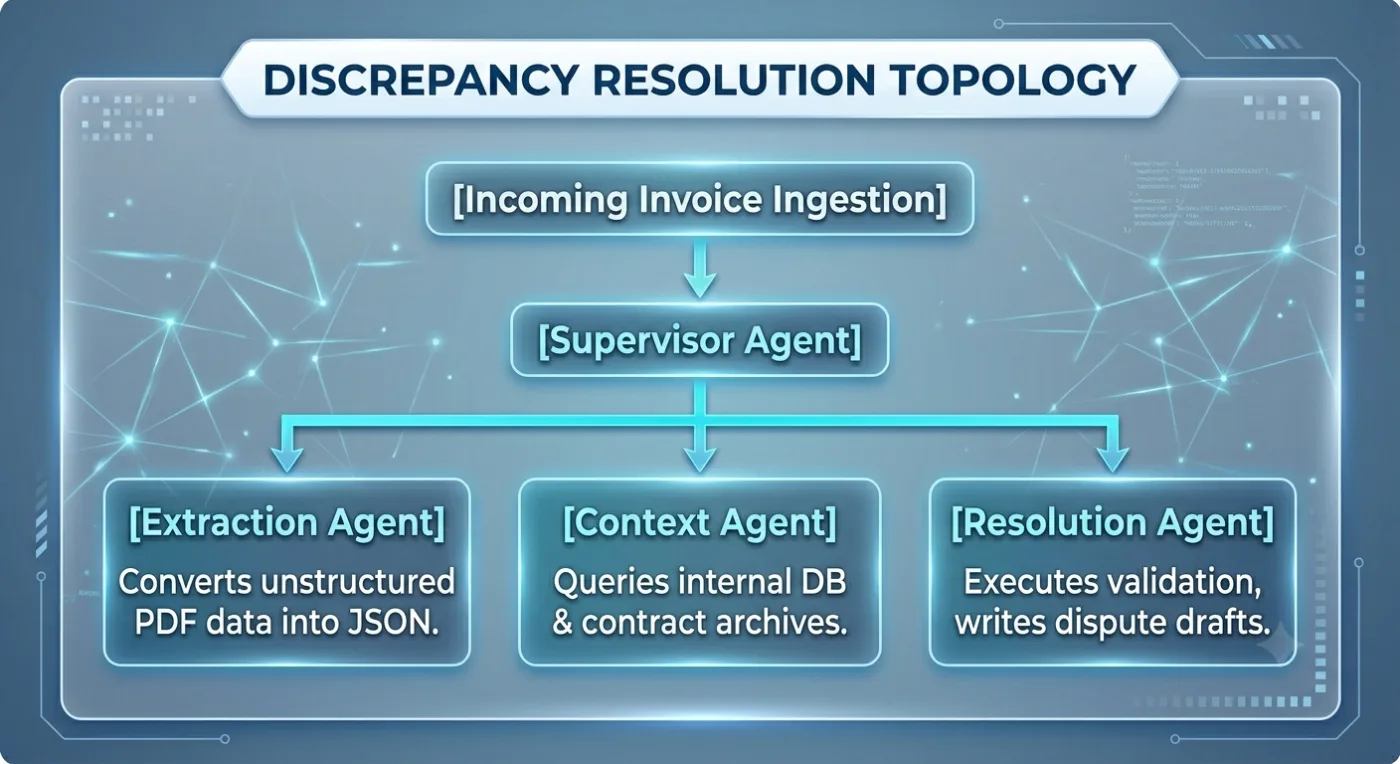
-
The Context Agent: Queries internal transactional databases via our RAG Development Service to retrieve historical booking sheets, master carrier contracts, and digital bills of lading.
-
The Resolution Agent: Compares the extracted data against the contractual text, flags anomalies, determines if the extra charges are legally valid, and compiles a comprehensive dispute brief complete with line-item citations if an overcharge occurred.
The Project Financials
-
System Discovery & Architecture Mapping: $18,500
-
Data Pipelining & Context Vectorization: $32,000
-
Multi-Agent Orchestration & Logic Build: $48,000
-
API Integration (Custom TMS & Accounting Stack): $36,000
-
Validation, Testing & Guardrail Harness: $14,500
-
Total Project Capital Build: $149,000
The Operational Outcomes
The system ran concurrently with human staff for four weeks before taking full autonomy over restricted tiers.
-
Processing Time: Dropped from 28 minutes to under 45 seconds.
-
Autonomous Resolution: 74% of invoice discrepancies are resolved end-to-end with zero human touches.
-
Direct Capital Recovery: According to internal telemetry metrics, the system automatically caught, logged, and successfully disputed $310,000 in invalid carrier overcharges within the first six months of operation. This represents a highly accelerated return pacing with benchmarks documented in recent McKinsey AI Impact Studies, achieving full capital amortization within 92 days of launch.
8. Hidden Costs and Post-Launch OpEx (Operating Expenses)
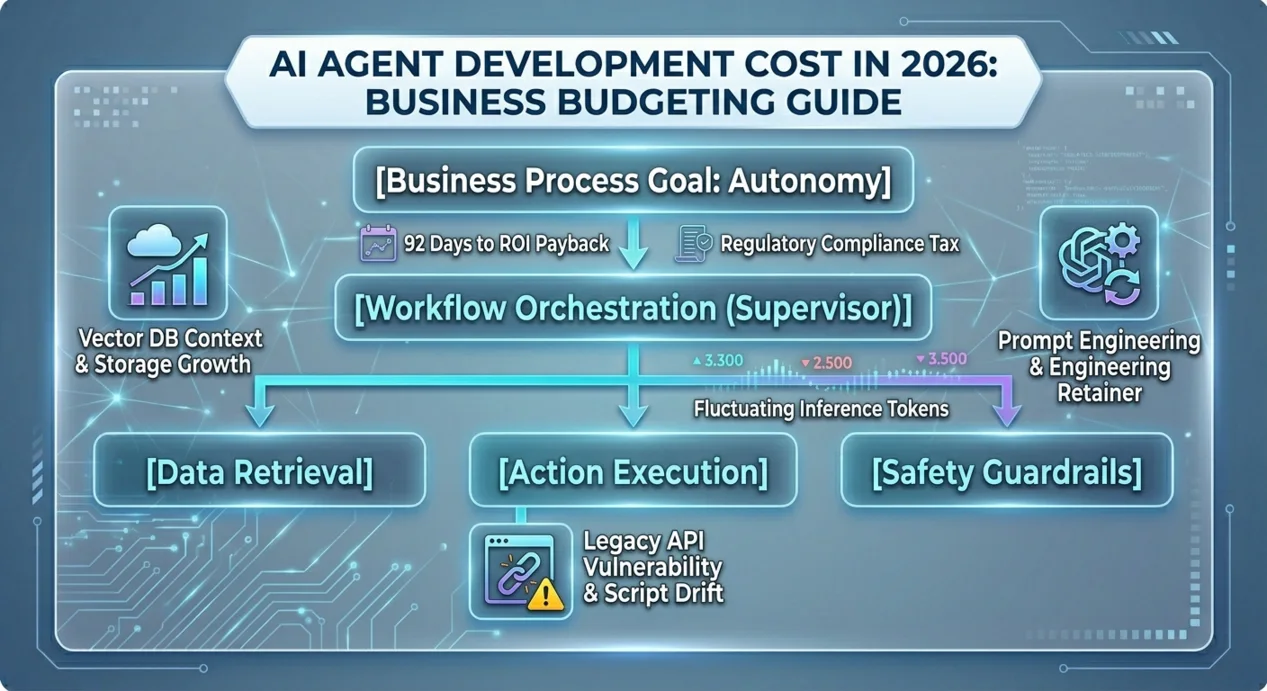
Budgeting for an AI agent doesn't end at deployment. Production systems incur predictable monthly operating costs that must be mapped to avoid margin degradation. For a typical Tier 3 operational agent, ongoing expenses average $2,500 to $6,500 per month.
-
Vector Database Growth & Storage Context: As the agent processes more historical interactions, system records, and organizational documentation, the index size within your vector database scales. Compute fees for high-performance vector searching (Pinecone, Qdrant) expand alongside data volume.
-
Prompt Maintenance & Engineering Drift: AI models undergo continuous background performance optimization by their parent providers. A prompt or reasoning chain that yields high precision in January can experience "prompt drift" or subtle behavioral regression following a major model architecture upgrade. Systems require ongoing developer allocations to refine prompt formats and tool boundaries.
-
Upstream API Vulnerability: An agent relies entirely on its tools. If your CRM vendor changes an API endpoint format, or your internal IT team updates a database schema, the agent's tool call will return an unhandled error state. Production systems require real-time observability alerts to detect and repair integration friction immediately.
Ready to Scope Your AI Agent?
Determining the exact cost of an AI agent requires auditing your specific data infrastructure, API readiness, and operational logic pathways.
TechMamba hosts AI Agent Discovery Workshops for mid-market and enterprise organizations. Our engineering team maps your operational workflows, isolates high-ROI targets, analyzes your data systems, and provides an immutable development roadmap with a fixed-price cost structure before you write a single line of production code.
About the Author
TechMamba Technical Strategy Team specializes in Architecting Agentic RAG Systems and Enterprise Workflow Automation. With extensive experience guiding production engineering pipelines and cloud infrastructure deployments, we map cutting-edge LLM orchestration models to verifiable corporate ROI. Connect to explore more in the TechMamba AI Agent Cluster.
Watch this Enterprise AI Agents Guide to learn how leading CIOs evaluate operational value and framework complexities before committing to enterprise budgets.