In the early days of enterprise artificial intelligence deployment, integrating a Large Language Model (LLM) with proprietary internal infrastructure resembled the fragmented era of personal computing—a fragile, chaotic mess of custom "glue code." Every time an engineering team wanted an AI assistant to fetch a row from a PostgreSQL database, update an active ticket in Jira, or broadcast a milestone to a teammate on Slack, they had to write a brand-new, vendor-specific API wrapper.
This approach created an unsustainable integration bottleneck: if an organization utilized distinct AI models and internal corporate applications, engineers were forced to maintain hundreds of custom-coded connections just to keep them talking.
Enter the Model Context Protocol (MCP).
Now established as the bedrock industry standard, MCP has done for artificial intelligence what USB-C did for hardware peripherals and HTTP did for data transfer across the web. It delivers a universal, highly secure, open-source standard that allows complex AI Agents to plug directly into any business tool, local file system, or enterprise data repository right out of the box.
What is the Model Context Protocol (MCP)?
The Model Context Protocol (MCP) is an open standard, application-layer protocol designed to unify how AI applications (known as hosts) safely discover and interact with external data sources, developer utilities, and enterprise SaaS APIs (known as servers).
Originally open-sourced by Anthropic, MCP development shifted into hyper-drive when it was officially donated to the Agentic AI Foundation (AAIF) under the Linux Foundation—co-founded by a coalition including Anthropic, OpenAI, Google, and Block.
Instead of forcing developers to write fragile, bespoke middleware for every single LLM variant, MCP relies on structured JSON-RPC 2.0 messages executing over standard transport layers (such as local stdio or remote streams). This creates an elegant ecosystem of interchangeable software parts, fueling a new era of scalable AI Automation.
The Three Pillars of MCP Architecture
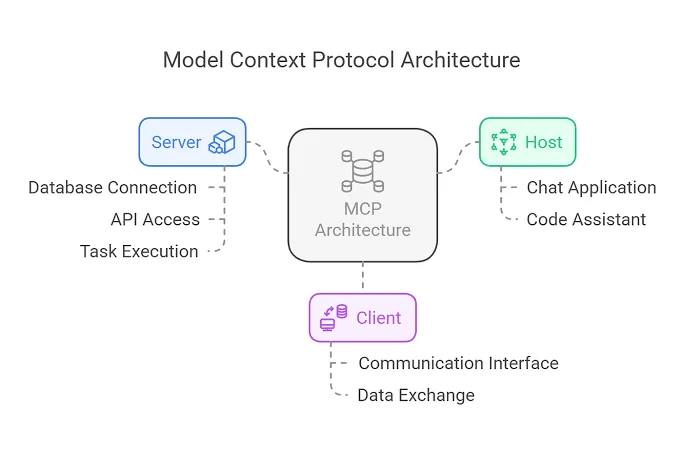
As visualized in the architectural schema above, the protocol cleanly isolates responsibilities across three decoupled layers:
-
The MCP Host: The primary execution environment where the user interacts with the AI application. Modern examples include the ChatGPT desktop application, Claude Desktop, Claude Code, or AI-native IDEs like Cursor and VS Code.
-
The MCP Client: The foundational layer embedded directly inside the host. The client manages the protocol lifecycle, translating abstract reasoning and high-level LLM intents into strict, schema-validated protocol commands routed to the correct server.
-
The MCP Server: A lightweight microservice or local background process that securely exposes specific resources, actions, and custom prompt formatting to the connected client.
Why MCP Matters in 2026
The explosion of AI agents has exposed a major limitation in enterprise AI adoption: intelligent systems are only as useful as the tools and data they can access.
A language model may generate impressive responses, but without access to company knowledge bases, ticketing systems, CRMs, cloud infrastructure, and business workflows, its impact remains limited.
This is where Model Context Protocol becomes critical.
As organizations deploy increasingly autonomous AI agents, MCP provides a standardized mechanism for tool discovery, secure data access, and workflow execution. Rather than building custom integrations for every application, enterprises can expose capabilities through MCP-compatible servers that any compliant AI host can understand.
The result is faster deployment, reduced engineering overhead, and a future-proof architecture capable of supporting complex agentic workflows.
Supercharging Retrieval-Augmented Generation (RAG)
Before MCP standardized the data layer, building out enterprise-grade data ingestion meant engineers spent months manually stringing together disparate vector ingestion pipelines. The protocol fundamentally simplifies how LLMs dynamically discover contextual data.
Instead of writing custom API bridges to pull static enterprise records into vector indexes, companies can now mount an MCP server directly over production databases. This structural shift fundamentally optimizes RAG vs Fine-Tuning dynamics by providing a standardized, real-time context bridge.
Rather than permanently changing a model's static weights via costly, slow-moving fine-tuning cycles, autonomous agents use MCP to dynamically pull current documents, server logs, and structural schemas on demand. This approach dramatically reduces hallucinations while keeping sensitive corporate data securely stored where it belongs.
The Core Primitives: Resources, Tools, and Prompts
When an MCP server establishes an active connection with an application host, it exposes three essential primitives that allow advanced AI Chatbots and backend autonomous workflows to interact with complex environments safely:
1. Resources (Passive Context)
Resources operate as read-only data streams. They act like standard GET requests, allowing an AI model to safely inspect real-time context without changing system states or risking unintended side effects.
-
Production Examples: Database schemas, active application log files, live API documentation, or local markdown files.
2. Tools (Active Execution)
Tools represent executable functions that empower the AI agent to carry out active, state-changing operations. These function identically to POST endpoints, accepting strict JSON Schema-validated arguments and returning clean outputs back to the model.
-
Production Examples: Executing a scoped SQL write-query, generating an issue tracking ticket in GitHub, modifying a HubSpot lead status, or spinning up a virtual container.
3. Prompts (Pre-structured Templates)
Prompts are reusable, parameterized templates served up directly from the server end. They allow companies to anchor models into highly specific roles, serving as native guardrails right at the data layer.
MCP vs Function Calling
One of the most common misconceptions is that MCP is simply another version of function calling.
While there is some overlap, they solve different problems.
Function calling enables a language model to invoke predefined functions within a specific application. MCP provides a universal protocol that allows tools to be discovered, described, and invoked consistently across different models, platforms, and vendors.
| Function Calling | MCP |
|---|---|
| Vendor-specific | Open standard |
| Static tool definitions | Dynamic tool discovery |
| Single application focus | Cross-platform interoperability |
| Manual integration | Standardized architecture |
| Limited ecosystem support | Multi-vendor ecosystem |
A useful analogy is that function calling helps an AI use a tool, while MCP helps an entire ecosystem of AI systems discover and use tools consistently.
MCP Adoption Across Industries
Healthcare
Healthcare providers are using MCP-enabled agents to retrieve patient records, schedule appointments, summarize clinical notes, and assist with administrative workflows while maintaining strict compliance controls.
Financial Services
Financial institutions leverage MCP for portfolio analysis, compliance monitoring, fraud investigations, and automated reporting workflows that span multiple internal systems.
Retail and E-Commerce
Retail organizations use MCP-powered agents to synchronize inventory, manage customer support requests, automate order fulfillment processes, and coordinate logistics operations.
Software Development
Engineering teams connect GitHub, Slack, Jira, Figma, and cloud infrastructure through MCP to create AI-assisted development workflows that can analyze code, generate pull requests, and notify stakeholders automatically
Modern Breakthroughs: The Move to Stateless Transport and Enterprise IAM
The modern iteration of MCP has evolved significantly past basic function-calling abstractions. Driven by the Stateless Specification Release, the protocol has achieved massive enterprise scalability by solving two historical friction points: stateful server scaling and complex authorization.
1. Stateless Protocol Architecture
Previously, routing tool calls across distributed cloud servers required persistent, stateful sessions (traditionally via Streamable HTTP and server-sent events). This created a nightmare for infrastructure engineers managing load balancers, where a single request routed to a separate server pod would drop connection state and break the agentic loop.
The updated protocol eliminates protocol-level session footprints entirely. State travels cleanly within request metadata fields (_meta). Any individual MCP tool call can land on any container instance behind an enterprise proxy or load balancer without requiring complex sticky sessions, enabling planetary-scale agentic networks.
2. Enterprise Identity & Access Management (IAM)
In early agent deployments, connecting an LLM to internal business systems meant employees were constantly interrupted by a barrage of individual OAuth logins for every single sub-task.
Modern enterprise architectures use native OAuth 2.1 with PKCE and SAML/OIDC integrations directly through the MCP gateway. Background agents execute within highly secure, audited sandboxes, mapping operations explicitly to the exact access permissions of the logged-in employee while keeping precise audit trails for compliance.
How It Works in Practice: A Real-World Workflow
To understand the sheer efficiency of eliminating proprietary integration code, consider a cross-platform engineering scenario: a developer needs to locate a bug report, patch the code repository, and update the product management team using Figma, GitHub, and Slack MCP Servers all communicating through a unified AI agent host.
[User Input] ➔ [AI Host Application (Client)]
                        │
                        ├─► [Figma MCP Server]  ──► Pulls UI specs & CSS tokens
                        ├─► [GitHub MCP Server] ──► Automatically opens Pull Request
                        └─► [Slack MCP Server]  ──► Alerts engineering channel
-
The Prompt: The engineer instructs their AI-native development environment: "Inspect the UI bug logged against the main dashboard layout, match the layout to our latest approved design specs, and loop in the team."
-
Context Gathering: The AI client reads the capabilities of the active Figma MCP Server, triggering a
get_design_tokenscall to pull the exact layout constraints and CSS attributes from the live design file. -
Action Execution: The agent analyzes the code discrepancies, modifies the local codebase, and uses the GitHub MCP Server to call
open_pr, pushing the branch and generating an automated code-change description. -
Team Communication: Finally, the agent calls the Slack MCP Server using
send_messageto broadcast the pull request link and details to the QA team.
The Crucial Edge: The developer did not have to write a line of integration code, manage disparate API keys, or build out multi-platform webhooks. The host application dynamically requested the capability manifests directly from the servers, mapped out the multi-step execution path, and completed the complex, cross-app workflow out of the box.
The Strategic Outlook: True AI Autonomy
The widespread industry consolidation around the Model Context Protocol signals a massive paradigm shift in enterprise software design. Industry tracking indicates that 40% of modern enterprise applications include native agentic runtimes, and 75% of leading cloud API gateways provide native out-of-the-box MCP routing solutions.
By transforming generative LLMs from isolated text predictors into authorized, context-aware operators of physical production infrastructure, MCP has broken the traditional integration logjam. It provides the open framework allowing companies to eliminate data silos, phase out brittle custom middleware, and deploy highly resilient, interconnected agent networks.
Frequently Asked Questions (FAQs)
How does MCP differ from traditional REST APIs?
Traditional REST APIs require unique, client-side code blocks to parse data and map payloads manually for every endpoint. MCP acts as a protocol layer on top of APIs, using JSON-RPC 2.0 so that an LLM can query the server, instantly understand its capabilities through schemas, and invoke functions dynamically without bespoke coding.
What Is the Difference Between MCP and RAG?
RAG helps AI retrieve relevant knowledge before generating a response. MCP enables AI systems to interact with tools and perform actions. Many enterprise deployments use both technologies together.
Does OpenAI Support MCP?
MCP is an open standard and continues to gain adoption across the AI ecosystem. Many AI platforms and developer tools are building MCP-compatible integrations to support interoperable agent architectures.
Is MCP tied exclusively to Anthropic and Claude models?
No. While Anthropic pioneered and open-sourced the protocol, MCP is completely model-agnostic. It runs seamlessly with OpenAI's GPT models, Google's Gemini, or open-weight models like Llama running on private local architecture.
Can I transform an existing FastAPI codebase into an MCP server?
Yes. Using the official FastMCP framework in Python, developers can wrap an entire existing FastAPI instance with a single line of code using mcp = FastMCP.from_fastapi(app). This automatically converts your existing endpoints and Pydantic validation models into discoverable tools for any MCP-compliant AI host.
Internal & External Resources for Further Learning
-
Official Framework Specifications: Review the core development documentation and upcoming roadmaps over at the Model Context Protocol GitHub Repository.
-
Enterprise Security Architectures: To plan an isolated deployment strategy, read our comprehensive overview on Enterprise AI Governance and Zero-Trust Tool Access.
-
Developer Implementation Guide: Walk through your first deployment step-by-step with our tutorial on How to Build Your First Python FastMCP Server in Under 10 Minutes.