A few years ago, business automation usually meant building long chains of rules.
If a customer asked a specific question, the chatbot followed a predefined path. If an invoice needed approval, the workflow moved to the next step. Everything worked as long as people stayed within the expected process.
The moment something unexpected happened, the automation stopped and a human had to step in.
That is what makes the rise of AI agents different.
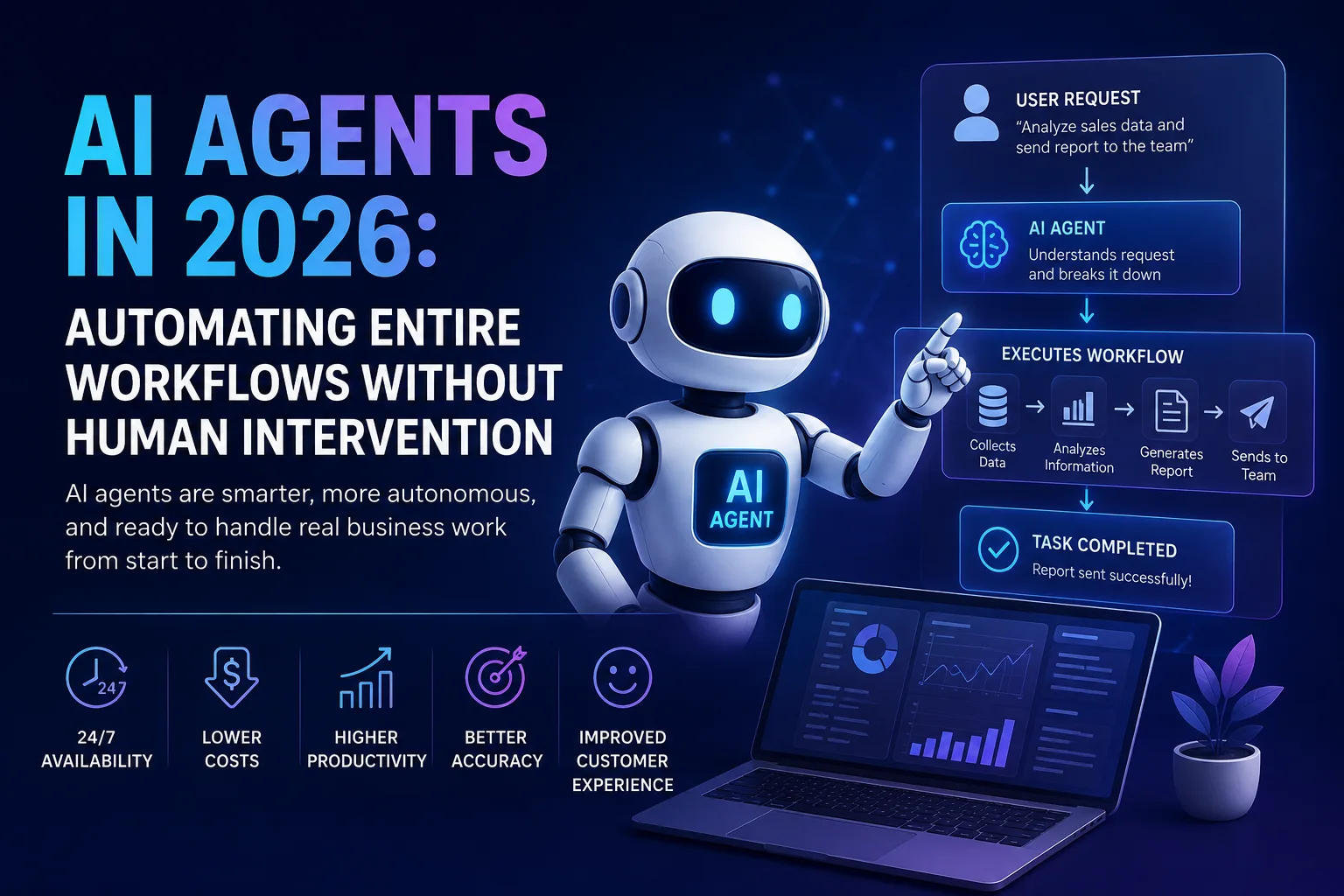
In 2026, businesses are no longer just automating individual tasks. They are beginning to automate entire workflows. Modern AI agents can understand goals, retrieve information, interact with software tools, make decisions based on context, and complete multi-step processes with minimal supervision.
This doesn't mean businesses are replacing employees overnight. In reality, most successful organizations are using AI agents to eliminate repetitive work so that employees can focus on higher-value activities that require judgment, creativity, and relationship building.
The question is no longer whether AI agents will be used in business. The real question is where they create the most value and how organizations can implement them responsibly.
What Is an AI Agent?
An AI agent is an intelligent software system that can understand goals, make decisions, interact with tools, retrieve information, and complete tasks with minimal human intervention.
Unlike traditional chatbots, AI agents can execute entire workflows rather than simply answer questions.
What Makes AI Agents Different?
Unlike traditional chatbots, AI agents can:
- Understand objectives
- Break tasks into smaller steps
- Access company data
- Use external tools and applications
- Make contextual decisions
- Execute actions
- Learn from previous interactions
Think of the difference this way.
A traditional chatbot can answer:
"What are your business hours?"
An AI agent can handle:
"A customer wants to return an item purchased three weeks ago. Check the order history, verify eligibility, generate a return label, update the CRM, and notify the customer."
The second scenario involves reasoning, tool usage, and workflow execution rather than simple conversation.
If you're evaluating conversational AI for your business, read our article:
AI Chatbots for Business: Are They Actually Worth It in 2026?
Why Businesses Are Investing in AI Agents
Every growing company eventually faces the same challenge.
The number of repetitive tasks increases faster than the team size.
Common challenges include:
- Growing support ticket volume
- Increasing customer inquiries
- Manual reporting processes
- CRM maintenance
- Operational coordination
Hiring additional employees can solve the problem, but it also increases operational costs.
AI agents offer a different approach.
Instead of adding more staff for repetitive work, businesses can automate significant portions of their operations.
For many businesses, the goal is not workforce reduction.
The goal is efficiency.
AI Agent Adoption by the Numbers
The rapid growth of AI agents is being driven by measurable business outcomes rather than hype.
Organizations are increasingly adopting AI agents to:
- Reduce operational costs
- Improve productivity
- Deliver faster customer support
- Scale operations without proportional increases in staffing
- Improve business decision-making
The trend is clear: companies are moving beyond simple chatbots and investing in systems capable of executing meaningful business tasks.
AI Agents vs Traditional Chatbots
| Capability | Traditional Chatbot | AI Agent |
|---|---|---|
| Rule-Based Responses | Yes | No |
| Context Awareness | Limited | High |
| Multi-Step Tasks | Rarely | Yes |
| Tool Integration | Basic | Advanced |
| Decision Making | Minimal | Extensive |
| Workflow Execution | Limited | End-to-End |
| Learning Capability | Low | High |
A chatbot provides information.
An AI agent completes work.
AI Agents vs Human Employees
AI agents are excellent at:
- Data processing
- Repetitive tasks
- Workflow automation
- 24/7 availability
Humans excel at:
- Strategic thinking
- Creativity
- Leadership
- Relationship building
- Negotiation
The future isn't AI versus humans.
It's AI working alongside humans.
Real Business Workflows AI Agents Are Automating
Customer Support
Customer support remains one of the fastest-growing use cases for AI agents.
Modern support agents can:
- Track orders
- Process returns
- Update customer accounts
- Escalate complex issues
- Generate support tickets
- Recommend solutions
Many organizations are already reducing support costs while improving customer satisfaction.
Read more:
How AI-Powered Customer Support Is Reducing Costs and Improving UX
Sales Operations
AI agents can:
- Qualify leads
- Schedule meetings
- Update CRM records
- Generate follow-up emails
- Create proposals
- Summarize conversations
This allows sales teams to focus on building relationships and closing deals.
Marketing Automation
Marketing teams use AI agents for:
- Competitor research
- SEO analysis
- Content research
- Campaign reporting
- Social media scheduling
- Performance tracking
Instead of manually gathering information from multiple tools, AI agents generate actionable insights automatically.
Human Resources
Common HR applications include:
- Resume screening
- Interview scheduling
- Employee onboarding
- Policy assistance
- Internal knowledge retrieval
Internal Knowledge Management
Many businesses struggle with information scattered across multiple systems.
AI agents help employees quickly locate:
- Policies
- Procedures
- Training materials
- Documentation
- Operational guidelines
Real-World Examples of AI Agents in Action
Customer Support Automation
Many businesses use AI agents to handle order tracking, account updates, and customer inquiries at scale.
This allows support teams to focus on complex situations that require human judgment.
Sales Enablement
AI agents help sales teams qualify leads, schedule meetings, and maintain CRM accuracy.
Internal Operations
Organizations use AI agents for onboarding, reporting, documentation, and process automation.
Marketing Automation
Modern marketing teams rely on AI agents for competitor monitoring, keyword research, and campaign analysis.
How AI Agents Actually Work
Step 1: Understand the Goal
The agent receives a request and determines the objective.
Step 2: Create a Plan
The system identifies the information and actions required.
Step 3: Retrieve Information
The agent gathers data from:
- CRM systems
- Databases
- Analytics platforms
- Documentation tools
Step 4: Execute Actions
The system performs the required tasks.
Step 5: Validate Results
The agent checks for errors or missing information.
Step 6: Deliver the Outcome
The completed result is presented to the user.
Benefits of AI Agents
Faster Response Times
Tasks that previously required hours can often be completed in minutes.
Improved Scalability
Businesses can grow without proportionally increasing staffing requirements.
Lower Operational Costs
Automation reduces repetitive manual work.
Better Customer Experiences
Customers receive faster and more consistent service.
Reduced Human Error
Automated workflows improve accuracy.
Risks Businesses Should Understand
Hallucinations
AI systems can occasionally generate incorrect information.
Data Security
Sensitive business data requires strong protection.
Compliance Requirements
Highly regulated industries must ensure compliance.
Over-Automation
Not every customer interaction should be automated.
Human empathy remains important.
Build or Buy: Choosing the Right AI Strategy
One of the first questions businesses face is whether they should build custom AI agents or rely on SaaS solutions.
The answer depends on:
- Scalability requirements
- Data privacy needs
- Workflow complexity
- Long-term costs
Read:
Custom Software Development vs SaaS: When Businesses Should Build Instead of Buy
What Businesses Often Get Wrong About AI Agents
One common misconception is that AI agents immediately replace entire teams.
In reality, the biggest gains usually come from automating:
- Scheduling
- Reporting
- Data entry
- Information retrieval
- Ticket routing
Businesses that view AI agents as collaborative tools rather than replacements typically achieve stronger results.
The Future of AI Agents
The future lies in multi-agent systems.
Imagine:
- A research agent
- A content agent
- A design agent
- An analytics agent
All working together toward a shared objective.
As these technologies mature, businesses will increasingly operate with digital workforces that complement human teams.
Ready to Implement AI Agents in Your Business?
AI agents are helping organizations automate customer support, streamline operations, improve productivity, and deliver better customer experiences.
At TechMamba, we help businesses design, develop, and deploy custom AI solutions tailored to their goals.
Whether you're exploring AI for the first time or building enterprise-grade automation systems, our team can help you unlock the full potential of AI.
Contact us today to discuss your AI strategy.
Frequently Asked Questions
What is an AI agent?
An intelligent software system capable of performing tasks and making decisions with minimal human intervention.
How are AI agents different from chatbots?
Chatbots answer questions. AI agents complete tasks and execute workflows.
Can small businesses use AI agents?
Yes. Many small businesses use AI agents for support, marketing, lead qualification, and administration.
Are AI agents expensive?
Costs vary depending on complexity and integrations.
Do AI agents replace employees?
No. They automate repetitive work and support employees.
What industries benefit most?
Customer service, healthcare, finance, retail, logistics, marketing, and professional services.
What is a multi-agent system?
A system where multiple AI agents collaborate toward a shared objective.
What is the future of AI agents?
Future AI agents will become more autonomous, collaborative, and deeply integrated into everyday business operations.