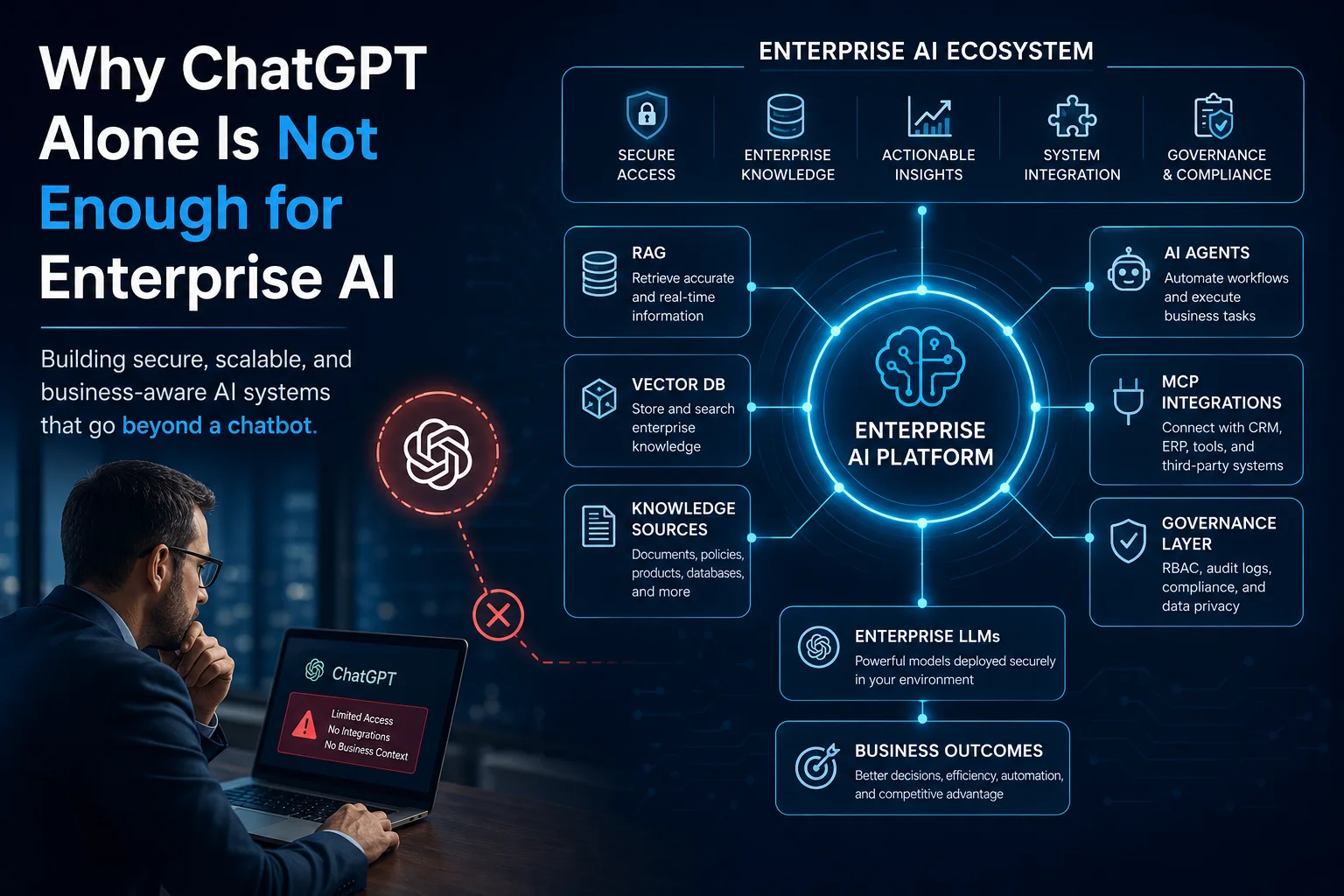
Beyond the Chatbox: Why ChatGPT Alone Is Not Enough for Enterprise AI
If your executive leadership team believes that purchasing individual ChatGPT Plus subscriptions for your staff constitutes a modern "AI strategy," your organization is running on a high-risk operational vulnerability.
In 2026, the initial novelty of generative AI has evaporated. We have entered a highly critical, metrics-driven deployment phase. While consumer-facing chat interfaces like ChatGPT excel at isolated research, drafting copy, or summarizing general documents, they are fundamentally inadequate for running autonomous business processes at enterprise scale.
The blunt reality is that consumer-facing chat wrappers cannot safely interface with your legacy databases, enforce role-based access control, run real-time actions across fragmented software stacks, or protect your company’s intellectual property from being ingested into public training datasets.
Before committing your department to a superficial AI framework, your technical leadership team needs a rigorous breakdown of why off-the-shelf chat products fail in production, what a secure enterprise architecture looks like, and how to build a proprietary system that drives actual, compounding business margins.
The Core Limitations of Consumer LLMs in Production
When enterprise organizations try to force raw public language models to handle deep business operations, they inevitably run into three structural barriers:
1. The Zero-Integrity Security Vector (No Granular RBAC)
A standard public chat model treats your uploaded data as a flat file. It has no built-in mechanism to parse user identities or enforce directory permissions natively.
If an administrative assistant and a junior financial analyst both query the same internal organizational database, the public model cannot dynamically restrict response payloads. To deploy AI safely, your system must verify user permissions before running queries. In a custom application, this is handled via Role-Based Access Control (RBAC) filters at the database level. In a public chat interface, once confidential data is added to the system prompt, it is permanently accessible to anyone interacting with that session.
2. The Lack of System Interoperability (Chat vs. Action)
A standard chat interface is a closed loop. It receives an input string, runs calculations in its parametric weights, and outputs a text response. However, true corporate efficiency requires action execution.
If a customer asks: "A customer wants to return an item purchased three weeks ago. Check the order history, verify eligibility, generate a return label, update the CRM, and notify the customer," a public chat interface can only tell you the steps to take. It cannot natively query your Shopify API, cross-reference your database records, execute a postal carrier webhook, update HubSpot, or send a transactional email. Bridging this execution gap requires custom system endpoints and event-driven orchestration layers.
3. The "Context Tax" & Token Cost Volatility
Relying entirely on a public model's general context window to analyze your proprietary records introduces severe performance and financial penalties. packing hundreds of pages of technical PDFs or billing ledgers into a generic chat prompt dramatically increases prompt token counts.
This leads to:
-
Severe Latency Spikes: Models must process massive, repetitive token inputs for every single query, causing response delays.
-
Exploding Operational Costs (OPEX): You pay a heavy "context tax" on every API transaction, rendering high-volume customer-facing workflows financially unviable.
The Enterprise AI Architecture Blueprint
To bypass these limitations, modern organizations are transitioning away from general consumer interfaces and building secure, private multi-agent systems (MAS).
Instead of routing all requests through a single general model, a production-grade enterprise system decouples operations into a coordinated, multi-layered microservice stack:
By separating infrastructure into three core layers, enterprises achieve absolute control over security, cost, and reliability: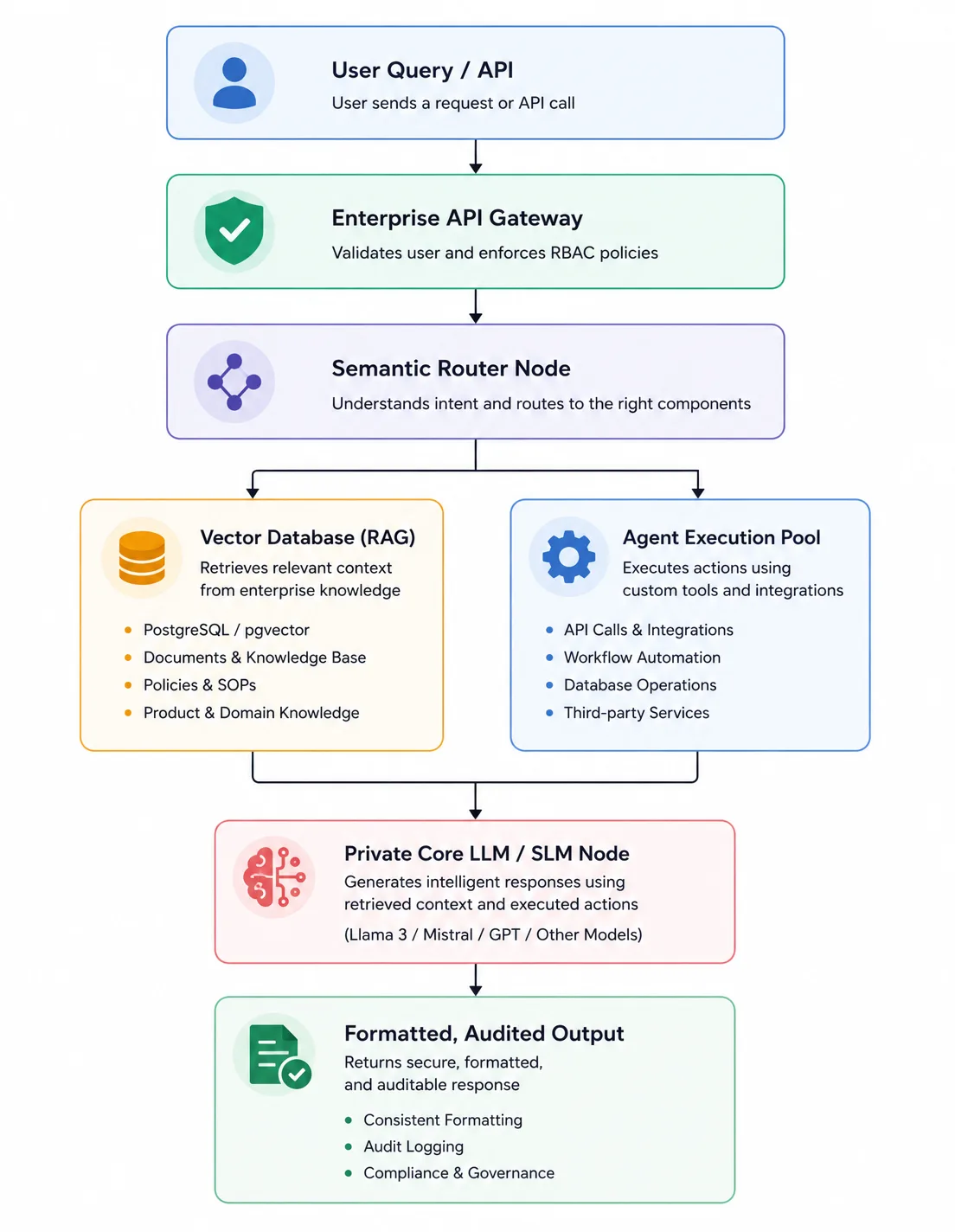
Layer 1: Stateful Retrieval-Augmented Generation (RAG)
Instead of feeding your entire dataset into a model's weights, we build specialized Retrieval-Augmented Generation (RAG) pipelines. When a query is initiated, our system searches a private, secure vector database (like PostgreSQL with the pgvector module), identifies the precise paragraph chunks matching the query, and presents only those relevant sections to the model. This guarantees strict factual accuracy and minimizes token overhead.
Layer 2: Secure Tool-Calling & Orchestration
Through frameworks like LangGraph and standards like the Model Context Protocol (MCP), custom AI applications execute complex processes autonomously. The system parses the user's objective, breaks it into programmatic tasks, calls external database APIs securely, and verifies the outcome. For a deep look at how this operates at scale, review our complete guide on AI Agents in 2026: Automating Workflows Without Human Intervention.
Layer 3: Enterprise-Grade Data Governance
A custom gateway protects your data from exposure. All outbound queries run through internal sanitize modules that scrub Personally Identifiable Information (PII) before any payloads are processed. Furthermore, our architectures keep your proprietary data strictly isolated, ensuring it never trains public models.
Real-World Case Study: Transforming a Corporate Logistics Pipeline
To see the difference between a consumer-grade chatbot and custom systems integration, look at a common enterprise bottleneck: Inbound Purchase Order Ingestion.
A mid-market manufacturing client was originally using a basic, out-of-the-box chat automation setup to parse incoming purchase orders from client emails. The system was fragile:
-
Whenever an invoice changed formats, the chat tool hallucinated quantities.
-
If three hundred emails arrived during a Monday morning rush, the standard API triggered rate limits, dropping orders without notifying the operations desk.
-
Sensitive client pricing details were floating unencrypted through third-party servers.
The TechMamba Custom Solution:
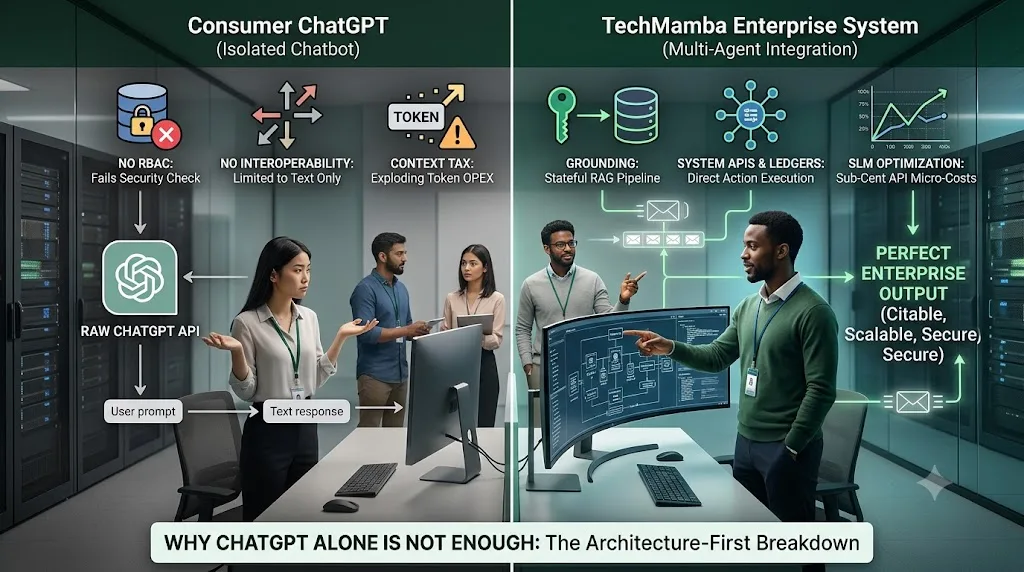
We replaced the brittle chat wrapper with a decoupled, asynchronous processing pipeline:
-
Asynchronous Queueing: We implemented RabbitMQ to ingest incoming emails instantly. Even if a sudden spike occurs, the incoming payloads are buffered safely in a queue without causing system timeout crashes.
-
Deterministic Extraction: Instead of using general LLM prompts, we built a lightweight microservice powered by a fine-tuned small language model (SLM). Its sole, optimized job is to parse unstructured text strings and return highly structured, valid JSON.
-
Database Sync via Secure APIs: The parsed JSON payload automatically triggers internal ERP updates (SAP) and synchronizes with the client’s custom CRM lead management pipeline to schedule fulfillment timelines.
The Business Outcomes:
-
0% Rate-Limit Failures: Decoupling via RabbitMQ resolved the peak-traffic bottleneck completely.
-
100% Data Sovereignty: Patient and corporate ledger data stays strictly within the secure cloud perimeter, meeting standard enterprise compliance models.
-
99.2% Data Integrity: Factual hallucinations on pricing and quantity fields were entirely eliminated.
Quick-Reference Guide: Consumer Chat vs. Enterprise Custom AI
|
Strategic Metric |
Consumer ChatGPT Plus |
TechMamba Custom Enterprise Platform |
|---|---|---|
|
Data Sovereignty |
High risk of public model training leaks. |
Immutable private VPC boundaries; zero training leaks. |
|
Data Enrichment Strategy |
Manual, static copy-pasting of records. |
Automatic, real-time sync via private vector indexing (RAG). |
|
Systems Action Execution |
None (Limited to text outputs). |
Unlimited API tool-calling (DBs, CRMs, ERPs). |
|
Cost Scaling Model |
Linear per-user SaaS license fees ($20+/mo). |
Decoupled server scaling (Sub-cent API micro-costs). |
|
Response Latency |
Variable (Speeds degrade during high public traffic). |
Fixed, sub-500ms caching via Redis architectures. |
Building a Unified AI Strategy: The Path Forward
If your organization is serious about utilizing artificial intelligence to drive sustainable growth, stop treating LLMs like a casual novelty. The ultimate value of AI is not in generating paragraphs of text; it is in building autonomous business processes that eliminate administrative drag and optimize your bottom line.
A successful, phased enterprise rollout should look like this:
-
Conduct a Security & API Audit: Identify where sensitive data sits across your current company databases, and map where manual bottlenecks are slowing down your operations.
-
Build a Private Grounding Layer: Implement a performant RAG pipeline to ensure your AI always works with fresh, real-time, permission-verified business facts.
-
Layer on Custom Autonomous Agents: Integrate specialized, secure agents to execute tasks across your business tools (such as automated client follow-ups or ledger syncs). Discover whether a conversational chatbot or a deeper, custom agentic system matches your roadmap in our analysis of AI Chatbots for Business: Are They Actually Worth It in 2026?.
Ready to Build a Secure, Proprietary AI Architecture?
Eliminating operational inefficiencies and securing your data pipelines requires seasoned, proven systems engineering. At TechMamba, we design, develop, and integrate enterprise-grade AI systems tailored to your unique workflows, ensuring your technology stacks scale cleanly and securely.