
A few years ago, suggesting a chatbot for a business usually got the same reaction: "Our customers will hate it." To be fair, that concern wasn't completely wrong. Most early chatbots were incredibly frustrating. They followed rigid, robotic scripts, stumbled over basic questions, and usually ended up forcing the customer to wait for a human anyway.
Things look very different today.
The newer generation of AI chatbots for business is significantly better at understanding actual human intent. They don't just spit out pre-written templates; they answer specific product questions, qualify leads, schedule appointments, track orders, and pull real-time data directly from your company's knowledge base.
More importantly, they do it instantly.
We’ve noticed that most growing companies face the exact same bottleneck. Their support teams spend hours every single week answering the same handful of questions over and over:
-
What are your prices?
-
Do you offer support on weekends?
-
How long does shipping take?
-
Can I book a quick demo?
None of these questions are difficult to answer. The issue is pure volume. When a business scales, these repetitive conversations eat up time that should be spent on closing sales, fixing complex technical bugs, or building client relationships.
That is why customer service automation has shifted from a luxury to a baseline requirement. They aren't meant to replace your entire team. They exist to handle the repetitive, mind-numbing work so your people can focus on problems that actually require a human touch.
What Are AI Chatbots (And How Do They Actually Work)?
At its core, an AI virtual assistant is software designed to chat with users through text or voice. However, unlike old-school bots that break the moment a user typos, modern business chatbot solutions utilize advanced natural language processing (NLP).
Instead of looking for rigid keyword matches, they look at context. This allows them to:
-
Interpret natural phrasing: They understand that "Where's my stuff?" and "Can I get a tracking update?" mean the exact same thing.
-
Learn on the job: They analyze past interactions to refine their answers over time.
-
Adapt dynamically: They can pivot mid-conversation if a user changes their mind or asks a follow-up question.
The best part? You aren't limited to a tiny widget in the corner of your website. Today's AI chatbot development allows you to deploy these assistants wherever your customers already hang out:
[Your AI Knowledge Base]
        │
        ├──► Website Chat Widgets
        ├──► Mobile Apps
        ├──► WhatsApp & SMS
        └──► Social Media (Instagram, Facebook Messenger)
Why Modern Businesses Are Pouring Money Into AI Chatbots
Most founders or operational managers don’t wake up one morning and decide they want to buy artificial intelligence just because it sounds cool. Usually, there’s a burning problem that needs fixing first.
Maybe your support inbox is growing faster than your budget to hire. Maybe website visitors are bouncing before your sales team can reach out to them. Or maybe you're losing international customers because your team is asleep when they are shopping.
Here is what actually happens when you deploy AI customer support chatbots to solve these bottlenecks:
1. True 24/7 Availability
Customers no longer care about your business hours. If someone is browsing your site at 11 PM on a Sunday and hits a roadblock, they want an answer right then. If they don't get it, they open a new tab and check out your competitor. A chatbot keeps your doors open all night.
2. A Massive Drop in Support Costs
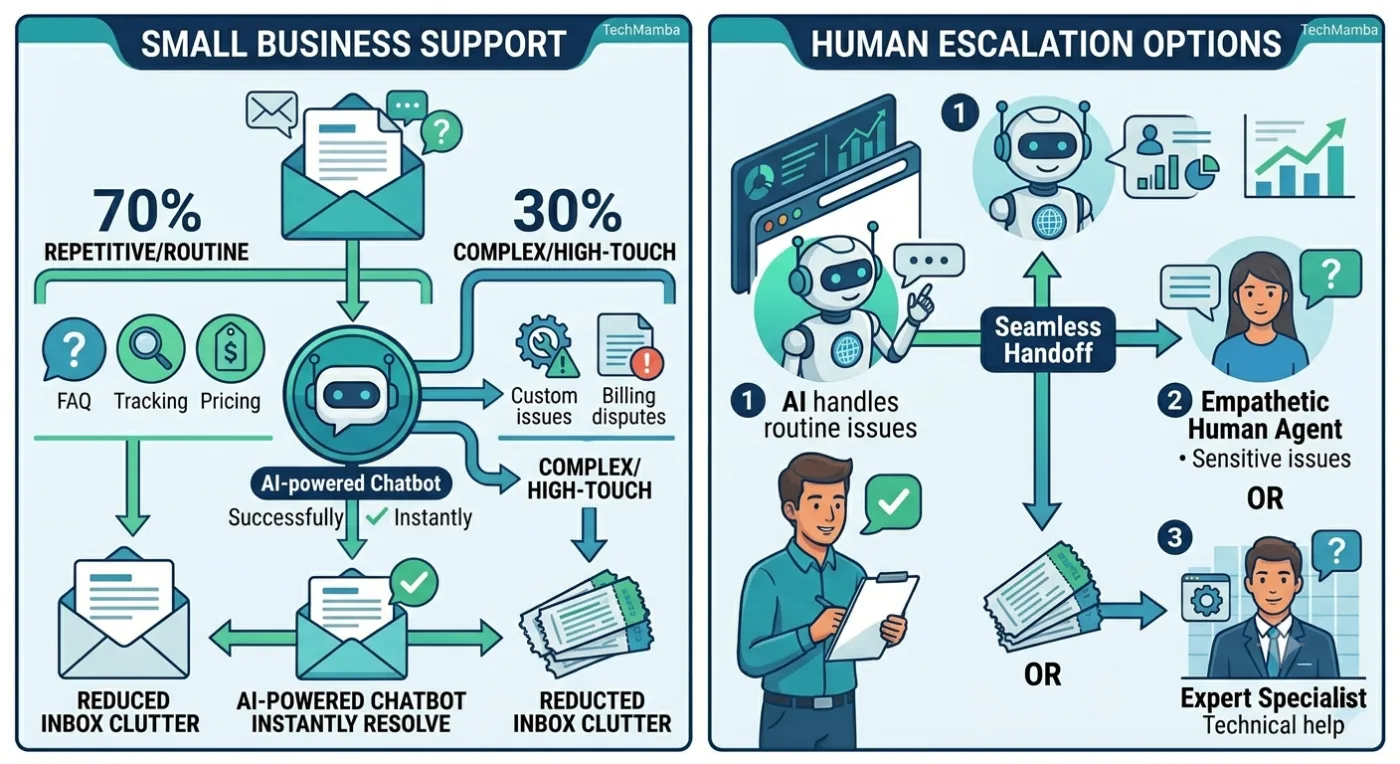
In our experience, roughly 60% to 70% of incoming tickets are completely routine. By letting a bot handle order tracking, basic policy questions, and password resets, you drastically reduce the cost per interaction. Your human team stays small, focused, and highly efficient.
3. Turning Ghost Traffic into Real Leads
You spend thousands on SEO and paid ads to get people to your site, but most leave without filling out a static, boring contact form. A conversational bot can step in, grab their details, qualify whether they have the right budget, and hand them off directly to your sales team.
Top Use Cases: Where AI Excels vs. Where It Fails
One mistake many businesses make is expecting a chatbot to do everything. It won't. If you try to automate your entire business operation overnight, you’re going to end up with frustrated customers.
The secret is knowing where to deploy them and where to keep humans in the loop.
| Feature / Scenario | Human Support | AI Chatbots |
| Availability | Limited to business hours | 24/7/365 |
| Response Speed | Minutes to hours | Under 2 seconds |
| Handling Tier-1 Issues (Tracking, FAQs) | Expensive & slow | Ideal & immediate |
| Handling Complex Issues (Billing disputes) | Essential & empathetic | Struggles with context |
| Scalability | Hard to scale quickly | Unlimited concurrent chats |
Where AI Thrives
-
Customer Support Automation: Resetting passwords, checking order statuses, and explaining return policies.
-
Lead Qualification: Asking a visitor, "What is your team size?" or "What is your timeline?" before booking a call.
-
Appointment Scheduling: Syncing directly with tools like Calendly or Google Calendar to book demos without the back-and-forth emails.
-
E-commerce Cart Recovery: Reminding a user they left an item in their cart and offering a quick discount code to close the deal.
Where AI Struggles (Keep Humans Here!)
-
Handling Angry Customers: A bot cannot express genuine empathy. When a customer is upset about a major billing error, they need a real person immediately.
-
Highly Technical Troubleshooting: If an issue requires deep investigation or creative problem-solving, the bot needs a seamless way to hand off the conversation to a developer or senior support agent.
Real-World Business Scenario: The ROI of a Hybrid Model
Let’s look at a practical example. Imagine a mid-sized B2B software company or an e-commerce storefront pulling in about 1,200 customer inquiries a week.
Without AI Support Automation:
1,200 tickets ──► 100% handled by humans ──► Long queues, stressed staff, missed leads

With AI Support Automation:
1,200 tickets ──► 800 handled instantly by AI (FAQs, Tracking, Booking)
               └──► 400 complex tickets passed smoothly to Humans (High value, deep focus)
By filtering out the white noise, your staff can actually take their time with high-value clients, resulting in better reviews, higher retention, and a much healthier work environment. That is how you calculate true AI chatbot ROI—it’s not just money saved on headcount, it’s the revenue saved by not dropping the ball on critical customer issues.
The Hidden Pitfalls: What Nobody Tells You About Implementation
If you read any generic marketing blog, they'll tell you that installing an AI chatbot is a "one-click solution." That’s a myth. If you want your bot to sound natural and actually help people, you need to watch out for three common traps:
-
The Garbage In, Garbage Out Dilemma: A chatbot is only as smart as the documentation you give it. If your internal wiki or FAQ page is outdated, the bot will confidently give your customers incorrect answers.
-
The "Trapped in an AI Loop" Nightmare: We’ve all been there—typing "let me speak to a human" five times while a bot ignores us. Your setup must feature an explicit, easy-to-find escape route to human support.
-
Ignoring the Data: Building a bot isn't a set-it-and-forget-it project. You need to review chat logs weekly to see where the bot got confused, what new questions customers are asking, and where the content needs to be tweaked.
How to Get Started (Without Wasting Time)
If you're ready to look into AI chatbot development, don’t try to build a massive system all at once. Take a phased approach:
-
Audit Your Inbox: Look at your last 200 support tickets. Figure out which 5 to 10 questions pop up every single day.
-
Clean Up Your Knowledge Base: Write clear, concise answers to those specific questions in plain text.
-
Choose the Right Integration: Ensure the platform you choose plugs directly into your existing tech stack—whether that’s Shopify, HubSpot, Salesforce, or Zendesk.
-
Launch Internally First: Let your team test the bot, try to break it, and ask it weird questions before you publish it to your live website visitors.
Frequently Asked Questions
Are AI chatbots worth it for small businesses?
Absolutely. In fact, small businesses often see the highest relative impact because they don't have the budget for a dedicated support team. A bot allows a solo founder or small team to look highly responsive and professional around the clock.
Will AI chatbots completely replace human support agents?
No. They replace repetitive tasks, not people. Complex problems, sensitive billing disputes, and high-touch sales will always require human judgment and empathy.
How long does it take to set up a business chatbot solution?
For a standard setup using an existing knowledge base, you can have a highly functional bot running within a few weeks. Custom integrations with proprietary software can take a bit longer.
What metrics should I track to measure success?
Focus on your Customer Satisfaction Score (CSAT) after bot interactions, your Resolution Rate (how many tickets the bot closes without human intervention), and First Response Time.
Conclusion: The Bottom Line for 2026
At this stage, using AI chatbots for business isn't about chasing a tech trend. It's about operational efficiency. Customers demand instant answers, and your team deserves relief from answering the exact same questions fifty times a day.
When implemented correctly—with a clean knowledge base and a clear path to human escalation—a chatbot doesn't degrade your customer experience. It elevates it. It gives your audience the speed they want, while giving your business the breathing room it needs to scale.