If your software engineering team is building a custom enterprise AI application right now, you have likely found yourself in a messy architectural debate: Should we deploy a Retrieval-Augmented Generation (RAG) pipeline, or should we fine-tune an LLM?
A few years ago, the common assumption was that if you wanted an AI model to truly understand your company's proprietary data, you had to train it yourself. Fine-tuning felt like the premium, high-tech option, while RAG was viewed as a quick hack for developers who didn't want to get their hands dirty with data science.
Things look completely different today.
As large language models have evolved, the practical boundaries between these two strategies have solidified. According to a 2026 PwC AI Optimization Survey, 88% of enterprise engineering budgets are pivoting away from monolithic model training toward precision customization infrastructure. We have moved past the initial hype phase. The choice is no longer about which technology sounds cooler; it is entirely about your ongoing variable token budgets, your underlying data decay rate, and your strict compliance requirements.
We regularly see software engineering teams sink months of development time and tens of thousands of dollars into fine-tuning a model, only to realize that a basic RAG setup would have solved their problem over a weekend. Conversely, we see teams trying to force RAG into complex stylistic tasks or structured data formatting pipelines where it simply doesn't belong.
In this guide, we will break down the real engineering tradeoffs between RAG and Fine-Tuning, skip the theoretical fluff, and look at how to choose the right architecture for your project.
The Core Concept: Explaining It to Your CFO
Before dropping twenty pages of technical documentation on your executive team, it helps to use a simple analogy to explain the fundamental difference.
-
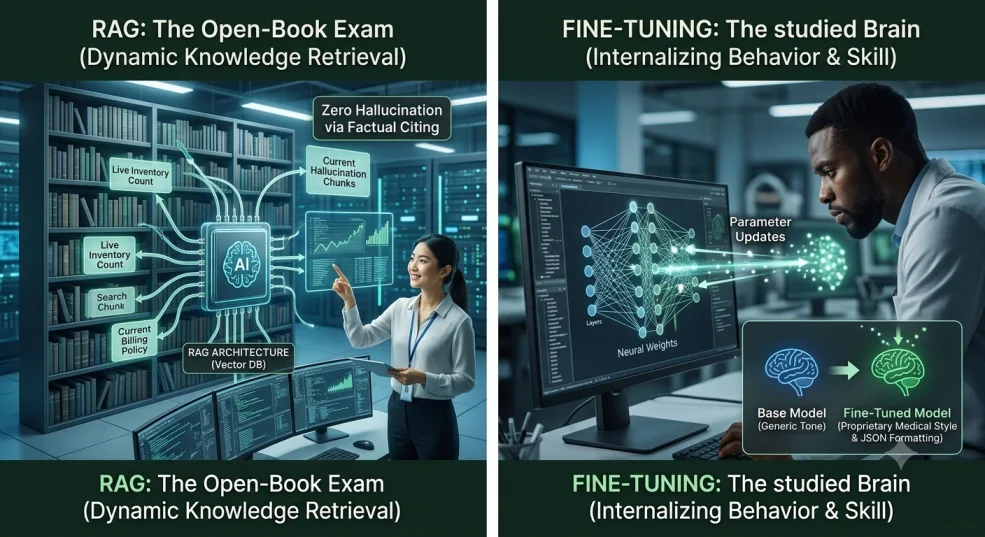
Fine-Tuning is studying for a closed-book exam. You feed the model thousands of curated, highly specific examples until its underlying parametric weights change. It internalizes the behavioral patterns, adapts how it formats data, and no longer needs external context tokens to perform the task.
-
RAG is an open-book exam. The underlying model weights remain exactly the same. Instead of modifying its brain, you give it an advanced semantic search engine (a vector database). When a user asks a question, the system searches your company’s internal files, grabs the relevant data chunks, and hands them to the model to synthesize.
Both methods optimize an AI application, but they address entirely separate parts of the software stack.
When to Use RAG (Retrieval-Augmented Generation)
In our experience, RAG is the correct engineering starting point for roughly 80% of enterprise AI applications. If your primary goal is to prevent your AI from making things up (hallucinating) when discussing your company’s internal data, RAG is your best friend. Because the model is forced to source its answers from the exact documents injected into the context window, you achieve deterministic verification.
The Big Advantages of RAG:
-
Real-Time Data Updates: If a product catalog changes or a software engineering runbook is updated, you don't need to retrain anything. You simply update the document in your vector index, and the LLM instantly has access to the updated reality.
-
Granular Role-Based Access Control (RBAC): This is a massive issue for enterprise data security. With RAG, you can easily restrict data access at the database level. If an employee asks a question about executive payroll, your system can check their user permissions before searching the vector index. You cannot do this with a fine-tuned model; once data is baked into the model’s parameters, everyone who interacts with it can potentially extract that data through prompt engineering.
-
Minimal Upfront Capital (CAPEX): Setting up a vector search infrastructure requires proper data pipelines, but it does not require millions of tokens of training compute. You can run RAG using standard off-the-shelf embedding models and APIs, allowing you to validate a prototype in days. This is highly beneficial for organizations validating market-readiness, as we highlight in our operational guide on Why Small Businesses Are Switching to AI Automation in 2026.
Ideal Real-World Use Cases for RAG:
-
Internal Knowledge Repositories: Scanning thousands of highly volatile internal HR policies, compliance sheets, and benefit documents.
-
Autonomous Customer Support: Grounding an enterprise system in an active help desk knowledge base to ensure technical answers are completely accurate. To understand how this impacts the bottom line, see our deep-dive analysis on How AI-Powered Customer Support Is Reducing Costs and Improving UX.
-
Financial Analysis Platforms: Parsing dynamically updated market reports, portfolio performance files, and live financial news feeds.
When to Use Fine-Tuning
Fine-tuning is not designed to teach a model what facts to know; it is designed to teach a model how to act.
If you feed an LLM five thousand pages of internal customer records via fine-tuning, it will not perfectly memorize every field. What it will do is learn the exact vocabulary, syntax, structural boundaries, and programmatic patterns of your data style. In 2026, enterprise engineering teams rarely run full parameter tuning. Instead, they leverage Parameter-Efficient Fine-Tuning (PEFT) methods like LoRA and QLoRA, which insert tiny trainable adapters into the model layers, capturing 95%+ of full training quality at a fraction of the compute cost.
The Big Advantages of Fine-Tuning:
-
Flawless Style, Tone, and Syntax Adaptation: If you need your AI application to output code in a highly specific proprietary framework, or write complex API payloads that match your data schema perfectly, fine-tuning guarantees structure in a way simple prompting cannot.
-
Inference Efficiency (Mitigating the Context Tax): With RAG, you must pack dozens of context documents into every single API call. This makes your prompt payloads massive, which introduces latency and drives up ongoing variable costs (OPEX). A fine-tuned model already knows the structural logic natively, keeping your prompt payload incredibly light, fast, and cost-effective at high query volumes.
-
Optimizing Small Language Models (SLMs): Fine-tuning allows you to take an open-source 7B or 8B model (like Llama 3 or Mistral) and train it to perform a highly focused task with the accuracy of a massive frontier model, dramatically lowering your private hosting costs.
Ideal Real-World Use Cases for Fine-Tuning:
-
Structured Output Formatting: Forcing a model to consistently generate valid, complex JSON or YAML structures according to internal developer specifications without variance.
-
Niche Code Generation: Tailoring code completions to a highly specific, proprietary internal enterprise codebase.
-
Medical/Legal Transcription Parsing: Converting messy, raw audio transcript logs into highly structured, industry-compliant billing charts or legal briefs using strict professional vocabulary.
RAG vs. Fine-Tuning: The Architectural Tradeoffs
Choosing between these two models requires a clear-eyed look at engineering constraints. Here is how they stack up side-by-side across production metrics:
| Engineering Metric | RAG (Retrieval-Augmented) | Fine-Tuning (Parametric Update) |
| Upfront Dev Cost | Low to Medium | High (Requires rigorous data engineering & GPU compute) |
| Knowledge Cutoff | None (Real-time vector data access) | Fixed (Requires retraining or adapter updates to refresh) |
| Hallucination Risk | Very Low (Strictly bounded by source chunks) | Medium to High (Confidently articulates false facts) |
| Data Requirements | Unstructured corporate documents/PDFs | Highly structured, clean prompt-response pairs |
| Data Privacy (RBAC) | Easy to enforce at the vector query level | Impossible to partition once weights are altered |
| Latent Overhead | Higher per-query latency due to context bloat | Exceptionally low per-query response latency |
The Hybrid Architecture: The Gold Standard for Enterprise AI
Many software architects treat this as a binary choice. In production, it rarely is. The most sophisticated enterprise systems built today deploy a hybrid architecture that synthesizes the strengths of both frameworks.
Consider a modern enterprise customer billing system:
-
The Fine-Tuning Layer: A compact open-source model is fine-tuned via LoRA on 5,000 internal development logs. Its sole job is to master the exact formatting, secure API tool-calling syntax, and communication tone of your brand.
-
The RAG Layer: When a live query arrives, a vector database retrieves the specific customer's real-time invoice ledger and historical account data, injecting it into the prompt context window.
This unified approach delivers optimal performance: the factual grounding, real-time data freshness, and ironclad security permissions of RAG, executed by a model that has been structurally optimized for the exact style, formatting, and speed your business requires.
Frequently Asked Questions
Is fine-tuning more expensive than RAG?
Yes, from an initial capital perspective. Fine-tuning requires sourcing clean training datasets, paying for intensive GPU compute cycles, and managing dedicated hosting instances. However, for massive transaction volumes (100,000+ daily queries), fine-tuning a small language model can actually become more cost-effective over time because you eliminate the ongoing "context token tax" associated with RAG pipelines.
Can fine-tuning stop an LLM from hallucinating?
No. In fact, fine-tuning can make hallucinations harder to catch. Because the model learns to sound highly fluent, confident, and professional, it will articulate incorrect factual data with extreme authority. If your absolute priority is preventing factual errors, a RAG pipeline is required.
How do I choose between building a custom solution or using off-the-shelf software?
It comes down to your proprietary data advantage and workflow complexity. If you are handling standard business communications, a SaaS tool is highly efficient. If you are mapping core proprietary operations or highly regulated information, custom development protects your data sovereignty and long-term scaling margins. We break down this exact calculation in our analysis of Custom Software Development vs. SaaS: When Businesses Should Build Instead of Buy.
If conversational AI isn't the right fit, are standard chatbots still viable?
Basic chatbots are highly limited in handling complex business tasks. For a detailed breakdown of where basic conversational UI fails and where agentic workflows take over, check out our framework: AI Chatbots for Business: Are They Actually Worth It in 2026?.
Conclusion: Designing Your Implementation Path
Before writing a single line of code or provisioning expensive cloud hardware, ask your engineering team two diagnostic questions:
-
Does our application need to know volatile, constantly changing facts, or does it need to master a highly specialized behavioral pattern or format? If it needs facts, build RAG first. If it needs strict behavioral compliance, look at fine-tuning.
-
What happens when our underlying data updates next week? If retraining an entire model or redeploying adapters to keep up with daily business modifications sounds like an operational nightmare, RAG is your only viable path.
For the vast majority of software platforms, the most effective roadmap is clear: build a robust, performant RAG pipeline first. Maximize your document parsing, optimize your chunking strategies, use advanced reranking models, and benchmark the results. If you eventually find that the model struggles with formatting, token latency, or specialized brand voice despite having the correct facts, that is the exact moment you layer on a fine-tuning optimization strategy.
Ready to Design a Production-Grade AI Architecture?
Balancing vector infrastructure, context engineering, and model fine-tuning requires deep, proven data engineering experience. At TechMamba, we map, design, and deploy custom enterprise-grade AI environments built specifically to secure your data permissions, minimize your token latency, and optimize your business margins.