If your organization treats artificial intelligence as an unmonitored black box, you are accumulating systemic operational and legal liabilities that will inevitably disrupt your core business.
In 2026, the era of deploying "wild west" AI models with zero accountability has officially closed. With the enforcement of global regulatory boundaries—such as the EU AI Act, strict sector-specific FTC auditing rules, and evolving NIST AI Risk Management standards—enterprises are legally required to provide verifiable, reproducible audit trails for their automated systems.
For technical directors and systems engineers, AI governance is no longer a soft compliance checkbox; it is a rigid system engineering constraint. When an autonomous system executes high-leverage workflows—such as analyzing resumes, processing credit applications, or routing healthcare triage—your architecture must prove how and why specific outputs were generated.
Below is an architecture-first guide to implementing programmatic AI governance, calculating semantic drift, and engineering secure, auditable AI pipelines.
Quick Answer: What Is Enterprise AI Governance?
Enterprise AI governance is the framework of policies, technologies, and operational controls used to ensure artificial intelligence systems remain secure, transparent, compliant, and auditable throughout their lifecycle. It combines technical safeguards, monitoring, evaluation, and regulatory controls to reduce business risk while maintaining trustworthy AI operations.
What Is Enterprise AI Governance?
Enterprise AI governance is the structural framework of rules, technologies, and audit protocols deployed to manage, monitor, and secure an organization's artificial intelligence systems. It establishes strict, system-level mechanisms to enforce regulatory compliance, minimize operational drift, eliminate dataset bias, and provide cryptographically verifiable execution logging throughout an AI application's lifecycle.
The Three Core Pillars of Governed AI Pipelines
A robust, enterprise-grade governance strategy rests on three primary operational layers:
Figure 1. Enterprise AI Governance Framework. Three foundational governance pillars—Traceability, Alignment, and Compliance—work together to ensure transparent, auditable, and responsible AI operations.
Enterprise Governance in Practice
Governance policies must be converted directly into active code boundaries tailored to your specific industry constraints:
-
Financial institutions govern AI to maintain transparent, explainable lending decisions and satisfy strict federal regulatory audit requirements.
-
Healthcare organizations monitor clinical AI systems to ensure patient-facing diagnostic recommendations remain completely explainable and compliant with global health-tech privacy regulations.
-
Insurance providers continuously evaluate model drift within underwriting systems to prevent unfair, biased coverage outcomes.
-
Small businesses scaling up deploy automated guardrails to ensure local automations don't step outside brand voice boundaries. If you are exploring how smaller teams deploy these boundaries safely, read our operational guide on Why Small Businesses Are Switching to AI Automation in 2026.
These real-world examples demonstrate that true enterprise governance is not simply documentation—it is a functional operational framework embedded directly into your active production infrastructure.
Figure 3. Enterprise governance teams continuously evaluate AI systems to maintain transparency, regulatory compliance, and operational accountability.
Designing an Auditable Systems Architecture
To satisfy enterprise compliance audits, you cannot rely on simple, unmonitored API calls. Every state transition within an agentic pipeline must be logged in an immutable, serialized transaction ledger.
Figure 2. Enterprise AI Governance Architecture. Every request flows through authentication, governance controls, evaluation services, vector storage, and immutable audit logging before completing execution.
By decoupling the evaluation and logging layer from the core execution thread, you preserve system performance while capturing complete traceability for every user transaction.
Why Decoupling Is Necessary
Running comprehensive bias evaluations directly inside your primary execution path introduces unacceptable latency overhead (sometimes exceeding 1.2 seconds per transaction). This can severely degrade user experience, which is particularly detrimental when deploying customer-facing systems. To see how optimizing these latency configurations directly correlates with brand loyalty and conversion margins, check out our analysis on How AI-Powered Customer Support Is Reducing Costs and Improving UX.
To prevent this, our systems route transaction payloads asynchronously using distributed broker queues like RabbitMQ. The primary user thread receives responses instantly, while a dedicated background worker thread evaluates the trace logs against compliance rules and stores the finalized diagnostic data inside an immutable PostgreSQL instance.
Figure 4. Distributed AI workloads are processed asynchronously across secure cloud infrastructure to optimize system performance while maintaining complete auditability.
Mathematical Modeling: Calculating Semantic Drift
As your underlying business data, user behaviors, and models update over time, the system will inevitably experience semantic drift—a progressive decay in reasoning accuracy.
To govern this risk programmatically, our systems calculate the semantic divergence of model outputs over a sliding transaction window.

When the calculation yields , the governance gateway automatically triggers a system exception flag, notifying the engineering team that the model’s performance has shifted out of specification and requires retraining or database adjustment. This automated protection is critical when managing scaling software overhead, as analyzed in our comprehensive breakdown on AI Agent Development Cost in 2026: The Definitive Business Budgeting Guide.
Figure 5. Continuous real-time monitoring enables engineering teams to detect semantic drift, performance degradation, and governance violations before they impact production systems.
Technical Comparison: Governed Architecture vs. Ad-Hoc Deployment
|
Evaluation Metric |
Ad-Hoc Unregulated Setup |
Hardened Governed AI Architecture |
|---|---|---|
|
Audit Capabilities |
Zero (Relies on basic, raw server logs). |
Full traceability via cryptographically hashed trace IDs. |
|
Bias Mitigation |
Manual, reactive reviews after client escalations. |
Automated continuous checks using baseline evaluation datasets. |
|
Drift Management |
Untracked (Failures only spotted when users complain). |
Algorithmic tracking using Population Stability Index metrics. |
|
Regulatory Guardrails |
Rely on brittle system prompting boundaries. |
Strict validation gates running standalone local model checkers. |
|
Data Protection |
High risk of PII leaking to third-party endpoints. |
Stateless, zero-egress sandboxes running localized SLMs. |
Tooling and Implementation Best Practices
To deploy a highly compliant, governed AI platform, your development team should integrate specialized, open-standard technologies:
1. Implement Stateful Tracing with Langfuse or Arize Phoenix
Never execute an agentic workflow without tracing software. Tools like Langfuse capture every sub-step of a multi-agent system. If an agent executes an API call, searches a vector database, or makes a formatting error, the entire execution tree is visualizable, making diagnostic debugging and legal compliance reviews instantaneous.
2. Run Automated Regression Testing with Promptfoo
Before any updated system prompt or database schema goes live, execute programmatic regression tests. Utilizing automated tools allows your team to stress-test your AI systems against thousands of malicious prompts, evaluating accuracy, security, and bias thresholds before the code is ever merged into production.
3. Enforce Isolated Data Protocols via MCP
To keep systems auditable, enforce strict schemas for external tool calls. Utilizing standard frameworks like the Model Context Protocol (MCP) prevents models from issuing unpredictable, direct database commands, ensuring every external action runs inside a pre-approved, sandboxed boundary.
The Ultimate Convergence: Security and Governance
It is a common mistake to view security and governance as isolated disciplines. In production, they are structurally linked.
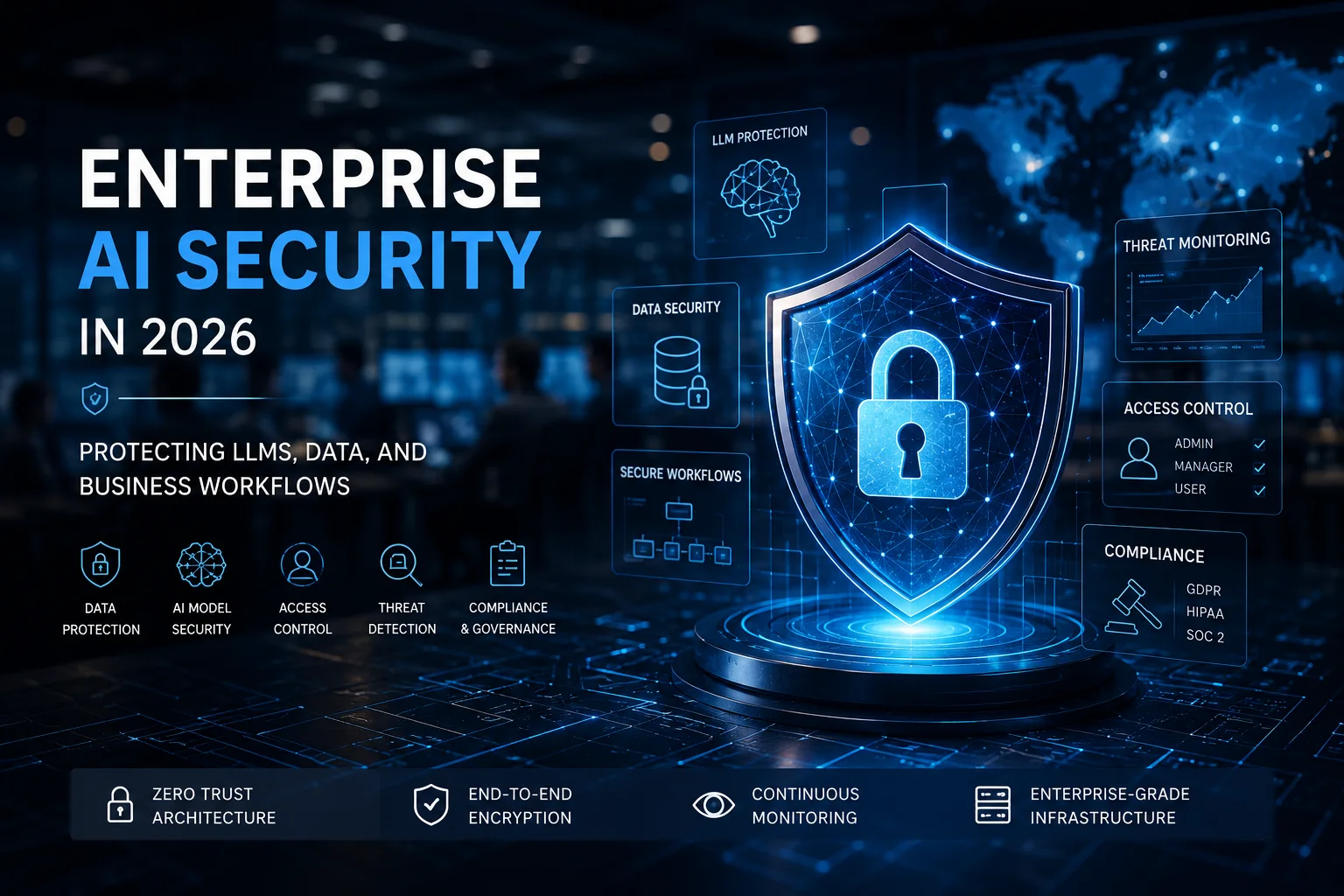
While Enterprise AI Security in 2026: Protecting LLMs, Data, and Business Workflows focuses on active threat mitigation (such as isolating indirect prompt injections), AI governance provides the programmatic tracking and auditing frameworks needed to verify that those security protocols are actually performing as expected.
Without deep visibility logs, a security breach can occur undetected inside your network for weeks. Combining security guardrails with immutable governance audit trails creates an impenetrable perimeter around your digital assets. This dual-layer approach is crucial for modern RAG Architecture setups and Agentic Retrieval-Augmented Generation (RAG) configurations that interface directly with protected corporate records.
Expert Opinion: The Shift from Ethics to Systems Engineering
In our experience, early corporate efforts in "AI Ethics" failed because they relied on abstract, manual policy documents that developers routinely ignored under tight release schedules. Ethical principles only carry value when they are converted directly into system-level code constraints.
By building automated guardrails, strict role-based data partitioning, and real-time semantic monitoring directly into your API gateways, you turn high-level corporate policies into deterministic technical realities.
What Most Organizations Get Wrong
Many organizations assume governance begins after deployment through documentation and compliance reviews. In reality, governance starts during architecture design.
Logging, traceability, evaluation pipelines, permission boundaries, and auditability should be treated as foundational engineering requirements rather than post-deployment compliance tasks.
If you are currently evaluating custom platform builds versus off-the-shelf software subscriptions, you must calculate how auditing constraints factor into your long-term infrastructure. Learn how to navigate this calculation in our breakdown on Custom Software Development vs SaaS: When Businesses Should Build Instead of Buy. Organizations that embed governance into their architecture from day one experience significantly lower operational risk as AI adoption scales.
Architect Your Compliant AI Infrastructure with TechMamba
Building highly secure, auditable, and performant AI systems requires extensive, real-world experience in distributed software design, advanced data pipelining, and scalable cloud networks. At TechMamba, we engineer production-ready multi-agent environments, compliant vector search networks, and enterprise private assistants designed to protect your compliance margins and optimize your operational bottom line.