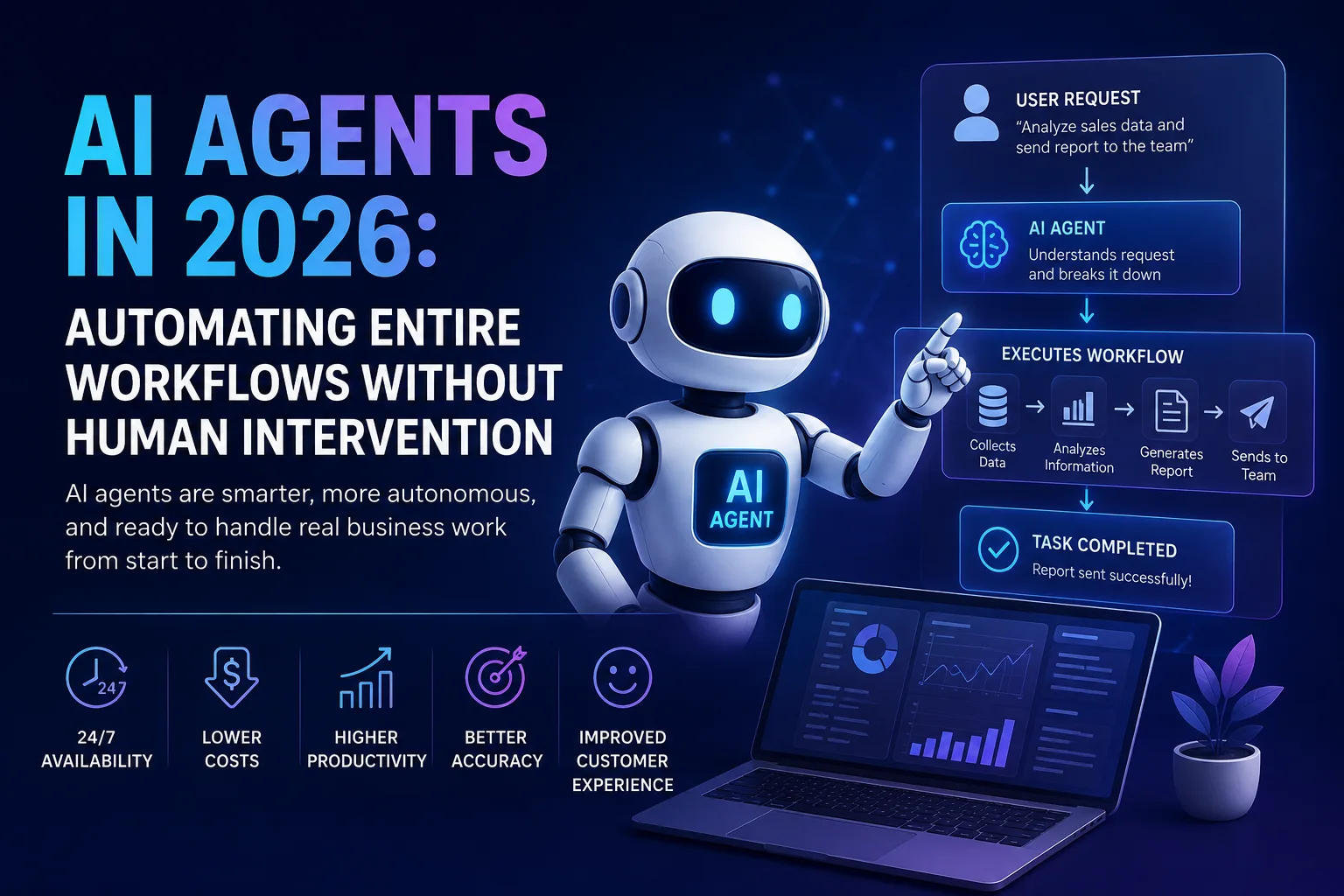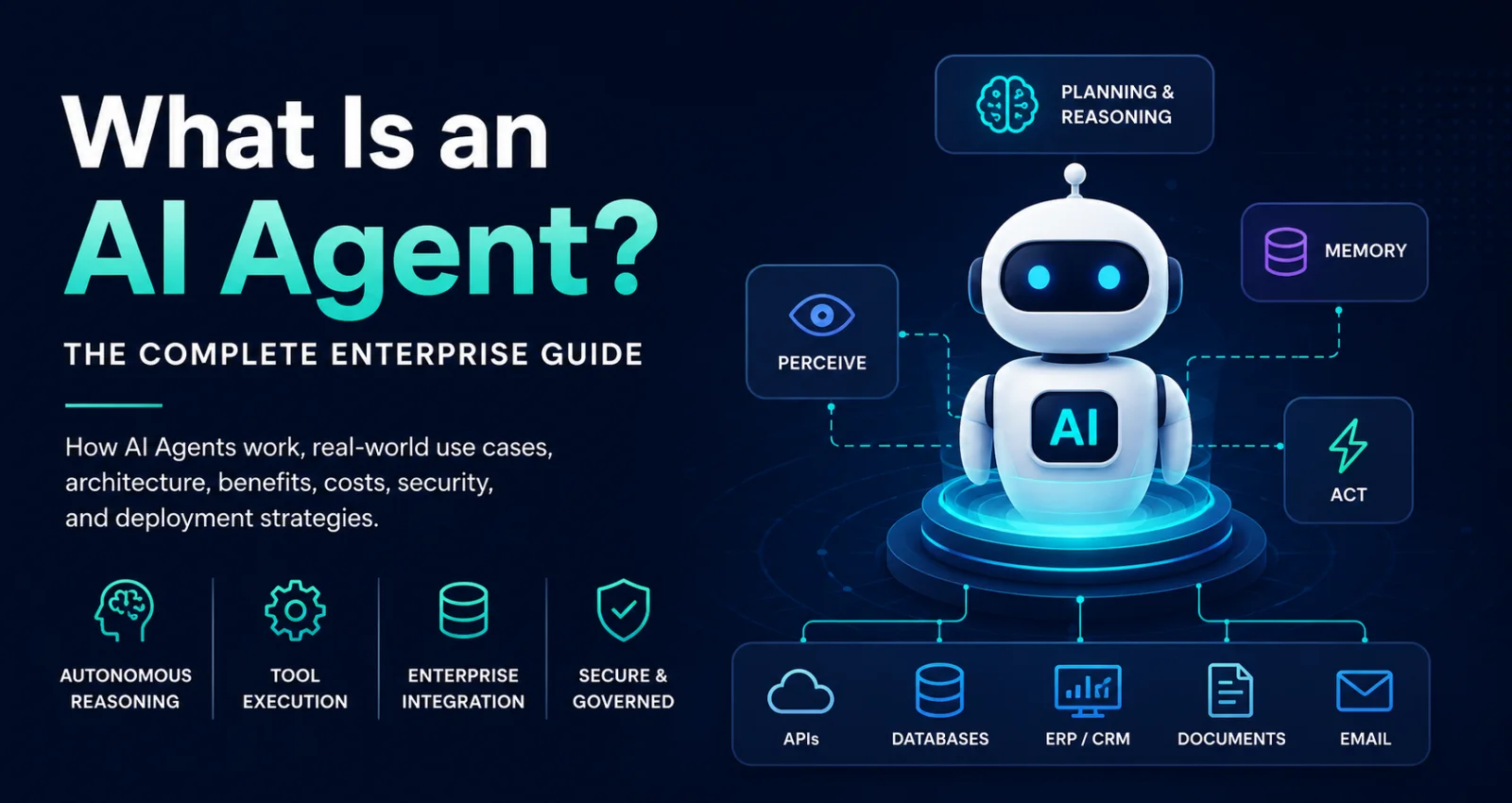
Executive Summary: The Shift from Chatbots to Coworkers
If you are running an enterprise today, you are likely exhausted by the artificial intelligence hype cycle. Over the past few years, tech vendors have flooded your inbox with promises of "transformational productivity," yet many of these deployments have resulted in glorified search bars or polite chatbots that occasionally hallucinate your company policies.
Through our work with enterprises and growing technology companies, we consistently observe the same trend: businesses want AI systems that execute work, not just generate answers.
This is the macro shift from Generative AI to Agentic AI.
Industry analysts predict rapid adoption of AI agents over the next several years, noting a stark market pivot away from purely conversational assistants toward automated, goal-oriented software. Tech executives are realizing that the true return on investment lies in autonomous task execution, with projections indicating that the vast majority of enterprise applications will embed task-specific AI agents within the next few years.
Whether you want to build AI agents internally or partner with an experienced AI Agent Development Company, this comprehensive guide is designed to strip away the marketing jargon. It gives you a rigorous, executive-level blueprint of what custom AI agents are, how they integrate into enterprise architecture, their real-world use cases, and how to project the true cost of deployment.
1. What Is an AI Agent?
An AI agent is a software entity powered by an underlying large language model (LLM) that can autonomously perceive its environment, reason through complex tasks, break down high-level objectives into sequential steps, and execute programmatic actions using external tools and APIs to achieve a specific goal without constant human intervention.
Unlike traditional software that relies on rigid, hardcoded rules, an enterprise AI agent leverages semantic reasoning. It doesn't just process data; it understands the intent behind a business objective.
How Do AI Agents Work?
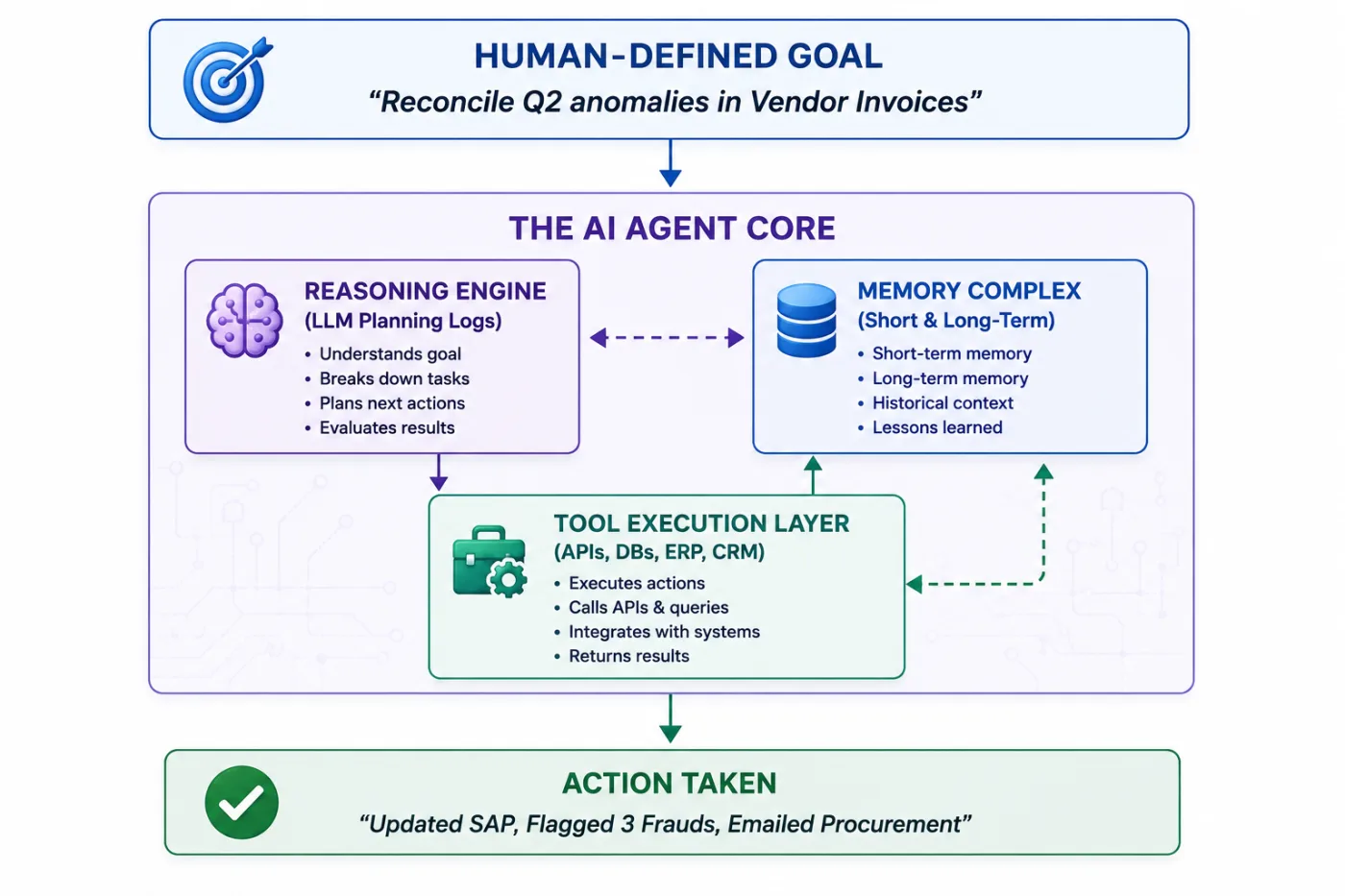
The operational lifecycle of an agent functions as an iterative, closed loop often referred to as the Perceive-Reason-Act cycle:
-
Perceive: The agent ingests an input—whether a direct user prompt, a webhook notification, an incoming email, or a scheduled database trigger.
-
Reason: The core model runs an internal thought loop (often using frameworks like ReAct or Chain-of-Thought). It assesses its goal, evaluates what information it is missing, and creates a mental plan of execution.
-
Act: The agent selects the optimal tool from its toolkit (e.g., executing an SQL query, calling a CRM API, or generating a document) and reviews the tool's output. If the tool returns an error, the agent self-corrects its reasoning and tries an alternative path until the objective is satisfied.
2. AI Agent vs. Chatbot vs. RPA
Many technology leaders confuse AI agents with two existing corporate technologies: standard Generative AI Chatbots and Robotic Process Automation (RPA). Mixing these up can lead to expensive architectural missteps.
Here is how they stack up across critical enterprise capabilities:
| Feature / Capability | Chatbot (Standard GenAI) | RPA (Robotic Process Automation) | AI Agent (Custom AI Agents) |
| Core Engine | LLM (Text Generation) | Hardcoded deterministic scripts | Advanced LLM + Planning Layers |
| Reasoning & Logic | Limited to generating text | None (Strictly conditional If/Else) | High (Dynamic problem-solving) |
| Tool & API Usage | Limited (Usually native search) | Yes (UI clicking & basic APIs) | Yes (Reads/writes to any open API) |
| Adaptability | Medium (Can adjust conversational tone) | Low (Breaks if software UI changes) | High (Finds alternate paths to goal) |
| Autonomous Action | No (Sits and waits for prompt) | Limited (Triggers on explicit schedules) | Yes (Loops autonomously until solved) |
| Primary Value | Information retrieval & drafting | High-volume, structured data entry | Complex, end-to-end workflow execution |
3. Common Components of an AI Agent Architecture
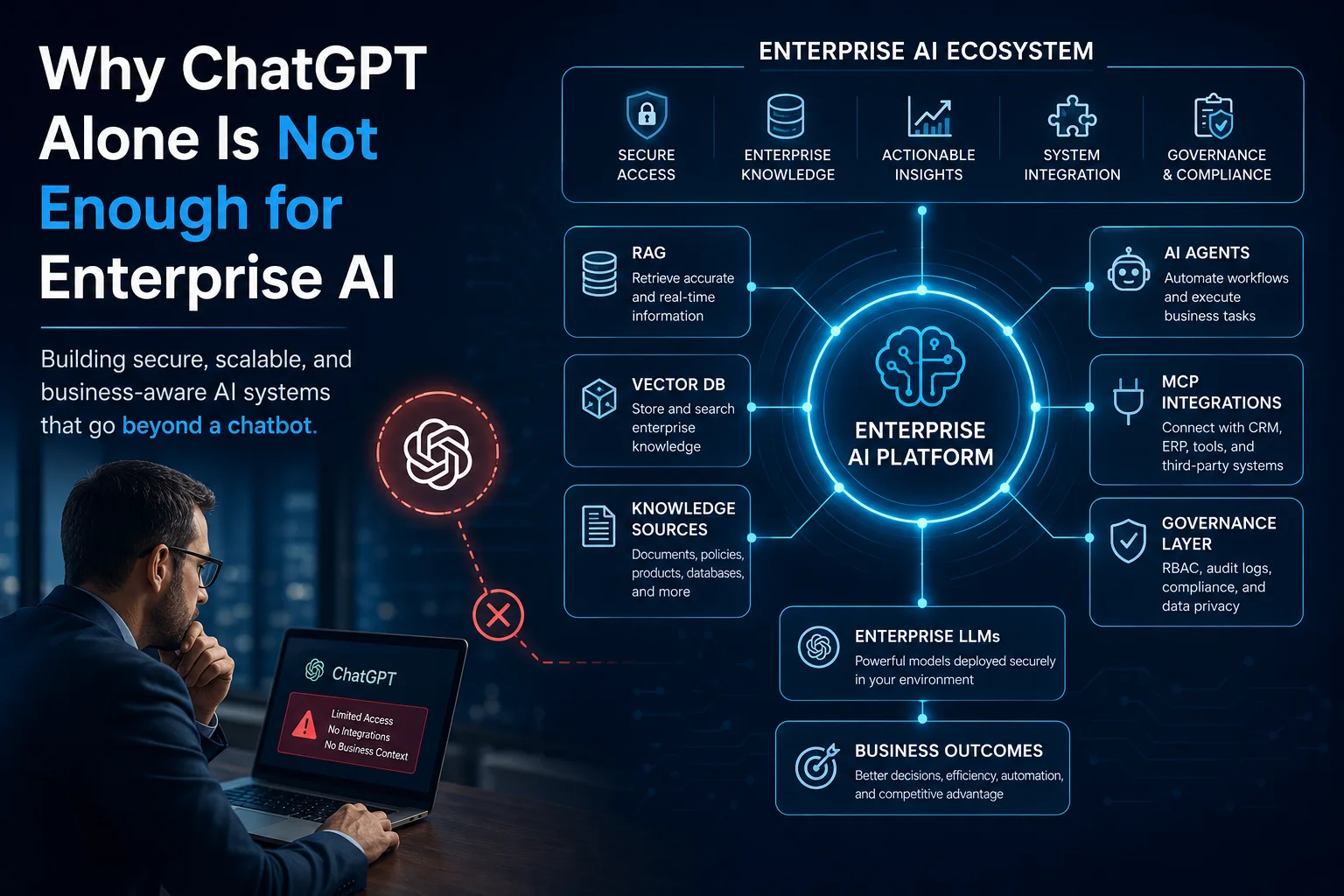
When deploying specialized AI Consulting Services to design an agent from scratch, developers don't just write prompts. They orchestrate a modular ecosystem of core architectural components that flow systematically from ingestion to final execution.
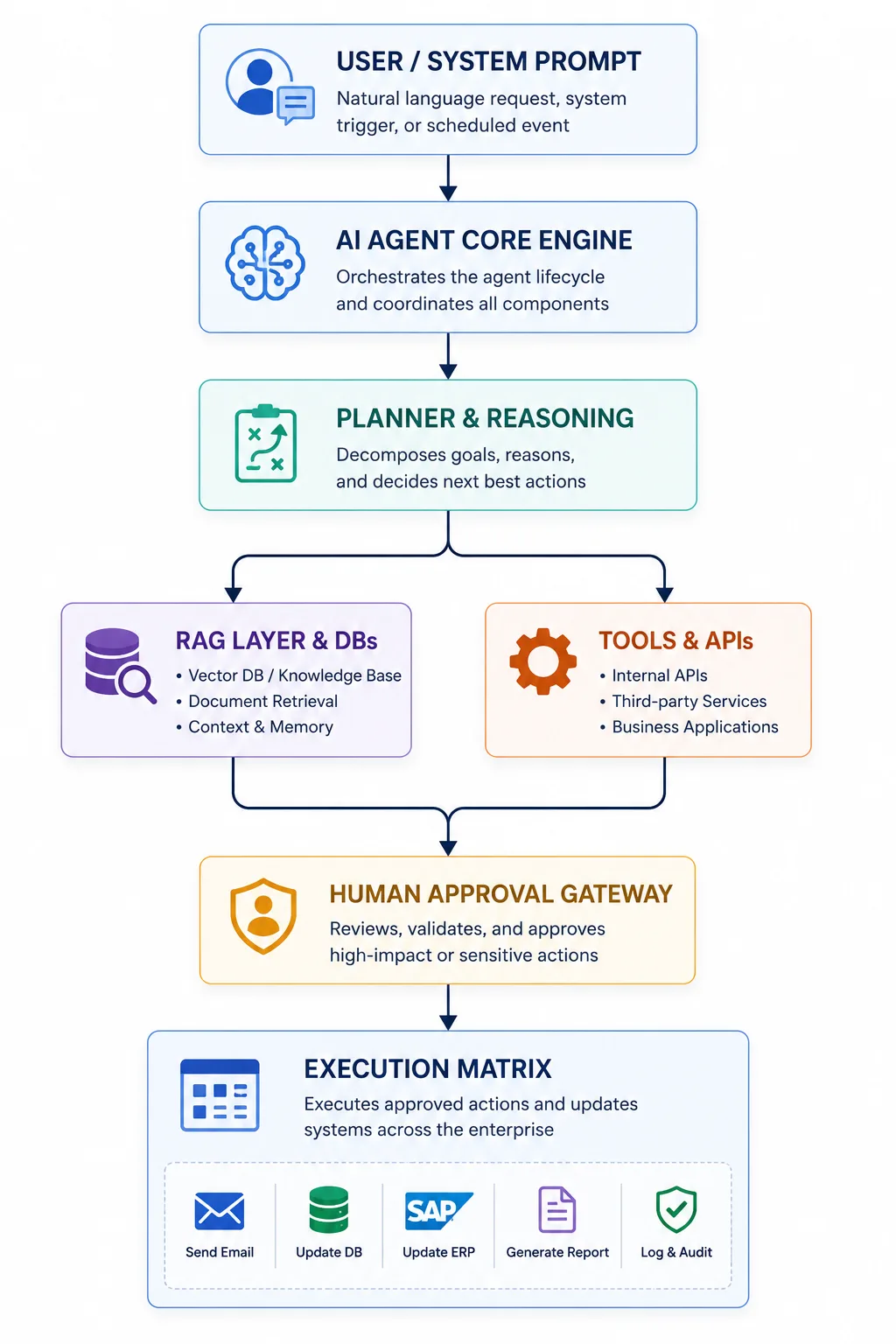
- The Foundational Model (LLM): The centralized engine that handles language understanding, semantic synthesis, and next-step reasoning.
-
Short-Term Memory: Maintains the immediate programmatic variables, state changes, and history of the active workflow execution session.
-
Long-Term Memory: Leverages an enterprise Vector Database (e.g., Pinecone, Milvus) to store and recall historical enterprise data across independent sessions.
-
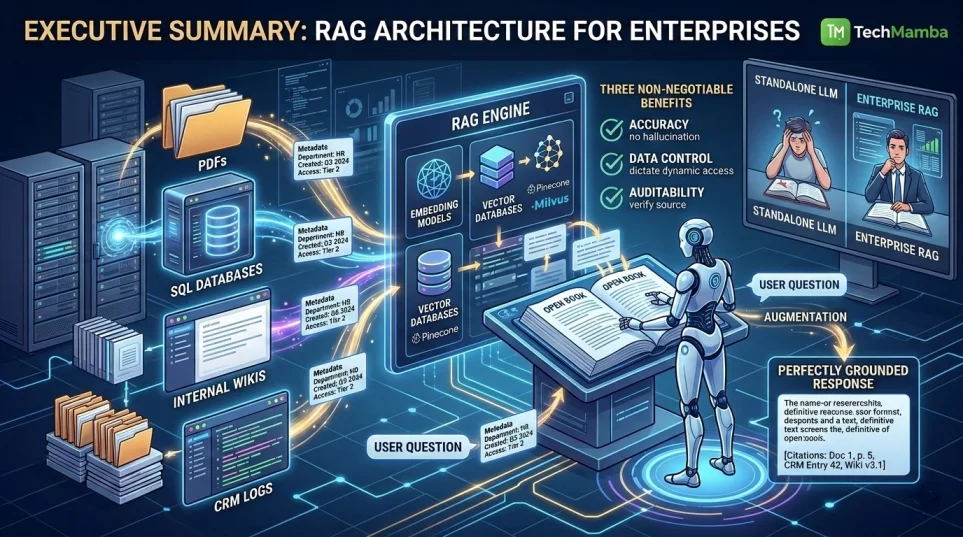
Retrieval-Augmented Generation (RAG): The lookup pipeline that grounds the model's output in real, authenticated corporate knowledge blocks to prevent hallucinations.
-
Tools & APIs: Concrete software hooks that give the agent the power to modify external state environments, such as pushing records into Salesforce or generating an invoice ledger.
-
Model Context Protocol (MCP): An open standard framework that defines how foundational models securely exchange data with external data sources and local environments without brittle, custom wrappers.
-
Guardrails & Policies: Hardcoded programmatic constraints that run validation scripts to verify data safety, ensure regulatory compliance, and prevent prompt injections.
-
Human-in-the-Loop Gateway: The absolute oversight layer where complex or high-consequence outputs are paused until a human administrator reviews and explicitly signs off on execution.
4. Real AI Agent Examples & Enterprise Use Cases
To realize the value of end-to-end AI Workflow Automation, let's look at how agents move beyond theoretical concepts into functional enterprise workflows across targeted vertical domains.
Customer Support & Success
-
The AI Agent Solution: A native customer support agent doesn't just spit out a link to an article. It reads an incoming complaint about a billing error, verifies the user's identity, securely queries the subscription database, calculates the pro-rated refund amount, issues the credit via a payment gateway API, and drafts a hyper-personalized email explaining the correction.
-
Core Benefit: Slashes ticket resolution times from hours to seconds while maintaining a unified brand voice.
Finance & Accounting
-
The AI Agent Solution: An automated invoice reconciliation agent constantly monitors incoming procurement receipts, extracts line-item details from unstructured PDFs, matches them against purchase orders within the ERP system, flags billing discrepancies, and dynamically manages approval routing based on corporate spending thresholds.
-
Core Benefit: Eliminates manual data entry errors and prevents financial leakage before invoices are processed.
Human Resources & Employee Operations
-
The AI Agent Solution: An interactive employee onboarding agent handles the complex checklist for new hires. It cross-references regional compliance codes, generates personalized employment contracts, coordinates background check APIs, triggers IT service requests to provision hardware, and schedules mandatory training sessions based on the employee's specific team role.
-
Core Benefit: Removes administrative overhead from HR teams while ensuring 100% regulatory compliance.
Procurement & Supply Chain Management
-
The AI Agent Solution: A supply chain optimization agent tracks fluctuating material costs, monitors inventory thresholds across regional warehouses, evaluates vendor performance metrics, and autonomously compiles comprehensive purchase order proposals when stock levels dip below safety margins.
-
Core Benefit: Stabilizes supply chain continuity and optimizes working capital.
Sales & Revenue Operations
-
The AI Agent Solution: An autonomous lead enrichment and outbound agent monitors public corporate updates and signals. It evaluates inbound leads against an Ideal Customer Profile (ICP), runs data enrichment workflows across third-party directories, updates CRM fields, and crafts tailored, context-aware pitch decks for account executives ahead of discovery calls.
-
Core Benefit: Increases sales velocity by allowing sales professionals to focus exclusively on closing deals.
5. Deep-Dive Case Study: Global Logistics Corp (GLC)
Disclaimer: The following case study outlines a representative enterprise deployment scenario executed by the TechMamba team. Client identity has been anonymized under a pseudonym for confidentiality purposes.
The Challenge
GLC faced an operational bottleneck in their global customs clearance and invoice reconciliation team. Every week, they processed thousands of multi-page, semi-structured shipping manifests, customs declarations, and commercial invoices coming from hundreds of international vendors.
Because international trade laws and tariff codes change constantly, standard OCR (Optical Character Recognition) and RPA solutions regularly failed. Over 35% of invoices contained minor data discrepancies (mismatched line items, varying currency exchange rates, fluctuating fuel surcharges), requiring a human team of 80 specialists to manually cross-reference ERP databases, verify international tariff sheets, and exchange emails with vendors to clear the anomalies. The average time to resolve an invoice discrepancy was 7.2 days.
The Solution: The TechMamba "ClearingHouse" Agentic Framework
We built and deployed a custom multi-agent system built on top of a highly secure enterprise data intelligence platform.
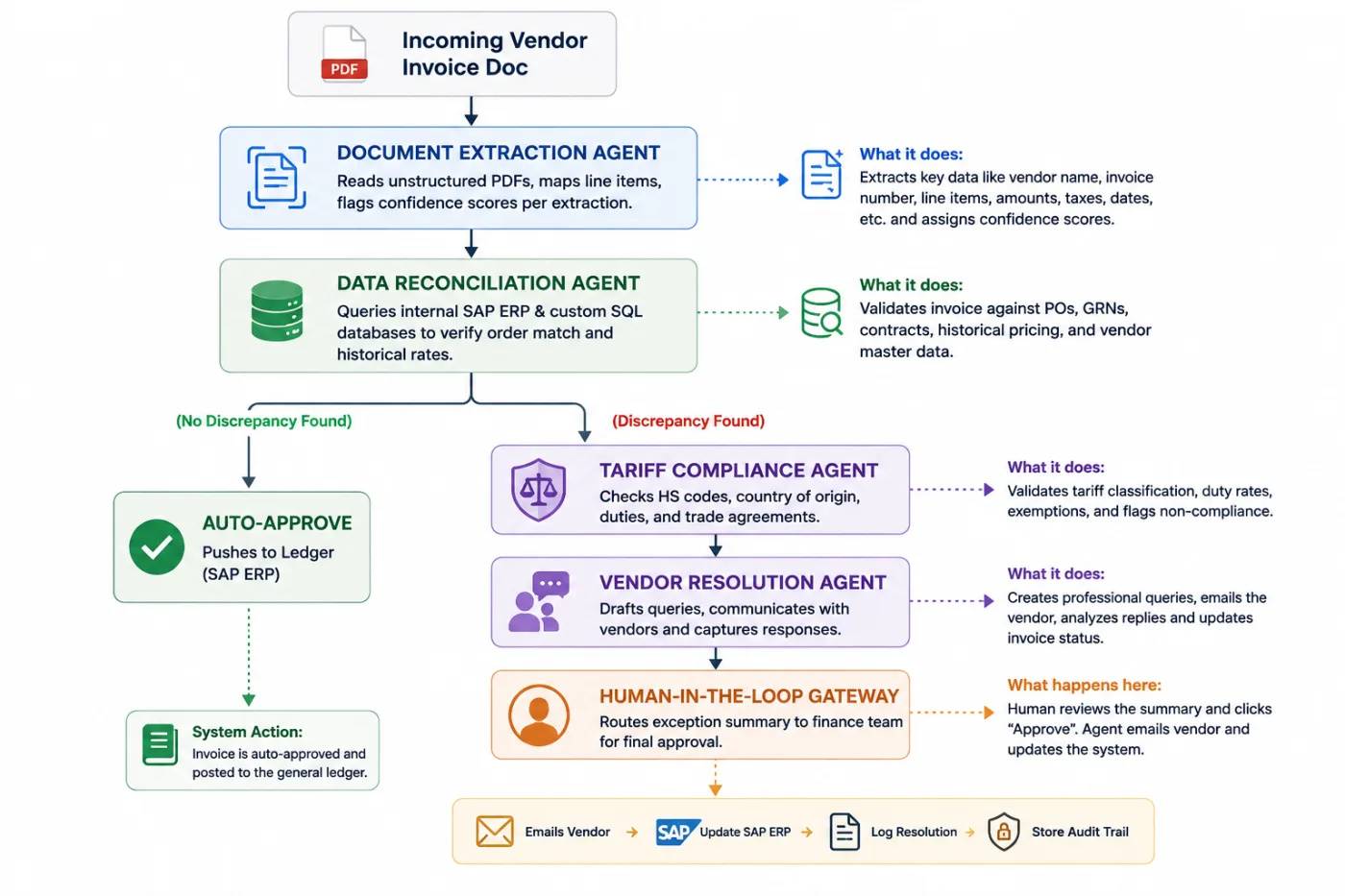
The Results
Within six months of moving from pilot to production, the metrics transformed radically:
| Metric Evaluated | Pre-Agent Era | Post-Agent Era | Net Impact |
| Discrepancy Resolution Time | 7.2 Days | 14 Minutes | 99.8% Reduction |
| Manual Touch Rate | 100% of anomalies | 6.2% of anomalies | 93.8% Automation Rate |
| Operational Costs | $24 per complex invoice | $1.80 per complex invoice | 92.5% Cost Savings |
| Quarterly Leakage Found | Bounded by human sight | $1.4M in overcharges caught | Found Net Savings |
The 80 human specialists were transitioned into strategic roles: managing complex international trade audits, optimizing vendor negotiations, and handling the rare 6.2% of edge cases flagged by the agentic guardrails.
6. Benefits of AI Agents for Enterprises
Deploying custom AI agents offers immense advantages over conversational AI tools or rigid automation code, directly solving complex operational friction points:
-
Drastic Cost Reductions: By replacing high-volume manual review processes with parallelized agent loops, processing overhead scales down by 80% to 90% or more.
-
Accelerated Business Velocity: Complex end-to-end tasks that traditionally stalled in queues for several business days now close out within minutes or seconds.
-
High Operational Scale: Agents handle unpredictable spikes in transaction volumes—such as end-of-quarter invoice overflows or sudden market events—without requiring proportional hiring spikes.
-
Contextual Error Correction: Unlike deterministic scripts that fail immediately when encountering an anomaly, agents reason through parsing problems, re-query missing tables, and self-correct on the fly.
-
Strict Compliance Assurance: Every decision path, context retrieval step, and tool-invocation block is logged in an immutable thread, providing transparent auditability for corporate compliance teams.
7. The Enterprise Agentic Stack: How to Build for Production
If your engineering team tells you they can spin up an enterprise-ready agent using a basic Python script and a wrapper over a public API, be very careful. Building a demo is easy; building a production system that survives corporate compliance, dynamic permissions, and data audits requires a multi-layered stack.
Data Layer & Agentic RAG
An agent is only as good as the context it can fetch. Enterprises that succeed with agents treat deployment as an advanced data-integration initiative.
-
Unstructured data (SOPs, contract PDFs, Slack history) must be cleaned, chunked, and stored in enterprise vector databases via professional RAG Development Services.
-
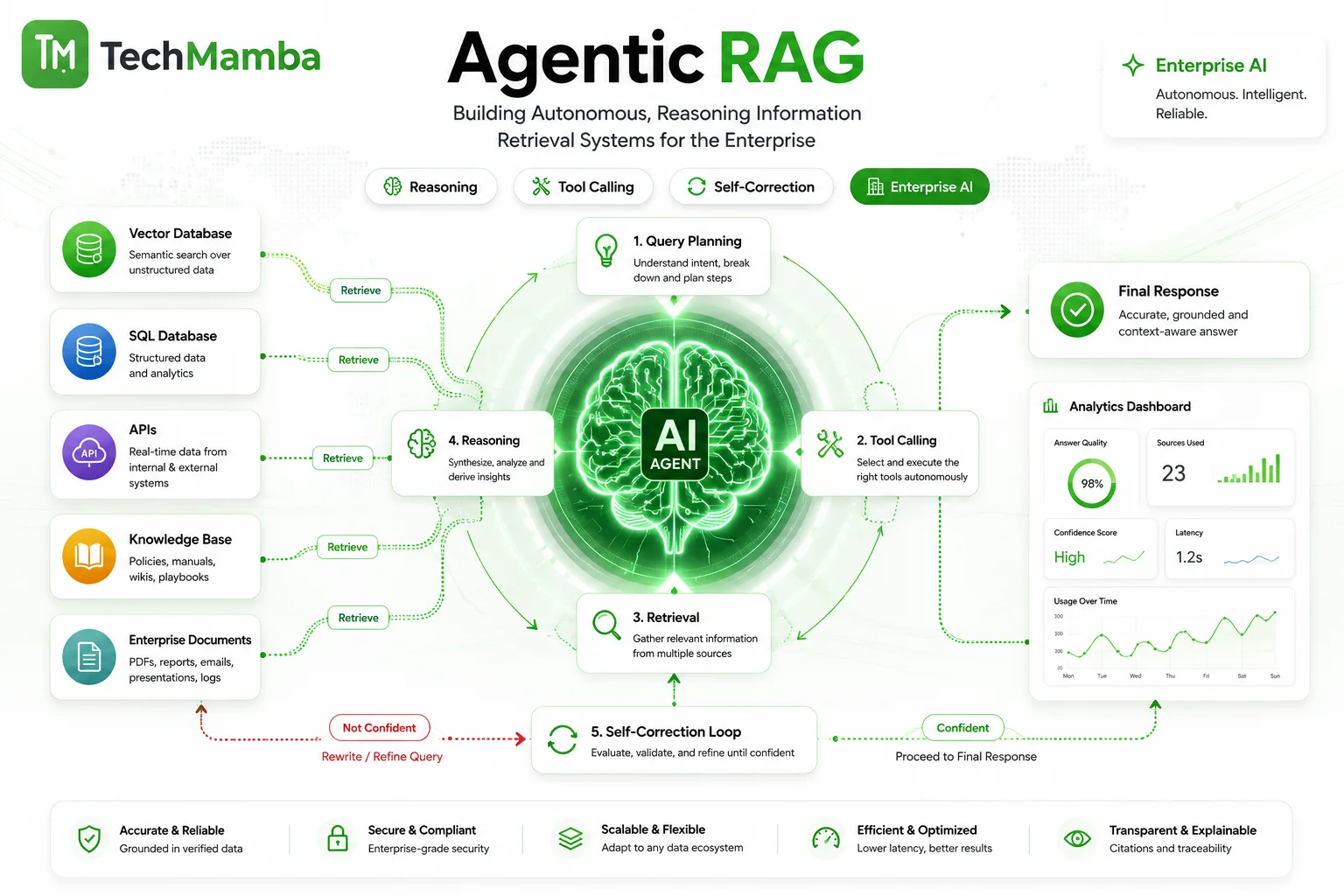
To achieve human-level accuracy, we implement an Agentic RAG Architecture. Traditional approaches simply perform a single keyword or vector search and pass the raw text to the model. While standard systems run into extraction limitations—as discussed in our deep dive on RAG Architecture Explained—Agentic RAG allows the model to iteratively evaluate its search results. If the first retrieval pass fails to answer the question, the agent reformulates its search queries, searches alternative data stores, and cross-references its findings to ensure complete context.
-
Structured data (ERP records, transactional logs) must be exposed via high-performance, governed APIs or semantic data warehouses (like Databricks or Snowflake) so the agent can execute programmatic lookups without guessing.
Orchestration and the Model Context Protocol (MCP)
To coordinate the agent's loops, enterprise developers lean away from raw prompting and utilize robust frameworks such as LangChain, LlamaIndex, or AutoGen. These libraries provide the native scaffolding for managing states, handling tool-calling exceptions, and maintaining conversational history across complex multi-step processes.
Furthermore, we design our modern enterprise stacks utilizing the Model Context Protocol. As we unpacked in our deep dive on MCP Explained, MCP acts as an open, standardized framework that defines exactly how LLMs securely connect to external data sources and developer tools. Instead of building brittle, custom API integrations for every new tool, MCP provides a uniform interface, making it vastly simpler to swap out foundational models without rewriting your entire enterprise tool infrastructure.
Evaluation & Observability
You cannot manage what you cannot measure. Data shows that enterprises utilizing robust evaluation and logging tools scale their AI projects into production six times faster than those flying blind.
-
Tooling like LangSmith, Arize, or Phoenix tracks every single step of an agent's reasoning loop.
-
It logs exactly what tool was called, what payload was sent to the API, how long the model spent reasoning, and how much each step cost in tokens. If an agent goes into an infinite loop or uses an incorrect assumption, observability tools alert your engineers immediately.
8. How Much Does AI Agent Development Cost?
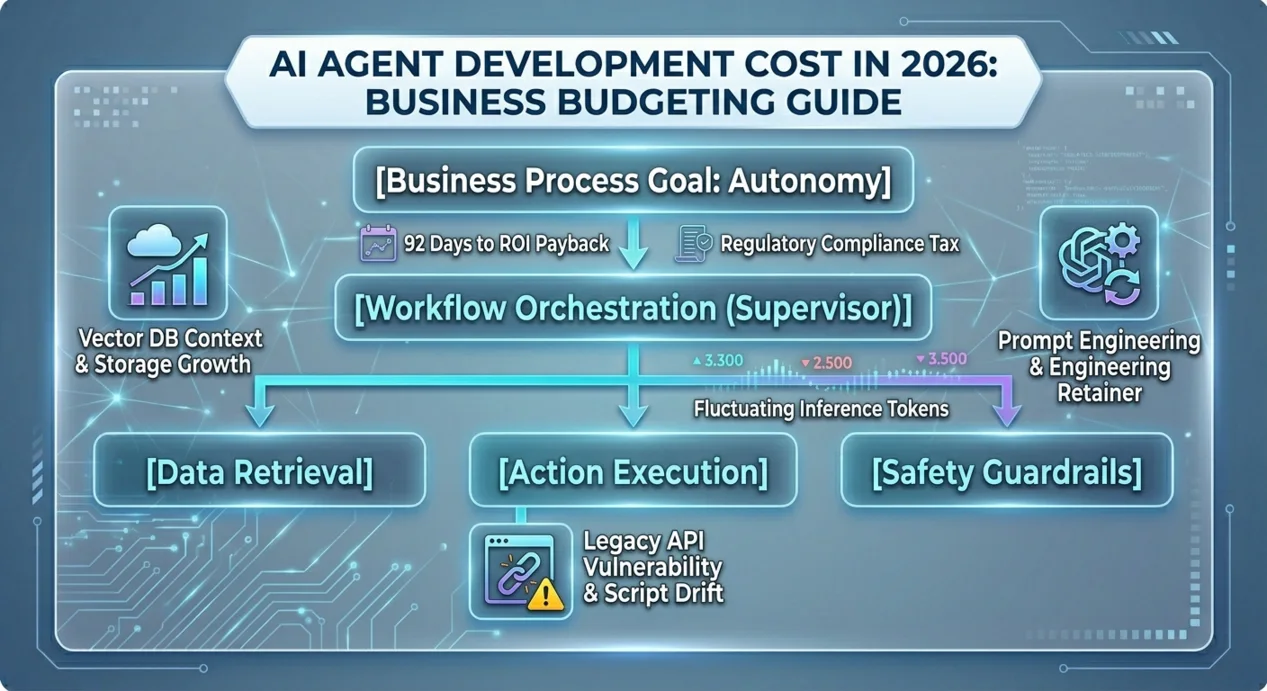
When preparing your fiscal budgets, calculating the financial scope of custom AI agents requires looking beyond simple software licensing. Operational parameters vary significantly based on internal system integrations, security requirements, and underlying workflow complexity. Total cost of ownership splits into two core buckets:
Upfront Engineering & Development
Depending on the engineering hours and scope, typical deployment investments align with three strategic brackets:
-
Proof of Concept (PoC) Tiers: Designed to validate technical viability within a rapid 4–6 week window using out-of-the-box models mapped to isolated, singular data sources.
-
Production-Grade Systems: Full-scale business automation systems engineered for safe production rollout, deeply integrated with legacy operational databases and wrapped in multiple infrastructure guardrails.
-
Complex Multi-Agent Networks: Bespoke cross-departmental frameworks containing multiple coordinating agents, extensive database read/write access permissions, and heavy customization.
Ongoing Run Costs (Tokens & Infrastructure)
Once live, agents generate variable runtime costs driven by model API token consumption, vector database hosting, and infrastructure compute. Because agents use iterative loops to evaluate their work, a single complex task might require multiple LLM calls.
For a granular breakdown of line-item budgeting, hardware scaling factors, and cost reduction strategies, explore our comprehensive resource on AI Agent Development Cost.
9. Security, Governance, and Risk Mitigation
As a CEO, the thought of giving software the autonomy to read your databases, call external APIs, and make decisions without a human clicking "OK" should make you cautious. Autonomy without guardrails is a severe liability.
To safely ship agents in an enterprise environment, your architecture must implement absolute compliance gates across three core zones:
1. Data Security & Sovereignty
-
Tenant Isolation: Agents operating for Region A or Department X must have zero programmatic ability to cross boundaries into Region B or corporate financial ledgers unless explicitly permissioned.
-
PII Redaction: A robust middleware layer must sit between your enterprise data and the LLM reasoning core to automatically strip out Social Security Numbers, credit cards, and HIPAA-protected health fields before the data passes to external model APIs.
2. The Human-in-the-Loop (HITL) Imperative
At TechMamba, we live by a strict rule: The question is never "can an agent do this?" It is "can this agent's actions be governed, audited, and reversed?"
Any action that moves money, alters a permanent record of consequence, or sends a message externally to a customer or vendor must feature a hardcoded human approval gate. The agent does 95% of the heavy lifting—gathering the files, analyzing the patterns, checking compliance, and drafted response. It then presents a clean, plain-English summary to a human manager, who reviews the work and clicks a single "Approve and Execute" button.
3. Prompt Injection Shielding & Tool Bounding
Agents must be given least-privilege tool access. If an agent only needs to read inventory data from an SQL database, its API token must be strictly restricted to read-only. It should be architecturally impossible for a malicious prompt from an external user to trick the agent into running a destructive command.
10. Your 90-Day Enterprise Deployment Strategy
Moving your enterprise from zero to production-grade AI agents requires a methodical roadmap. Avoid the trap of chasing a massive, cross-functional "holy grail" project on day one. Instead, execute a phased, metrics-driven approach.
Phase 1: Days 1–30 — Discovery & Scoping
-
Action: Audit your operational workflows to locate high-friction, high-volume tasks that possess a strong data trail. Look for areas where your team spends hours copying data between software systems or summarizing documents.
-
Goal: Identify one narrow use case with high visibility and low risk to establish your foundational business case.
Phase 2: Days 31–60 — Bounded Pilot Construction
-
Action: Clean the target dataset and establish your enterprise vector database. Build a role-specific agent with a clean UI, connecting it to read-only instances of your tools via secure orchestration frameworks.
-
Goal: Deploy a sandbox prototype that allows a selected group of internal team members to stress-test the agent's logic and build organizational confidence.
Phase 3: Days 61–90 — Evaluation, Security, & Scaling
-
Action: Implement production logging and observability. Run edge-case evaluations to confirm the agent stays within its sandbox. Turn on write-access for authorized APIs, strictly behind your Human-in-the-Loop gateway.
-
Goal: Push the agent live to production, baseline its operational cost reductions against your initial KPIs, and prepare to duplicate the architecture across other departments.
Conclusion: The Ultimate Competitive Advantage
AI agents are not a futuristic luxury; they are rapidly becoming a foundational baseline for modern enterprise efficiency. Companies that rely on legacy manual processes will find it increasingly difficult to compete with agile organizations capable of resolving customer needs, analyzing market shifts, and reconciling operations at software speed.
The transition to agentic infrastructure does not mean removing the human element from your business. It means liberating your workforce from administrative tasks and enabling them to focus entirely on strategy, creativity, and relationship building.
At TechMamba, we engineer production-grade, secure, and governed agent architectures tailored specifically to your unique data layout and corporate objectives. The era of the passive chatbot is over. It is time to deploy intelligent agents that execute your goals with precision.
Ready to transform your enterprise operations from manual workflows to autonomous execution? Let's build something extraordinary together. Reach out to our specialized AI Consulting Services team at TechMamba today to schedule a comprehensive data-readiness audit.