Imagine an AI agent responsible for onboarding a multinational banking client. It doesn't simply answer questions or summarize text. Instead, it securely parses multi-page legal documents, screens real-time sanctions lists, evaluates findings against complex internal compliance policies, collaborates with specialist sub-agents, and packages an exhaustive risk dossier for human approval.
That entire, autonomous workflow isn't magic—it's made possible by AI agent architecture.
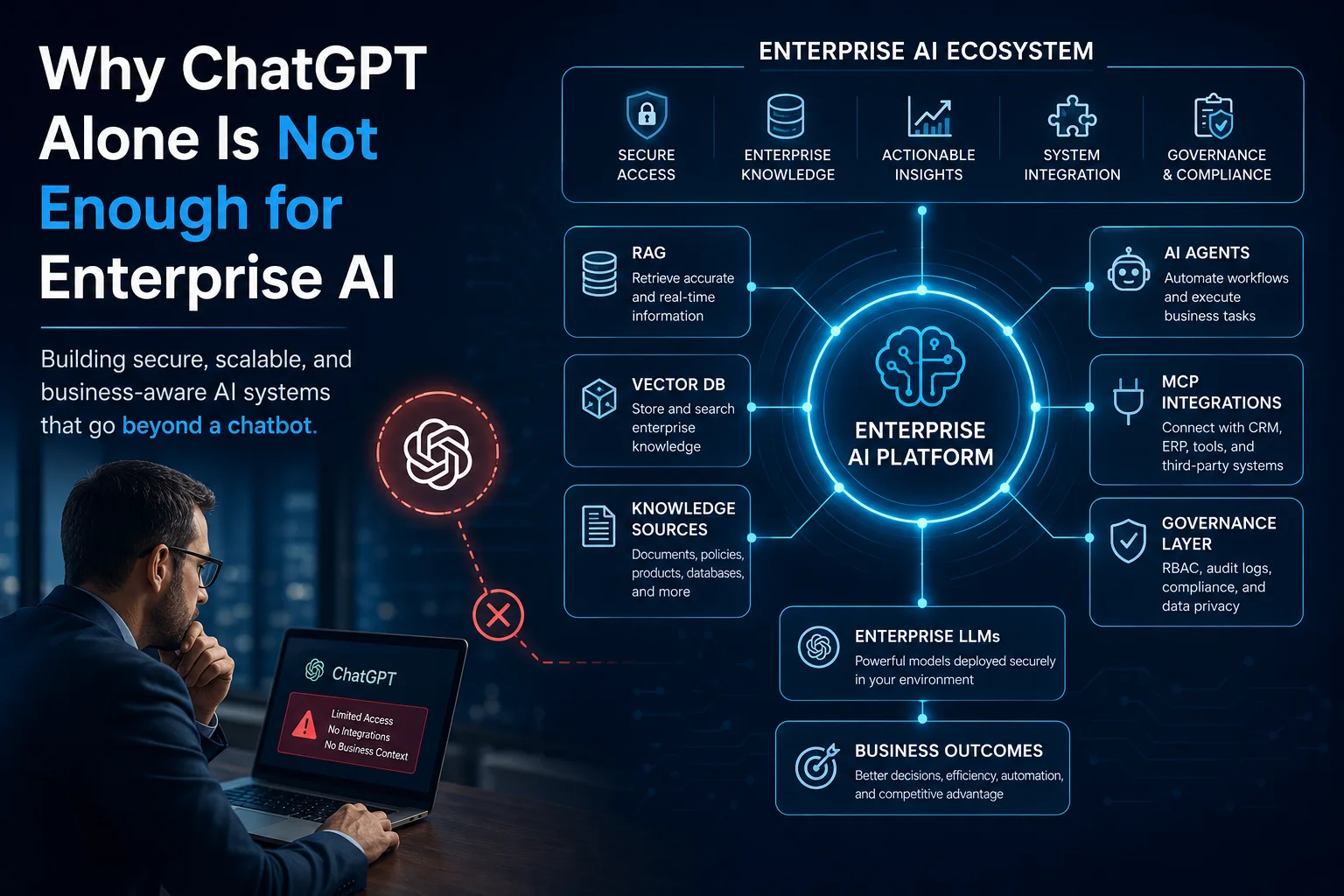
Through our experience designing enterprise AI systems and building bespoke AI agent infrastructure, we've seen a massive shift across the tech landscape. Organizations are transitioning away from the initial novelty of raw Large Language Models (LLMs) to a stark realization: static prompts and simple chat interfaces cannot drive true operational ROI. To unlock measurable business value, enterprises require resilient software engineering frameworks. These frameworks treat foundation models as one component of a larger system that includes memory, orchestration, security, and tool execution—the central processing unit of a deeply integrated, stateful ecosystem.
This architectural guide breaks down the core components, design patterns, and deployment strategies required to build production-grade, enterprise-ready intelligent agent orchestration platforms.
1. What is an AI Agent Architecture?
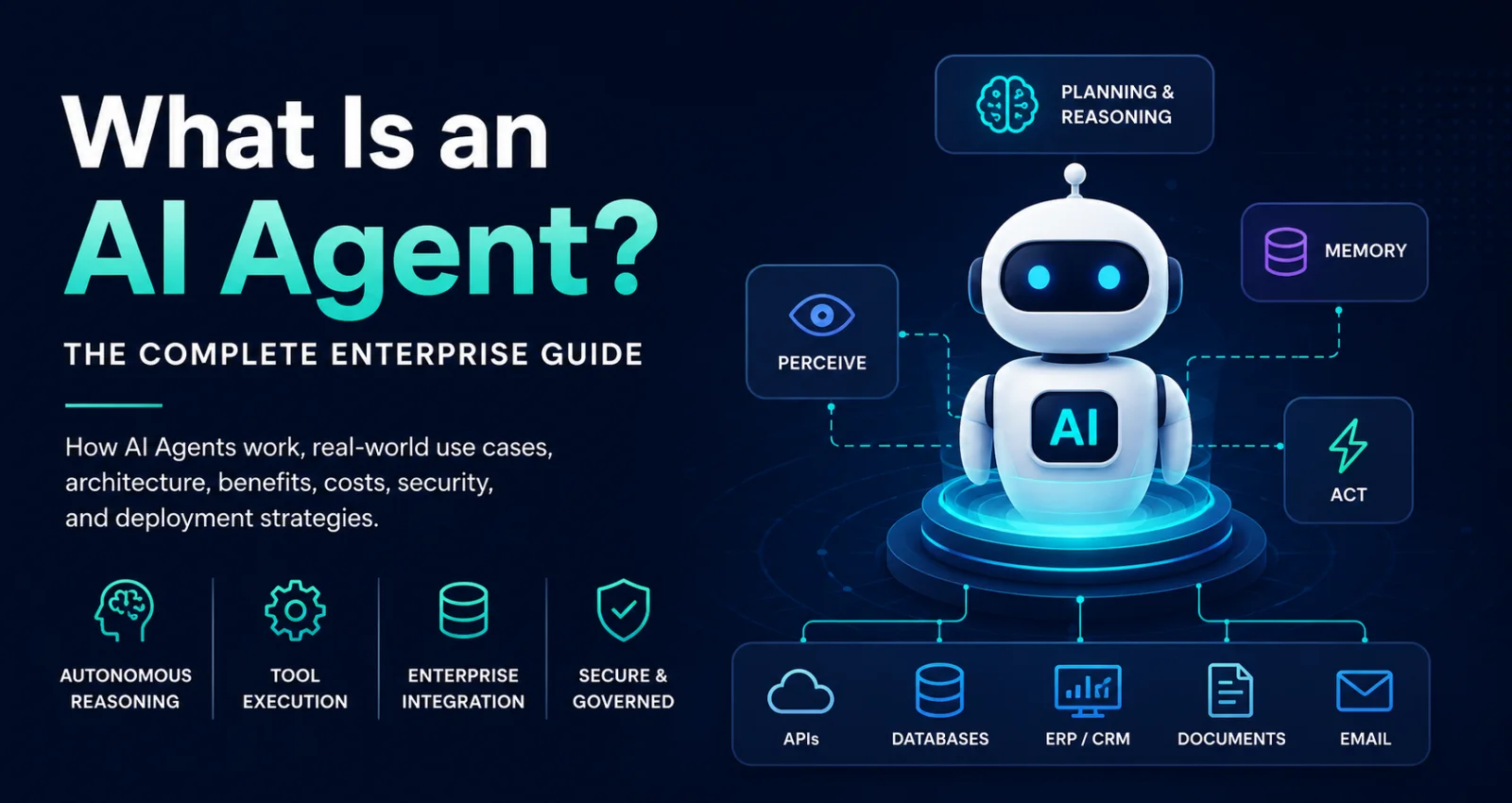
An AI Agent Architecture is a design framework that transforms a probabilistic LLM into a predictable, goal-oriented system. It gives the model the ability to continuously perceive its environment, create strategic plans, manage its own memory, and execute tools safely.
While standard LLM implementations operate on a strict, synchronous input-in, output-out basis, an agentic architecture establishes a closed-loop runtime environment. This structure wraps the model in layers of state management and operational guardrails, decoupling raw inference from systemic action.
AI Agent Architecture vs. Traditional AI Applications
To understand why this paradigm shift matters, it helps to contrast how an agentic architecture operates compared to traditional AI applications (such as simple chat interfaces or linear retrieval-augmented generation pipelines):
| Capability / Feature | Traditional AI Applications | AI Agent Architecture |
| Execution Flow | Single-turn, prompt-and-response. | Multi-step, iterative planning loops. |
| State & Memory | Stateless or basic linear chat history. | Persistent, episodic, and semantic memory matrix. |
| External Integrations | No tools or hard-coded API scripts. | Dynamic tool-calling and discovery. |
| Workflow Management | Static, predefined programmatic logic. | Autonomous workflow orchestration and optimization. |
| Behavioral Style | Reactive (responds only when prompted). | Adaptive (dynamically responds to environment changes). |
| Error Correction | Fails immediately on invalid model outputs. | Self-reflection and automated execution retry loops. |
2. Why AI Agent Architecture Matters
Building a reliable AI agent platform takes more effort than wrapping an API around an LLM. The payoff, however, is significant. A well-designed architecture is easier to scale, easier to audit, and far more predictable in production.
Establishing a dedicated architecture yields critical enterprise-level benefits:
-
Fewer Hallucinations: By enforcing structural planning frameworks like ReAct or Self-Reflection, the system systematically cross-checks its logic before executing actions. This prevents runaway model errors.
-
Production-Grade Reliability: Wrapping unpredictable models inside deterministic software state machines ensures that agent behavior remains predictable, auditable, and compliant with corporate policy.
-
Seamless Horizontal Scaling: A modular layout allows teams to easily add new tools, hot-swap underlying LLM models, and spin up specialized sub-agents without rewriting core business workflows.
-
Optimized Infrastructure Costs: Smart orchestration layers and localized model routing minimize token bloat. This ensures that expensive frontier models are invoked only for highly complex reasoning tasks.
-
Hardened Security & Isolation: Centralizing tool access through secure data gateways and isolated execution sandboxes mitigates the risk of prompt injections leaking data or compromising critical systems.
3. Core Components of the Architecture
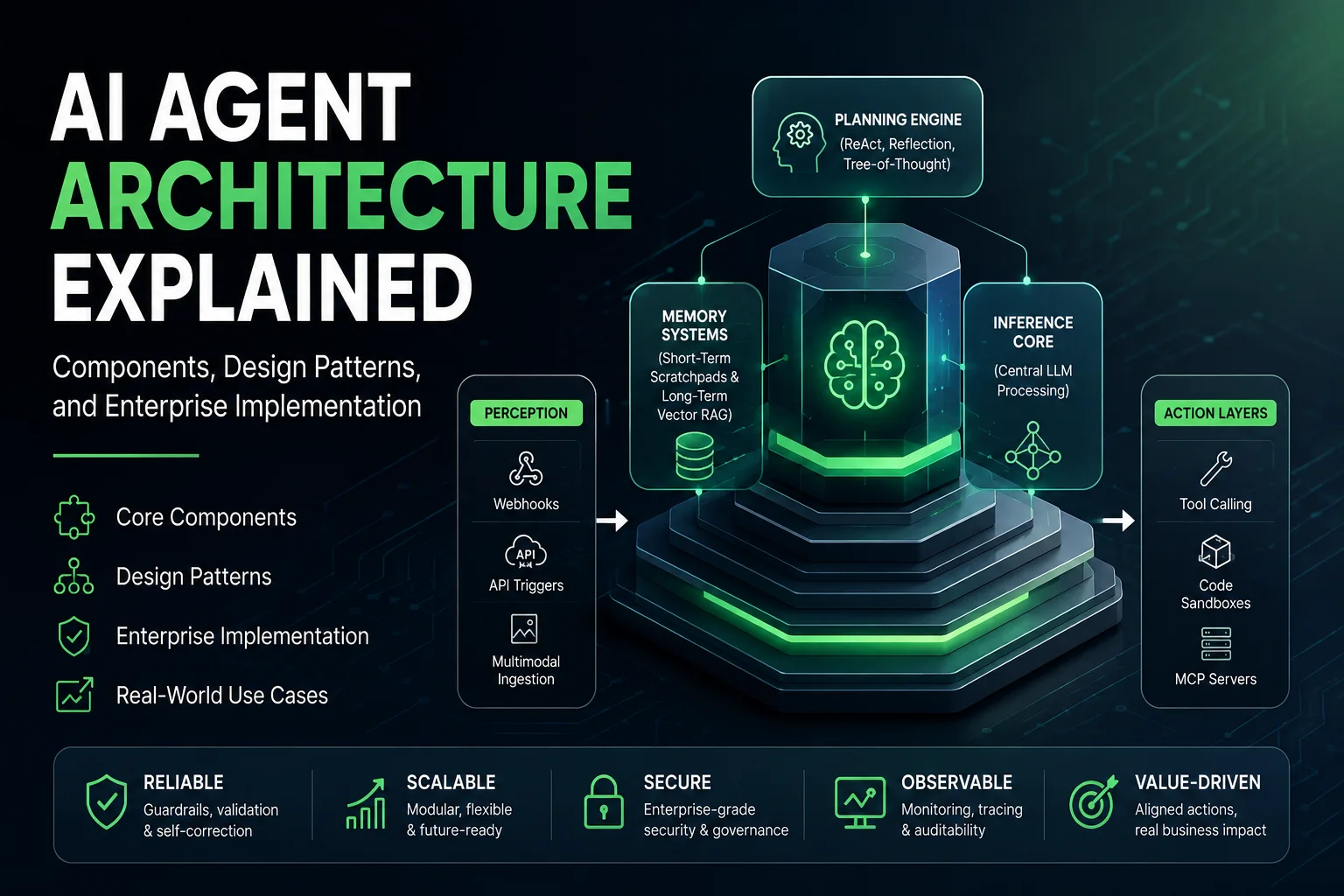
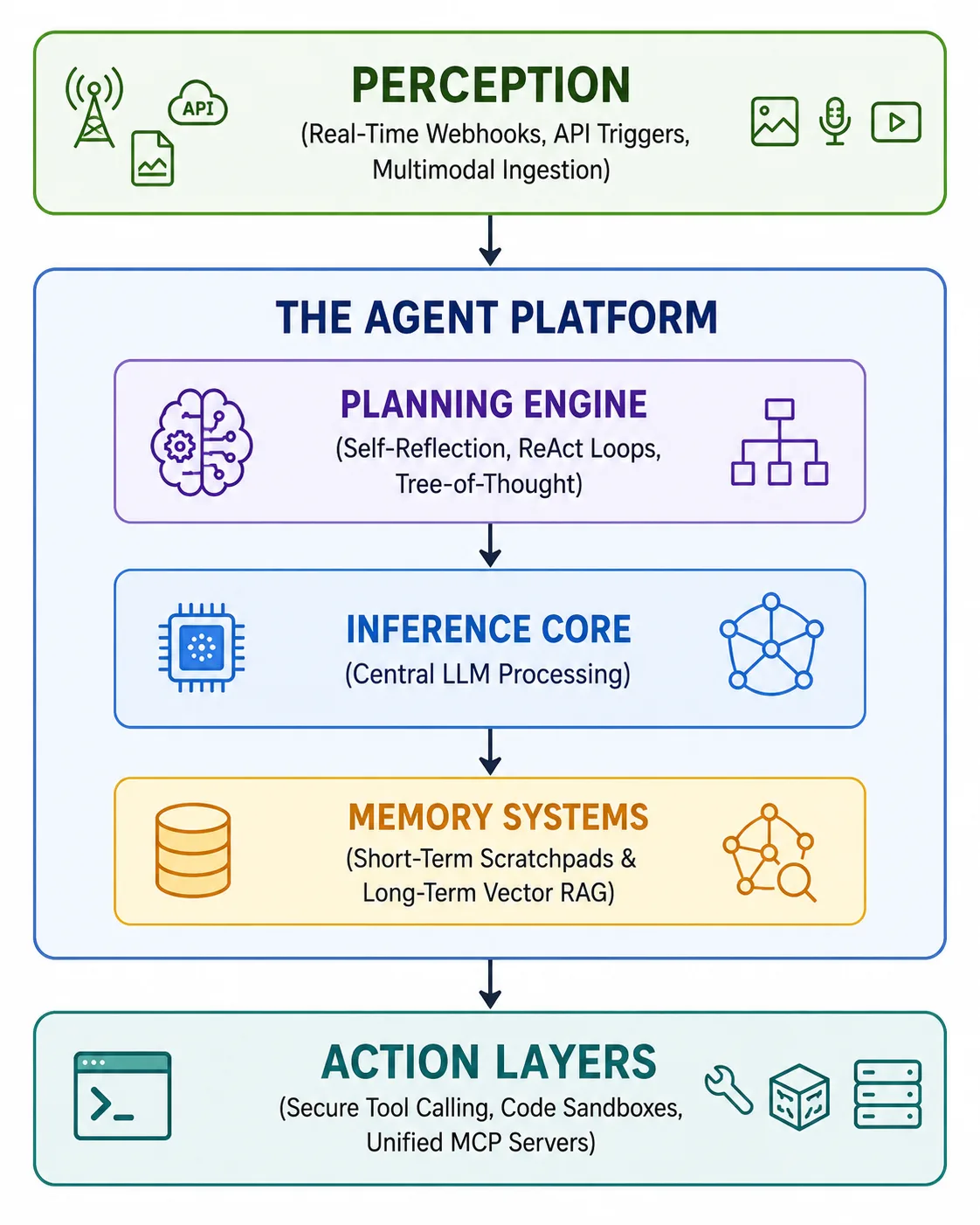
A production-grade AI agent workflow relies on the seamless orchestration of four foundational architectural pillars.
A. The Perception Layer (Input & Context Ingestion)
Perception is how an agent observes and processes its operating environment. In an enterprise setting, this extends far beyond a manual text input box:
-
Event-Driven Webhooks: Ingesting asynchronous data streams directly from systems of record (e.g., an updated lead status in Salesforce or a new issue logged in Jira).
-
Multimodal Decoders: Parsing structured and unstructured data simultaneously, such as architectural diagrams, scanned invoices (PDFs), or customer audio logs.
-
Protocol Adapters: Transforming data from distinct physical or software environments into clean tokens the core planning engine can comprehend.
B. The Planning & Reasoning Engine
The planning engine defines how the agent navigates toward its defined objective. Instead of generating a single response, the agent constructs structured execution graphs using several prominent cognitive design patterns:
-
Chain-of-Thought (CoT): Forcing the model to explicitly decompose a complex task into sequential, logical steps before formulating a final answer.
-
Tree-of-Thoughts (ToT): Allowing the agent to spawn multiple hypothetical reasoning branches, evaluate the probability of success for each path, and backtrack programmatically if an execution branch hits an error state.
-
Reasoning and Acting (ReAct): The operational standard for dynamic agent orchestration. The model continuously cycles through a structured loop: Thought (analyzing current progress), Action (invoking a specific tool), and Observation (evaluating the tool's runtime output).
C. The Multi-Tiered Memory System
To sustain multi-turn corporate workflows, an agent requires a highly structured, persistent memory matrix:
-
Short-Term Memory (Scratchpad): Captures the in-flight conversation history and tracking state of a single, active execution run. Typically implemented via sliding context windows or summary memory buffers.
-
Episodic Memory (Long-Term): Retains deep historical context regarding past interactions with specific users or clients over months. Built using vector databases (like Pinecone, Qdrant, or
pgvector) utilizing semantic search embeddings. -
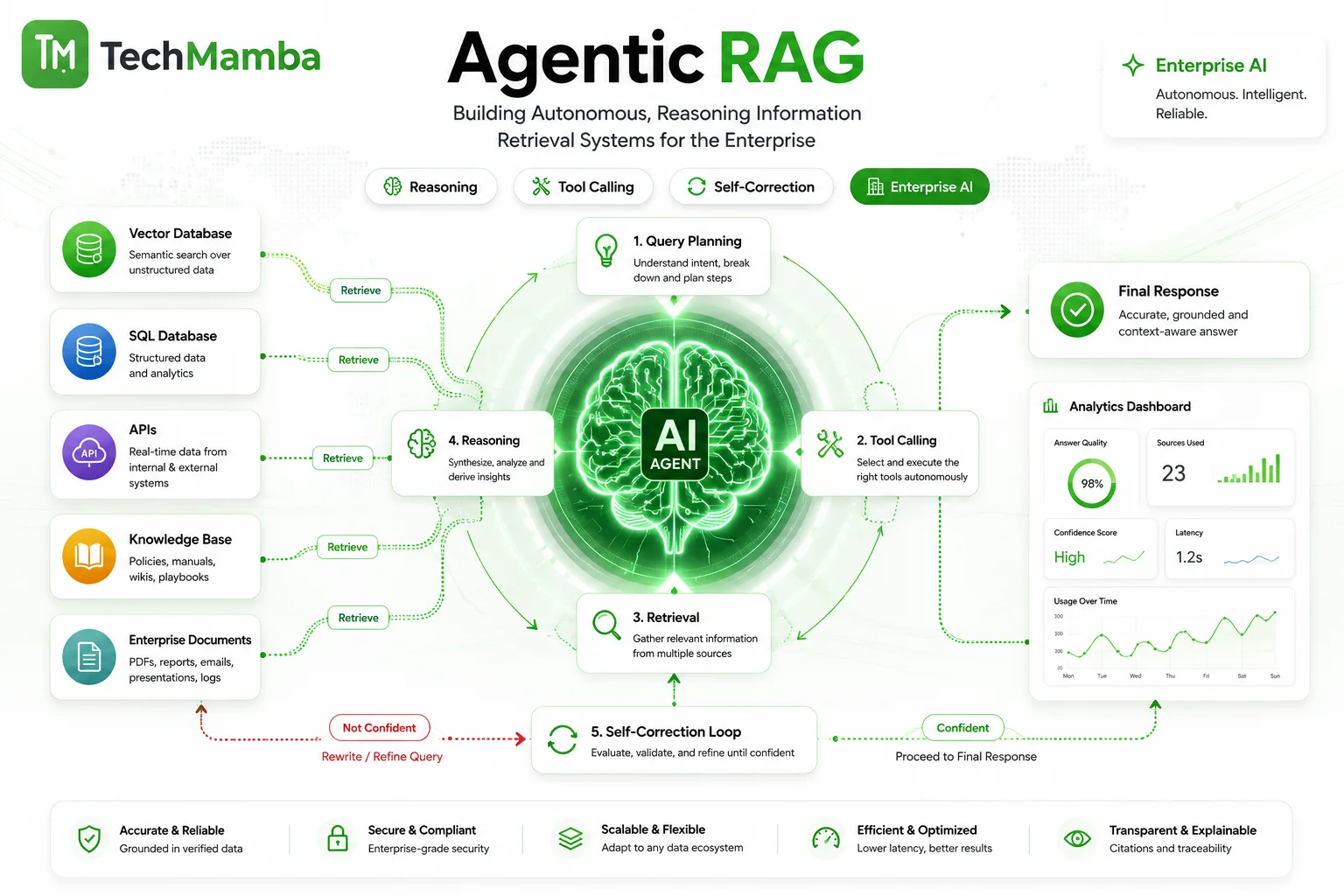
Semantic Memory (Knowledge Base): Houses foundational corporate knowledge, schemas, and compliance frameworks. This is typically managed via specialized Agentic RAG pipelines and Graph Databases (like Neo4j) to map complex, interconnected institutional structures.
D. The Action Layer (Tools & Integrations)
The action layer gives the agent agency over its digital environment. Tools are exposed to the agent as explicit JSON schemas containing descriptive metadata, which the model interprets to select the correct execution path:
-
Secure API Gateways: REST, gRPC, or GraphQL endpoints that allow the agent to safely read and write data to internal systems like ERPs, CRMs, or code repositories.
-
Isolated Code Sandboxes: Secure, ephemeral runtime environments (such as Docker containers or WebAssembly/WASM sandboxes) where the agent can dynamically write and run Python code to analyze data without risking native server integrity.
-
Model Context Protocol (MCP): An open standard that enables agents to automatically discover and safely consume data sources and developer tools over a unified protocol, eliminating brittle, custom integration glue code.
4. Advanced Agentic Design Patterns
When engineering complex enterprise systems, a single monolithic agent quickly succumbs to cognitive overload. To scale effectively, engineering teams deploy specific structural design patterns based on the operational use case.
Pattern 1: Reflection and Self-Correction
This pattern introduces an automated, closed-loop evaluation cycle before any output is routed to production environments or users.
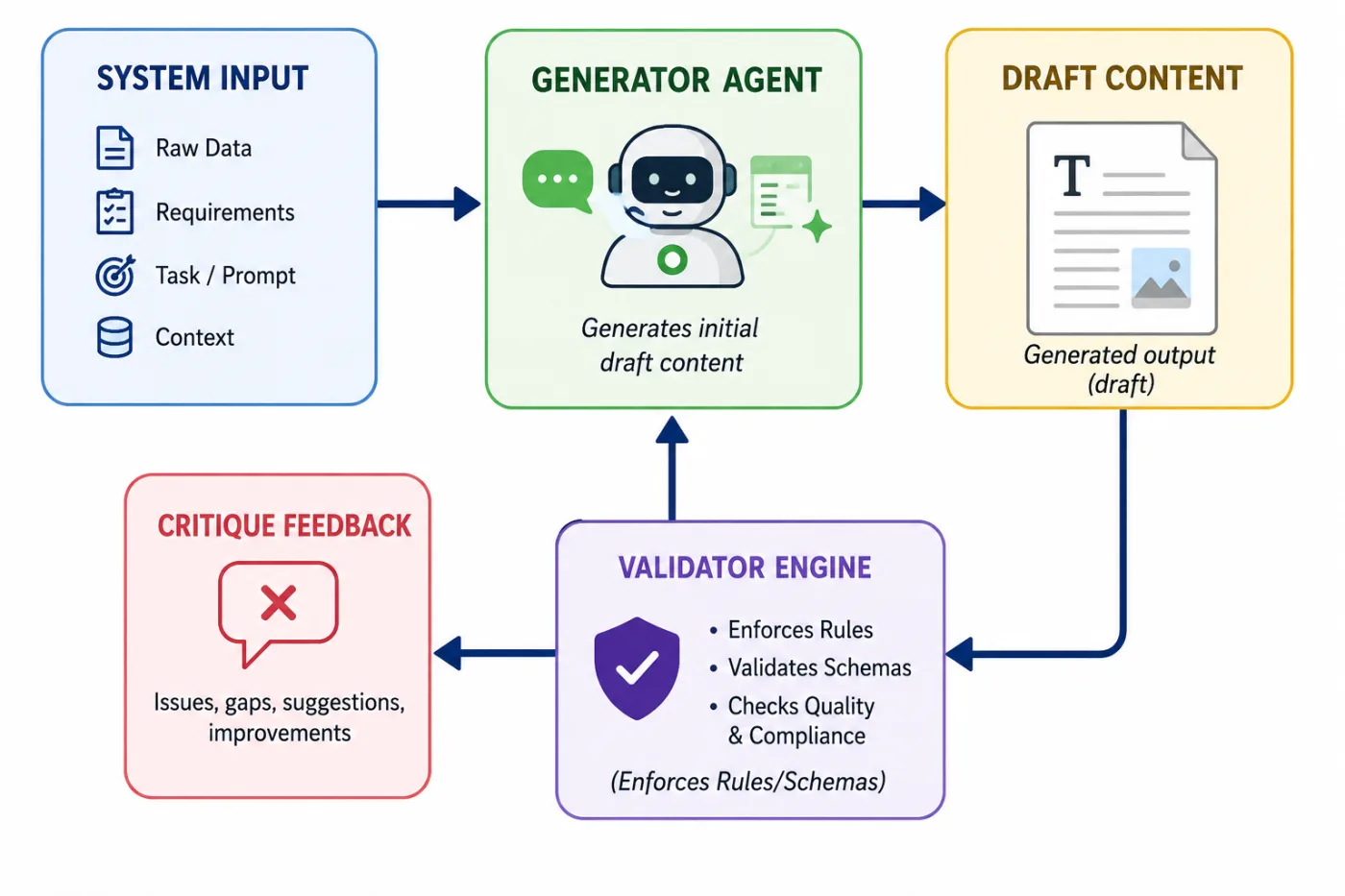
A Generator Agent produces an initial output (such as an automated software patch or a generated financial contract). A separate, highly specialized Validator Engine or Critic Agent independently audits the draft against concrete syntax schemas, policy rules, or compilation tests. If an issue is flagged, it compiles a detailed critique, passing it back to the generator for automated iterative correction.
Pattern 2: The Router Pattern
The router pattern positions a lightweight, highly optimized model or a semantic classifier at the main ingestion gateway. It acts as an intelligent traffic cop, inspecting incoming user intent and instantly offloading the query to a specialized sub-agent or a deterministic workflow. This prevents unnecessary token consumption on large frontier models for routine, simple requests.
Pattern 3: Multi-Agent Collaboration Architectures
For multifaceted enterprise workflows spanning multiple departments, tasks are split across an ecosystem of specialized agents.
Orchestrator-Workers
A centralized supervisor agent accepts the high-level objective, dynamically decomposes it into discrete sub-tasks, assigns those tasks to specialized worker agents (e.g., a data analyst agent and a technical writer agent), and synthesizes their modular outputs into a single, cohesive deliverable.
Supervisor-Choreography (Peer-to-Peer Event Mesh)
Agents interact asynchronously by publishing state updates to a centralized event bus (such as Apache Kafka). Specialized agents independently subscribe to specific event types, execute their isolated tasks, and push the updated state back to the mesh, making it perfect for distributed supply chain or fraud detection systems.
5. End-to-End Enterprise Architecture Blueprint
When moving from a localized developer sandbox to a live enterprise production environment, your architecture must be fortified to satisfy strict enterprise infrastructure, security, and IT governance standards.
The architectural blueprint below illustrates how user requests, orchestration frameworks, memory vectors, and internal systems safely interact in a production-grade enterprise deployment:
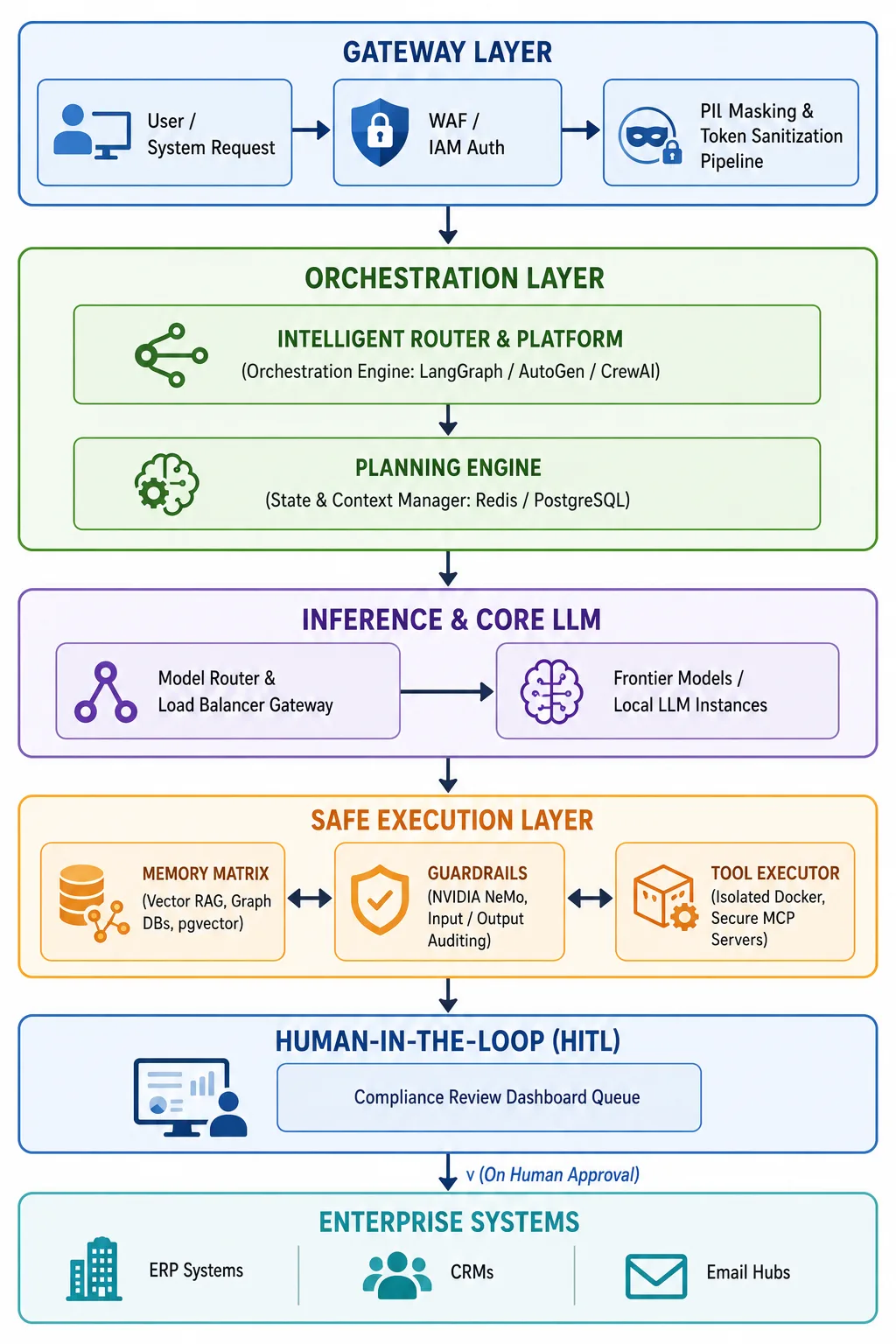
The Reference Enterprise Infrastructure Stack
To construct this blueprint, engineering teams look to a proven technology stack:
-
Orchestration Engine: LangGraph (for complex, cyclic state-machine graphs), Microsoft AutoGen (for conversational multi-agent multi-turn logic), or CrewAI (for pragmatic, role-based worker squads).
-
State & Memory Management: Redis for low latency transient session caching; PostgreSQL (with
pgvector) or Neo4j for persistent episodic memories and organizational semantic data mapping. -
Inference Gateways: Platforms like LiteLLM or Anyscale to handle unified API routing, model redundancy, automated failover management, and granular token-usage tracking across diverse LLM vendors.
-
Operational Guardrails: Systems like NVIDIA NeMo Guardrails or Llama Guard executing inline validation on both raw incoming user intents and outgoing tool response vectors.
6. Common Mistakes When Building AI Agent Architectures
Deploying an agentic platform is fundamentally different from traditional software engineering. Avoid these common architectural pitfalls when moving to production:
-
Treating the LLM as the Entire Application: The foundation model is simply the reasoning engine. Relying on it to handle state, enforce data formatting, or manage complex step progression without a supporting software architecture guarantees system failure.
-
Giving Agents Unrestricted Tool Access: Never expose raw write access to internal systems without strict containment. An agent given an unparameterized SQL database tool can easily overwrite critical production tables during a prompt loop error.
-
Ignoring State Management: If you build an agent on standard stateless API architectures, it cannot handle long-running, asynchronous operations. Agents must be managed via rigid state-machine backends that can pause, save progress, and resume securely.
-
Skipping Observability Infrastructure: Standard application logging is completely blind to agent reasoning loops. Without specialized tracing tools (like LangSmith or Arize) to monitor exact trajectory steps, token usage, and tool output results, debugging becomes nearly impossible.
-
Deploying Without Human Approval: Attempting fully autonomous execution for sensitive workflows (like customer communication or financial transactions) introduces severe risk. Always integrate a structured human review checkpoint before an action alters an external environment.
7. Enterprise Case Study: Automated Commercial Client Onboarding
(Note: The following scenario represents a scaled implementation designed to illustrate these architectural concepts in practice.)
The Challenge
A tier-1 global financial institution struggled with massive operational backlogs within its commercial banking onboarding and Know Your Customer (KYC) divisions. The process required human risk officers to manually extract entity structures from unstructured international corporate registries, cross-reference organizational charts against shifting global sanctions watchlists, verify internal policy compliance, and compile comprehensive audit logs. The manual lifecycle averaged 14 business days per client, severely restricting institutional growth.
Architectural Solution
We engineered an enterprise AI systems architecture featuring an asynchronous, multi-agent mesh built on top of LangGraph, deployed entirely within the institution's private cloud network.
The workflow operates as follows:
-
Ingestion Agent: Activated by an upstream onboarding trigger webhook, this agent utilizes a multimodal foundation model to parse complex corporate deeds, utility statements, and certificates of incumbency, outputting a strictly typed JSON schema payload.
-
Screening Agent: Pulls the verified corporate names from the JSON payload and queries international sanctions lists and regulatory watchlists via a highly secured Model Context Protocol (MCP) server linked directly to verified compliance databases.
-
Audit & Verification Agent: Operates as an internal critic. It ingests the findings of both prior agents and automatically checks them against historical underwriting databases to catch formatting anomalies or hidden compliance contradictions.
-
Supervisor Agent: Harmonizes the parallel outputs, generates a standardized, structured Compliance Dossier, and assigns an automated data-driven risk categorization score (Low, Medium, High).
The Human-in-the-Loop Safeguard
To guarantee absolute regulatory alignment, the architecture strictly forbids the agents from directly executing account activation or rejection actions. Instead, the final Compliance Dossier is routed to an internal review dashboard. Human compliance officers are presented with a completely populated checklist embedded with deep hyperlinked citations mapping directly to the exact source paragraphs within the submitted client documents.
Business Metrics & Outcomes
-
Drastic Processing Speedup: The end-to-end client vetting lifecycle collapsed from 14 business days to less than 45 minutes.
-
Uncompromising Accuracy: The rigorous multi-agent validation loop identified minor corporate structural inconsistencies that human auditing panels had overlooked in historical baseline control tests.
-
Operational Optimization: Empowered high-value compliance personnel to shift away from manual document gathering to focus entirely on advanced exception analysis and strategic risk oversight.
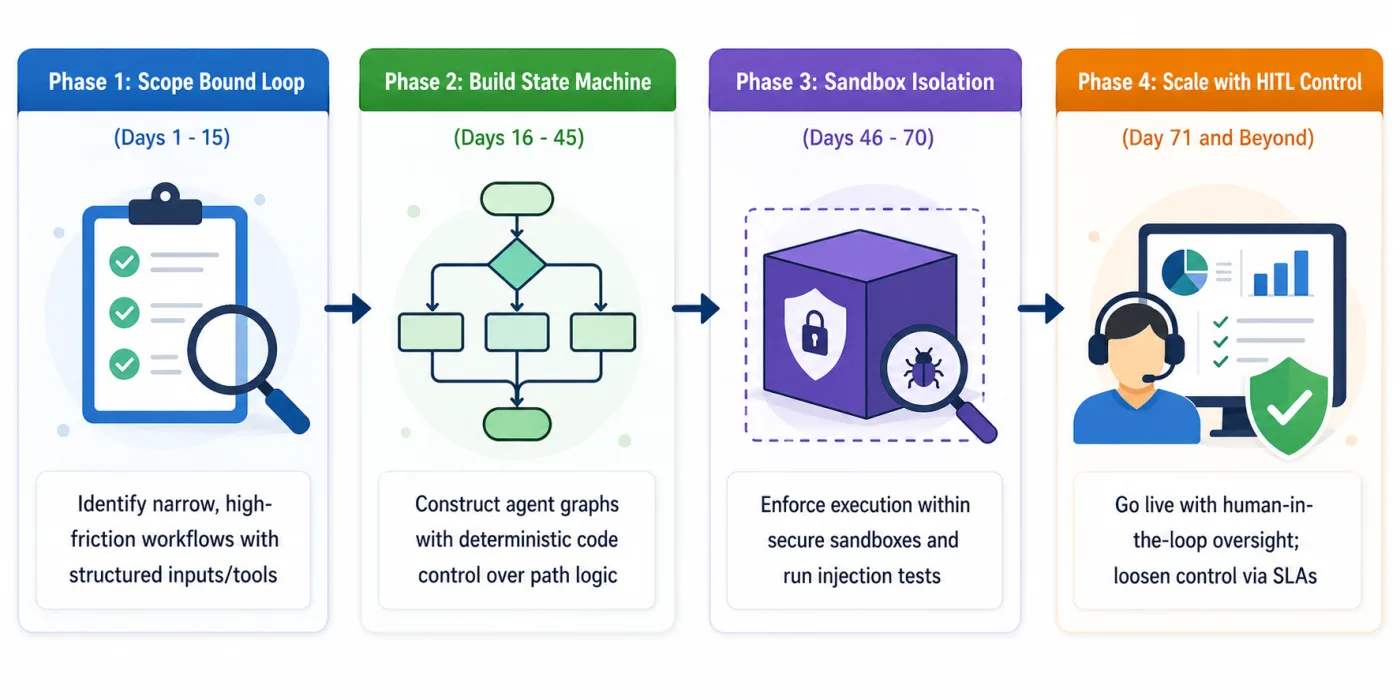
8. Strategic Implementation Roadmap
Based on our extensive experience building enterprise AI solutions, we advise technology executives to deploy intelligent agent orchestration systems through a tightly controlled, phased implementation lifecycle
9. Conclusion
AI agent architecture isn't about choosing a single framework or chasing the latest foundational model. It's about combining reasoning, memory, orchestration, security, and governance into a reliable system that can operate safely in production. Organizations that invest the engineering effort into building this structural foundation today will be far better positioned to scale their automated systems and realize genuine operational ROI tomorrow.