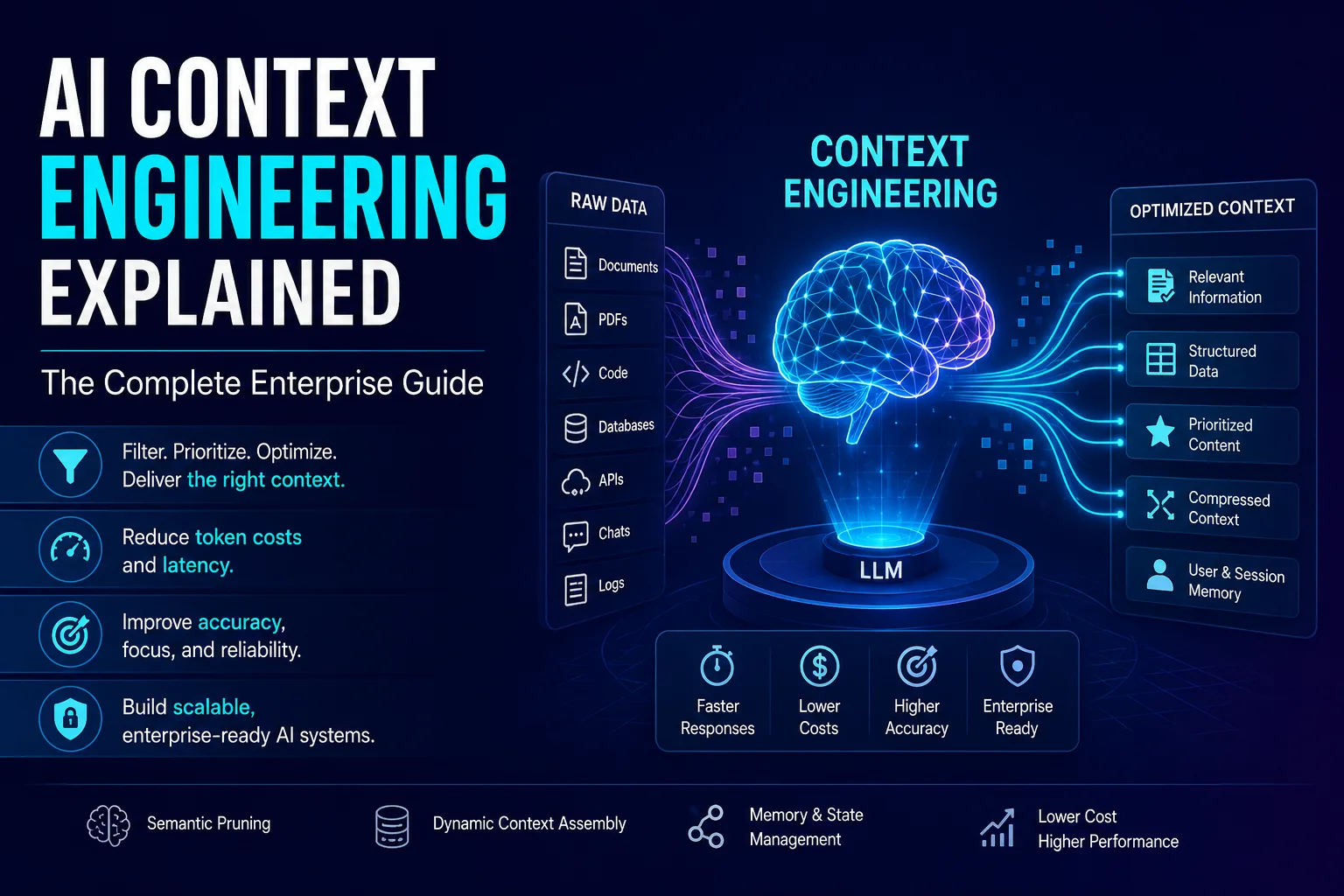
The artificial intelligence industry is currently waking up to a painful systems engineering reality: stateless large language models (LLMs) make terrible autonomous operators.
When you deploy an AI agent to execute complex, multi-step enterprise workflows—such as automating supply chain logistics, reconciling financial ledgers, or conducting clinical triage—the agent cannot operate like a simple search bar. It cannot treat every user interaction as a completely fresh, isolated event.
Without a sophisticated, multi-tiered memory architecture, an agent is functionally suffering from severe anterograde amnesia. It will forget what it did three steps ago, fail to learn from past execution errors, repeat identical reasoning mistakes, and rapidly exceed its token budget by stuffing unorganized historical raw logs into its context window.
To build autonomous agents that are truly production-ready, enterprise software engineers must transition from basic prompt-chaining to Stateful Cognitive Memory Architectures. This guide covers the software engineering mechanics of constructing, routing, pruning, and scaling short-term, long-term, and semantic memory layers within private enterprise networks.
What Is AI Agent Memory?
AI agent memory is the programmatic framework that allows an autonomous software agent to store, recall, and synthesize information across multiple execution steps and user sessions. It is structured into three distinct layers: Short-Term Memory (active conversation state and context window buffers), Long-Term Episodic Memory (vectorized records of past personal experiences and user interactions), and Semantic Memory (structured, immutable corporate knowledge, facts, and business rules hosted in databases or graphs).
Stateless Prompting vs. Stateful Agent Memory
To design performant systems, architects must understand how stateful cognitive memory differs from traditional stateless LLM prompting:
|
Operational Dimension |
Stateless Prompting (Legacy LLM) |
Stateful Cognitive Agent Memory |
|---|---|---|
|
State Retention |
Zero. Every API call is independent. |
Continuous. State persists across execution runs. |
|
Context Management |
Manual. Developer appends raw text history. |
Algorithmic. System routes, prunes, and prioritizes data. |
|
Error Correction |
None. Repeat queries yield identical logical paths. |
Reflective. Agent recalls past execution failures. |
|
Data Ingestion |
Static. Limited to initial prompt payload. |
Dynamic. Updates databases during active operation. |
|
Token Cost Scaling |
Linear and high. Prompt grows with every turn. |
Flat and optimized. Ephemeral context is continuously compressed. |
The Cognitive Triad: The Three Layers of Agent Memory
A production-grade AI agent does not rely on a single database. Instead, it coordinates three highly specialized storage and retrieval systems to mimic human cognitive processes.
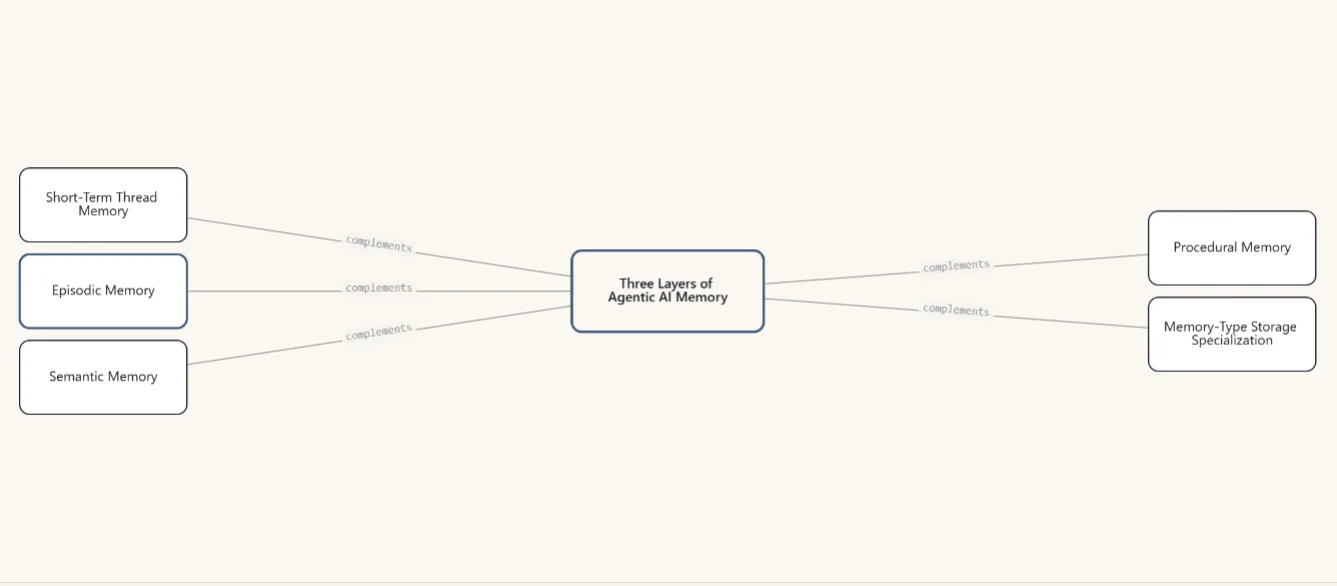
Figure 1. The Cognitive Memory Triad. Modern enterprise agents coordinate short-term, long-term, and semantic memory layers to achieve high reasoning accuracy while protecting token overhead.
1. Short-Term Memory: The Active Working Memory
Short-term memory corresponds directly to the model's active working memory inside its context window. It stores the immediate variables, formatting instructions, and the conversational history of the current transaction.
-
The Engineering Challenge: If you blindly append every message to the context, the sequence length eventually degrades model reasoning due to attention dilution, while exponentially inflating processing costs.
-
The Solution: Implement sliding-window buffers, conversation summary nodes, or semantic compression. When the active conversation thread exceeds a predefined token threshold, a background thread summarizes the earlier blocks, appending only the compressed high-density summary to the active buffer.
2. Long-Term Episodic Memory: The Experience Ledger
Long-term episodic memory acts as the agent's autobiography. It records past execution paths, intermediate calculations, user preferences, and historical execution failures.
-
How It Works: Every time an agent executes a workflow, the system vectorizes the execution trace (the input, reasoning steps, tool calls, and final output) and stores it inside a high-performance vector database.
-
Why It Matters: When the agent is tasked with a new query, it runs a similarity search over its own historical execution traces. For example, if a procurement agent previously experienced an API timeout while contacting a vendor, it can recall that episodic failure and proactively route the transaction through a backup gateway.
3. Semantic Memory: The Grounded Corporate Knowledge
Semantic memory is the agent’s static, structured understanding of the world. It contains immutable facts, business logic rules, standard operating procedures, and product taxonomies.
-
How It Works: Rather than relying on unstructured text chunks, semantic memory is hosted inside relational databases, relational vector tables, or Knowledge Graphs (such as Neo4j).
-
Why It Matters: Knowledge graphs map actual relationships between entities (e.g.,
Product A[IS_COMPATIBLE_WITH]Product B). This structure allows the agent to navigate complex relational logic with absolute deterministic accuracy, bypassing the fuzzy similarity limitations of pure vector searches.
Enterprise Memory in Practice
Structuring agent memory requires translating abstract architectural layers into active software boundaries configured for specific industry verticals:
-
Healthcare Patient Care Coordination: Clinical assistants must manage highly sensitive patient histories. The short-term memory holds active diagnostic readings, the episodic memory tracks patient appointment behaviors over years, and the semantic memory holds static medical ontologies (ICD-10 classifications). Security rules ensure raw episodic files are scrubbed of HIPAA identifiers before vectorization, matching the strict compliance baselines of our blueprint on Enterprise AI Security in 2026: Protecting LLMs, Data, and Business Workflows.
-
Financial Portfolio Audit Automation: Financial analysis agents read thousands of transactions. Relational vector caches store quarterly balance sheets (semantic), while episodic memories store previous auditing adjustments. Decoupling these processes is vital to keep execution latencies low, as explored in our strategic analysis on AI Governance Explained: Building Responsible Enterprise AI Systems in 2026.
-
E-Commerce Conversational Commerce: Digital stylists recommend outfits based on customer preferences. Short-term memory holds the current search term, episodic memory tracks the user's stylistic purchases across previous winters, and semantic memory maps the live product inventory. Learn how these personalized workflows systematically eliminate cart exit rates in our expert guide: eCommerce Semantic Search: Architecting Vector and Hybrid Search Systems for Scale.
-
Small Business Operations Management: Local marketing firms deploy agents to automate email responses. The memory layer stores the brand's voice guidelines, preventing agents from drifting outside standard communication boundaries. See how automated operations help smaller teams expand their margins in Why Small Businesses Are Switching to AI Automation in 2026.
Designing a Production-Grade Memory Routing Architecture
To run a reliable, sub-second autonomous agent, you cannot query every memory database simultaneously. You must design a deterministic routing gateway that manages memory access dynamically based on the current state of execution.
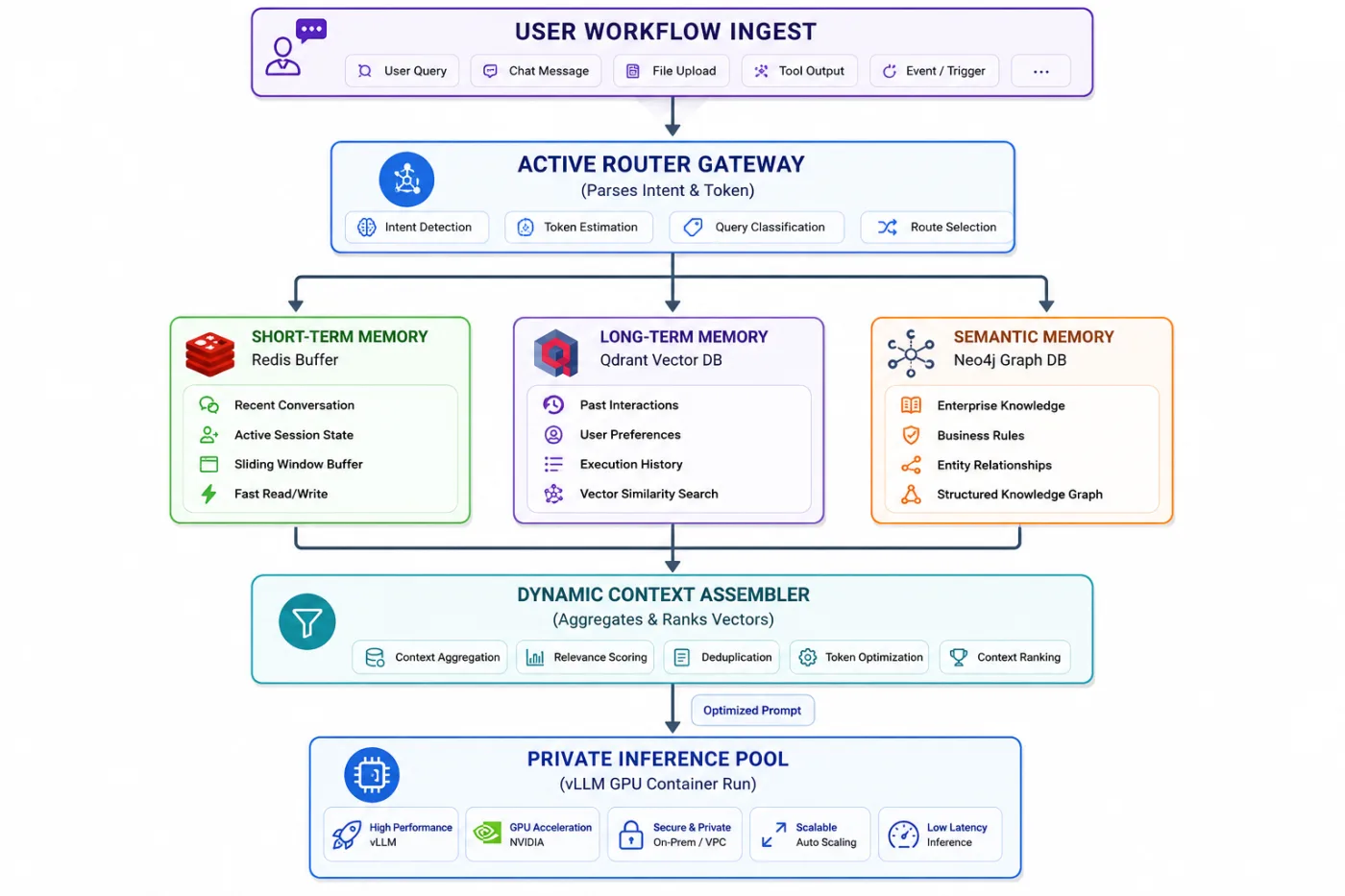
Figure 2. Stateful Agent Memory Request Routing Flow. The active router gateway dynamically intercepts inbound transactions, query matching databases in parallel, and structures the prompt payload prior to execution.
By separating the memory layers, your system can fetch data asynchronously. Short-term values are read in sub-millisecond ranges from in-memory stores, while long-term and semantic layers are fetched in parallel and ranked using lightweight reranking models before compiling the final inference payload.
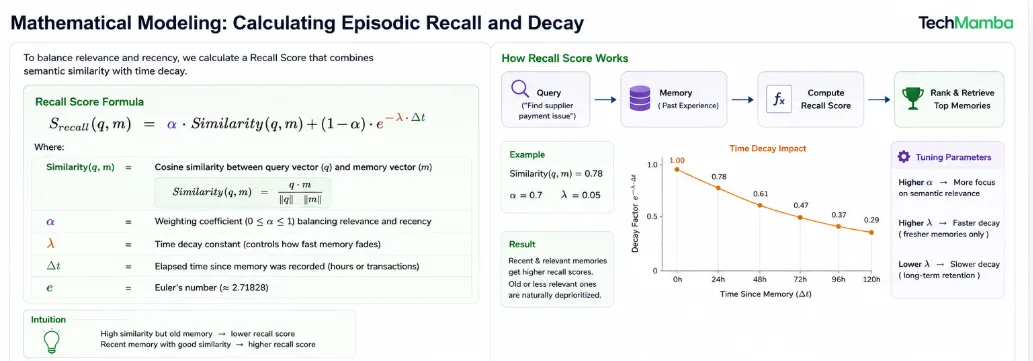
By tuning dynamically based on workflow configurations (for instance, higher decay rates for volatile inventory tracing, lower decay rates for stable customer histories), you ensure the model's context window is populated exclusively with highly relevant, fresh data. This level of optimization is critical to managing scaling resource expenses, as documented in our analysis of AI Agent Development Cost in 2026: The Definitive Business Budgeting Guide.
Technical Comparison: Cognitive Storage Options
Building a scalable private memory gateway requires integrating the correct database engine for each unique memory layer:
|
Storage Parameter |
Short-Term Memory |
Long-Term Episodic Memory |
Semantic Memory |
|---|---|---|---|
|
Primary Tooling |
Redis / In-Memory State |
Qdrant / Pinecone / Milvus |
Neo4j / PostgreSQL |
|
Data Structure |
Key-Value / JSON Strings |
High-Dimensional Vectors |
Graph Nodes & Relational tables |
|
Typical Latency |
Sub-3 milliseconds |
15–40 milliseconds |
10–30 milliseconds |
|
Pruning Protocol |
TTL (Time-To-Live) expiry |
Contextual clustering & cleanup |
Manual DB schema migrations |
|
Ideal Use Case |
Multi-turn chat session variables. |
User behavior histories over years. |
Complex corporate rules and APIs. |
Tooling and Implementation Best Practices
To deploy a highly performant, production-grade memory framework, your software divisions should enforce these three technical guidelines:
1. Leverage LangGraph for State Management
Avoid using unstructured Python loops to build your agents. Standardize your development pipelines using structured framework engines like LangGraph. LangGraph enforces state persistence natively, allowing you to define complex, cyclic routing paths where agent state variables are preserved automatically across sequential execution turns.
2. Implement Semantic Memory Compression (LLMLingua)
Do not pass raw conversational history directly to your model's context. Integrate specialized prompt compression libraries (such as LLMLingua) at your gateway. By evaluating token entropy and removing redundant conversational fillers, you can compress short-term context payloads by up to 80% while retaining 98% of reasoning accuracy, cutting monthly API costs dramatically. Learn how to configure these gateways in our comprehensive architectural guide: AI Context Engineering Explained: The Complete Enterprise Guide.
3. Enforce Strict Model Context Protocol (MCP) Boundaries
When connecting your agent's memory layers to external corporate systems, utilize standard communication protocols like the Model Context Protocol (MCP). MCP ensures your tools operate inside validated schemas, preventing agents from executing malicious or unformatted commands that could corrupt your database tables.
The Ultimate Convergence: Security, Observability, and Memory
Deploying stateful memory inside an enterprise network introduces unique security, governance, and tracing requirements:

Without deep visibility tracing, your security division will remain blind to memory corruption vulnerabilities. Connecting automated memory engines with comprehensive AI Observability Explained: Monitoring LLMs and Multi-Agent Systems in Production systems creates an auditable, highly secure perimeter around your company's intellectual assets, protecting your operating margins while eliminating operational risk.
Expert Opinion: What Most Developers Get Wrong
A common mistake we see technical teams make is trying to solve memory limitations by simply upgrading to a larger model with a bigger context window.
This is an expensive mistake. Relying on massive context windows to hold raw, unmanaged database logs degrades reasoning accuracy due to attention dilution and results in an extremely high "context tax" on every single transaction.
The future of autonomous AI belongs to organizations that treat context space as a premium, high-density computing memory buffer. By building structured, multi-tiered cognitive memory pipelines, you convert raw generative models into precise, highly efficient operational systems that scale without breaking your cloud infrastructure budget.
Scale Your Custom Cognitive Architecture with TechMamba
Designing, hosting, and optimizing a highly secure, private cognitive memory gateway requires deep software engineering expertise, reliable database configurations, and proven machine learning experience. At TechMamba, we specialize in building highly secure private assistant networks, performant RAG Architecture setups, and automated multi-agent environments designed to protect your operational margins and scale your enterprise efficiency.
If your team is evaluating custom cognitive software development versus off-the-shelf software subscriptions, calculate how custom engineering parameters directly scale your long-term margins. Read our analysis in Custom Software Development vs SaaS: When Businesses Should Build Instead of Buy.