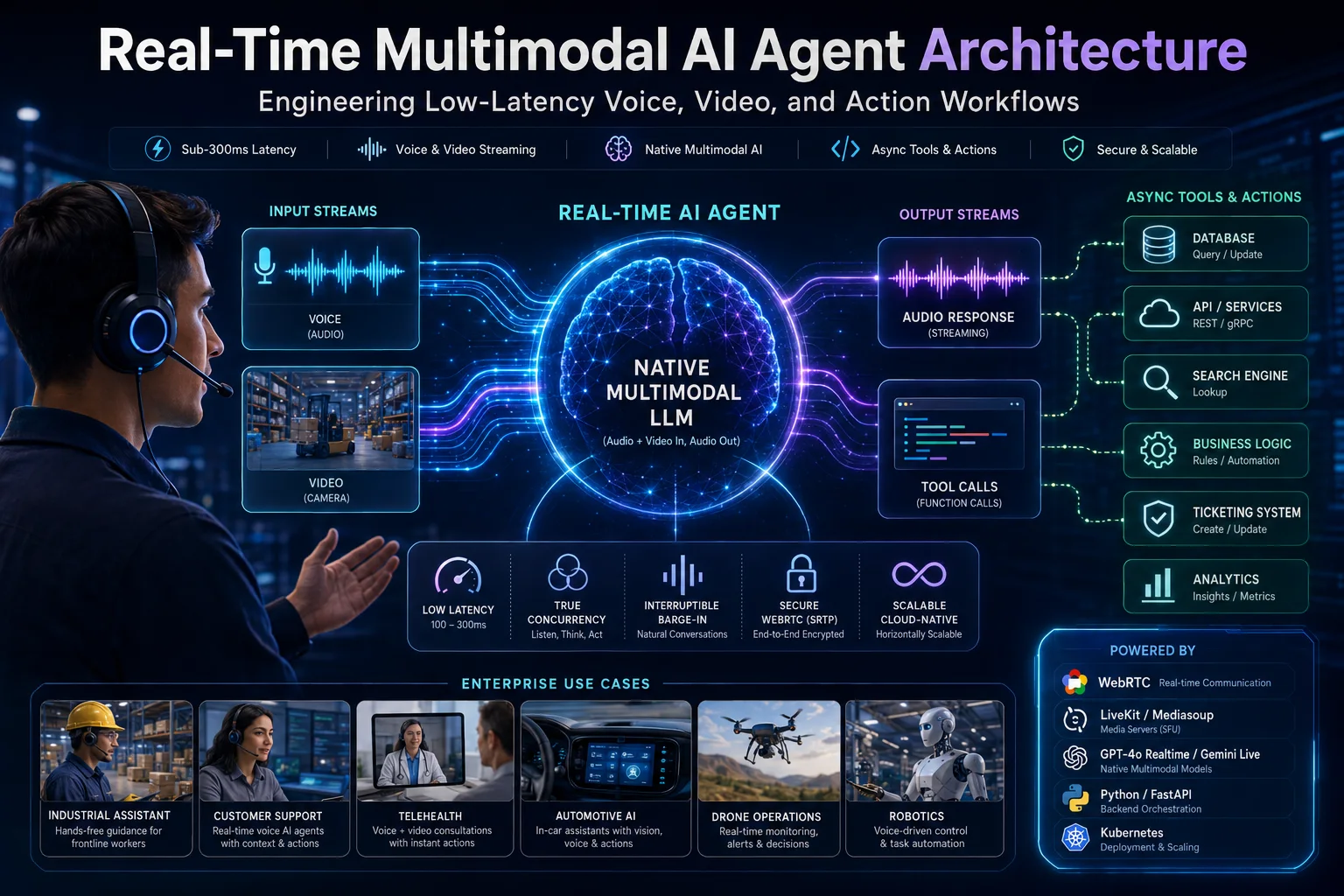
The standard enterprise chatbot architecture—a stateless, sequential pipeline of Automatic Speech Recognition (ASR), Text-to-Text Large Language Models (LLMs), and Text-to-Speech (TTS) synthesizers—is functionally obsolete for real-time applications. When a user speaks to a voice agent built on this legacy stack, they experience a jarring 1.5 to 3-second delay. In human conversation, a 500-millisecond pause signals hesitation; a 2-second pause signals a broken connection.
Consider a modern enterprise scenario: A global logistics company deploying AI agents to assist forklift operators in a noisy warehouse. The operator wears a headset and asks, "Where do I route pallet 4A?" If the system uses a standard HTTP/WebSocket text pipeline, the audio is recorded, buffered, sent to an ASR service, converted to text, routed to an LLM, processed, returned as text, synthesized to audio, and finally played back. By the time the operator hears "Aisle 12," they have already driven past it.
Conversely, the next-generation approach utilizes a Real-Time Multimodal Agent Architecture. Here, a native multimodal Small Language Model (SLM) or LLM ingests the audio stream directly via Web Real-Time Communication (WebRTC) and streams audio back instantly, achieving end-to-end latency as low as 100–300 milliseconds. The agent can process visual data concurrently, interrupt itself when the user speaks over it (barge-in), and execute background tools asynchronously without blocking the conversational flow.
This paradigm shift from "Request-Response" to "Continuous Bidirectional Streaming" is redefining human-computer interaction. However, achieving production-grade stability with WebRTC, native multimodal models, and asynchronous event loops requires a complete reimagining of backend infrastructure. This article will teach you how to architect, engineer, and deploy real-time multimodal AI systems capable of handling voice, video, and tool execution with sub-second latency.
CORE PARADIGM 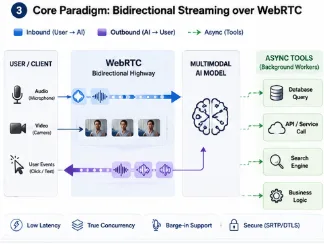
"What is the fundamental concept?"
The fundamental paradigm of Real-Time Multimodal AI Architecture is Bidirectional Streaming over WebRTC combined with Native Multimodal Inference.
Historically, AI systems treated different modalities (text, audio, image) as separate domains requiring independent translation steps. The core architectural idea of this new paradigm is the elimination of intermediate translation layers. Audio and video are no longer converted to text before reasoning; instead, continuous streams of raw audio/video blobs are transmitted securely over WebRTC and fed directly into the neural network (such as Gemini 2.0 Flash Live, GPT-4o Realtime, or Amazon Nova Sonic). The model simultaneously outputs an audio stream and functional tool calls.
From an engineering perspective, this shifts the architecture from a synchronous, stateless HTTP request lifecycle to a stateful, asynchronous event-driven loop where input, output, and background compute happen concurrently.
Visual Description
Imagine a high-speed, dual-lane highway (WebRTC). On the inbound lane, tiny packets of audio and video frames are continuously flowing into a central processing hub (the Multimodal Model). Simultaneously, on the outbound lane, audio packets and JSON tool commands are flowing back to the user. Alongside the highway, specialized worker drones (Asynchronous Tools) are flying in and out of the hub, delivering database queries without ever stopping the traffic on the main highway.
Core Characteristics
-
Native Modality: The model processes waveforms and pixel data directly, preserving prosody, tone, and environmental context that transcription destroys.
-
True Concurrency: The agent can listen, speak, and execute database queries simultaneously.
-
Natural Interruptibility (Barge-in): If the user speaks while the agent is generating audio, the system instantly halts playback and clears the generation queue, mimicking human conversation.
-
Protocol Supremacy: Utilizes WebRTC instead of HTTP or WebSockets, guaranteeing low latency via UDP, adaptive bitrate streaming, and built-in echo cancellation.
Analogy
The traditional sequential AI pipeline is like communicating via mail. You write a letter (audio), the post office translates it (ASR), the recipient reads it and writes a reply (LLM), and another post office translates it back (TTS). It is precise but painfully slow.
The Real-Time Multimodal paradigm is a live telephone call. Both parties can speak, listen, interrupt, and react instantly to the tone of voice, all over a continuous connection.
Deep Technical Explanation
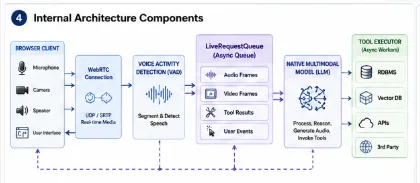
To build a production system, we must break down the internal architecture into its specialized components.
1. The WebRTC Transport Layer
Definition: A peer-to-peer communication protocol originally designed for browser-based video calls, now adapted as the primary transport layer for real-time AI.
Purpose: To transmit high-fidelity audio and video streams between the client and the server with the lowest possible latency.
How it works internally: WebRTC establishes a connection via a signaling server (often using WebSockets to exchange SDP and ICE candidates). Once connected, it transmits media via the Secure Real-time Transport Protocol (SRTP) over UDP. It dynamically adjusts bitrates based on network conditions and handles packet loss natively without stalling the stream.
Advantages: Sub-300ms latency, built-in Voice Activity Detection (VAD), acoustic echo cancellation, and automatic jitter management.
Limitations: More complex to implement and scale than stateless HTTP endpoints. Requires TURN/STUN servers for traversing strict enterprise NATs/Firewalls.
Engineering Notes: When building AI agents, WebRTC is strictly for the media layer. Application state and business logic must be managed outside of the WebRTC media pipeline.
2. The LiveRequestQueue (Asynchronous I/O Manager)
Definition: An asynchronous, thread-safe message queue sitting between the WebRTC media server and the AI model's inference engine.
Purpose: To manage the chaotic flow of concurrent, multimodal inputs (audio chunks, text, tool results) without blocking the main execution thread.
How it works internally: As WebRTC receives audio blobs, they are pushed into the LiveRequestQueue as LiveRequest objects. Background tools that finish executing also push their results into this queue. The agent's asynchronous runner consumes from this queue continuously, feeding the model as fast as it can process data.
Advantages: Enables true concurrency. The model doesn't have to wait for a formal "turn end" to begin processing environmental data.
Limitations: High risk of memory leaks if the queue is not drained properly during connection drops or application crashes.
Engineering Notes: Use standard Python asyncio.Queue patterns. Ensure strict backpressure mechanisms so a slow inference engine isn't overwhelmed by a fast stream of high-resolution video frames.
3. Voice Activity Detection (VAD) & Endpointing
Definition: An algorithm that analyzes an audio stream to determine when a human is speaking and when they have stopped.
Purpose: To trigger the model's response generation at the exact moment the user finishes a thought, avoiding awkward silences or cutting the user off.
How it works internally: Modern VADs (like Silero) use lightweight neural networks to detect human phonemes amidst background noise. "Endpointing" is the logic that decides, "The user has been silent for 600ms, therefore their turn is complete."
Advantages: Prevents the AI from processing empty room noise, saving massive token costs.
Limitations: Difficult to tune. Too aggressive, and the AI cuts off users who pause to think. Too lenient, and the AI feels sluggish to respond.
Engineering Notes: Always implement VAD before the audio hits the large model to optimize compute. Some advanced models integrate VAD natively, but edge-level VAD saves bandwidth.
4. The Native Multimodal Model (The Brain)
Definition: An LLM architected to accept dense continuous vectors (audio/video) alongside sparse discrete tokens (text) without separate transcription steps.
Purpose: To reason over all inputs and generate immediate, contextual responses.
How it works internally: It utilizes a unified speech-to-speech architecture (like Amazon Nova Sonic or Gemini Live). The model generates output tokens that represent raw audio waveforms, allowing it to modulate its own tone, inject artificial breathing, and express synthesized emotion.
Advantages: Eradicates the translation latency of ASR/TTS. Allows the model to understand sarcasm, urgency, and background context.
Limitations: Highly token-intensive. Processing raw audio and video consumes context windows rapidly.
Core Patterns / Architectures
While the underlying technology is similar, enterprise teams deploy real-time agents using specific architectural patterns based on business needs.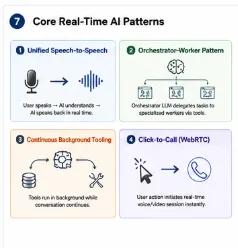
1. The Unified Speech-to-Speech Pattern
What it is: A direct, 1-to-1 connection between the user and a native multimodal model over WebRTC.
How it works: Audio flows from the browser to a media server, directly into the model, and audio flows back. No intermediate translation occurs.
Architecture: Client (WebRTC) <--> Media Server <--> Multimodal LLM (e.g., Nova Sonic)
Real-world use case: Customer support triage lines where the primary goal is human-like empathy, fast resolution, and natural conversation flow.
Trade-offs: Fast and highly natural, but lacks the ability to execute complex, multi-step business logic safely.
Best scenarios: General inquiries, emotional support, language tutoring.
Worst scenarios: High-stakes financial transactions requiring strict data validation.
2. The Orchestrator-Worker Streaming Pattern
What it is: An extension of the standard multi-agent supervisor pattern, adapted for real-time streams.
How it works: The user maintains a WebRTC connection with a lightweight "Router Agent." When the user asks a complex question, the Router Agent streams the request to a backend "Worker Agent" (e.g., a SQL specialist). The Router keeps the user engaged ("Let me look that up for you...") while waiting for the Worker.
Architecture: User <--> WebRTC <--> Router Agent <--> Internal Event Bus <--> Specialist Agents
Real-world use case: Drive-thru ordering systems where the Router handles the conversation, while an Inventory Agent continuously checks stock levels in the background.
Trade-offs: Adds latency to complex queries, but ensures highly accurate, deterministic execution of backend tasks.
3. The Continuous Background Tool Pattern
What it is: A design where tools operate as persistent, background processes that stream information back to the model over time, rather than a single request-response.
How it works: The model triggers a tool (e.g., "Monitor server logs for anomalies"). The tool runs indefinitely, pushing alerts into the LiveRequestQueue. The model can interrupt a conversation to notify the user of an alert.
Architecture: User <--> Agent <--> LiveRequestQueue <----- (continuous stream) Background Tool
Real-world use case: IT incident response. A DevOps engineer talks to the agent while the agent simultaneously monitors an active database migration, updating the engineer verbally as milestones are hit.
Trade-offs: Complex state management. The agent must balance responding to the user with processing background noise.
4. The Click-to-Call WebRTC Multimodal Pattern
What it is: Integrating the voice agent directly into the DOM of a web application, allowing synchronized voice and UI updates.
How it works: The user interacts with a web dashboard. They click a button to start a WebRTC voice session. As they speak, the agent not only replies via audio but sends JSON commands that visually manipulate the user's dashboard in real-time.
Architecture: Browser (UI + WebRTC) <--> Agent Pipeline --> Audio Stream & JSON UI Commands
Real-world use case: Complex B2B SaaS onboarding. The user asks, "How do I configure this setting?" The agent speaks the answer while simultaneously highlighting the exact button on the user's screen.
Trade-offs: Incredible user experience, but tightly couples the backend AI logic with frontend state management.
Technical Blueprint
Below is a production-grade blueprint using Python, asyncio, and an abstraction similar to the LiveKit Agent Framework and Google's LiveRequestQueue. This demonstrates how to handle asynchronous I/O and continuous multimodal streaming.
The Real-Time Agent Service (Python)
import os
import asyncio
from typing import Optional
from dataclasses import dataclass
from livekit.server_sdk import AccessToken, VideoGrants # Token generation
from livekit.agents import Agent, JobContext, llm # WebRTC agent abstractions
from livekit.plugins import google_ai # Direct integration for multimodal models

# 1. Define the Data Structures for Asynchronous I/O
@dataclass
class LiveRequest:
    """Represents a discrete chunk of multimodal data or a system signal."""
    blob: Optional[bytes] = None          # Audio/Video payload
    content: Optional[str] = None         # Text/JSON payload
    activity_start: bool = False          # VAD triggered (User started speaking)
    activity_end: bool = False            # VAD triggered (User stopped speaking)
    close: bool = False                   # Connection terminated

class LiveRequestQueue:
    """Thread-safe queue to manage bidirectional streaming."""
    def __init__(self):
        self._queue = asyncio.Queue()

    def send_realtime(self, blob: bytes):
        """Enqueues media blobs from the WebRTC track."""
        self._queue.put_nowait(LiveRequest(blob=blob))

    def send_activity_start(self):
        """Signals the model to prepare for new input and halt current output."""
        self._queue.put_nowait(LiveRequest(activity_start=True))

    async def get(self) -> LiveRequest:
        return await self._queue.get()

# 2. Define the Agent Architecture
class MultimodalVoiceAgent(Agent):
    def __init__(self):
        super().__init__()

        # Configure the native multimodal model for low-latency streaming
        self.llm = google_ai.LLM(
            model="gemini-2.0-flash-live",
            temperature=0.6,
        )

        # System instructions heavily govern tool usage and brevity
        self.instructions = """
        You are an enterprise logistics assistant. You are concise and direct.
        Never use conversational filler like "Let me check that for you."
        Execute tools immediately when asked. Keep answers under 10 seconds.
        """

        self.io_queue = LiveRequestQueue()

    async def handle_user_audio(self, audio_frame: bytes):
        """Callback triggered by the WebRTC media server when audio arrives."""
        self.io_queue.send_realtime(audio_frame)

    async def run_live(self, session):
        """The main asynchronous event loop."""
        print("Agent connected and listening via WebRTC...")

        # Consume the queue continuously
        while True:
            req = await self.io_queue.get()

            if req.close:
                break

            if req.activity_start:
                # BARGE-IN LOGIC: User interrupted the agent.
                # Immediately cancel any ongoing TTS audio playback to the WebRTC track.
                session.cancel_audio_playback()
                # Clear the model's generation context
                self.llm.interrupt()

            if req.blob:
                # Stream the audio directly to the native multimodal model
                # The model processes it instantly without ASR transcription.
                async for event in self.llm.stream_inference(req.blob):
                    if event.type == "audio_out":
                        # Push model-generated audio back to the user over WebRTC
                        await session.send_audio(event.payload)
                    elif event.type == "tool_call":
                        # Execute a background tool without stopping the audio flow
                        asyncio.create_task(self.execute_tool(event.payload))

    async def execute_tool(self, command: dict):
        """Simulates a non-blocking database query."""
        print(f"Executing tool: {command['name']}")
        await asyncio.sleep(1) # Simulate DB latency
        result = f"Data for {command['args']}: Verified."
        # Feed the result back into the LLM context so it can speak the result
        self.llm.inject_context(result)

# 3. Secure Token Generation Endpoint (Backend API)
def generate_webrtc_token(room_name: str, user_identity: str) -> str:
    """Issues secure JWTs for the frontend to connect via WebRTC."""
    api_key = os.environ.get("LIVEKIT_API_KEY")
    api_secret = os.environ.get("LIVEKIT_API_SECRET")

    token = AccessToken(api_key, api_secret)
    # Strict RBAC: User can join specific room and publish audio
    grant = VideoGrants(
        room_join=True,
        room=room_name,
        can_publish=True,
        can_subscribe=True
    )
    token.add_grant(grant)
    return token.to_jwt()
Engineering Notes on the Blueprint
-
The Event Loop (
run_live): Notice there are no HTTP endpoints inside the agent class. It is an infinite loop awaiting data from theLiveRequestQueue. This is the hallmark of streaming architecture. -
Barge-in Implementation: When
activity_startis detected, we aggressively invokesession.cancel_audio_playback(). If you rely solely on the LLM to realize it was interrupted, you will suffer a 1-second delay where the agent continues talking over the user. WebRTC track management is strictly decoupled from LLM inference. -
Task Spawning:
asyncio.create_task(self.execute_tool(...))ensures that when the AI decides to query a database, the main loop continues, allowing the agent to breathe or say "checking..." while the query executes.
Internal Execution Flow
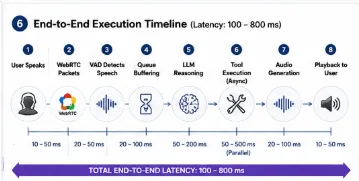
Understanding the exact millisecond-by-millisecond flow is critical for debugging latency.
Execution Step-by-Step
-
Input (T=0ms): User says "Check inventory." The browser captures the microphone audio and begins encoding it via the OPUS codec.
-
Transport (T=20ms): WebRTC UDP packets arrive at the server.
-
VAD Detection (T=50ms): The Voice Activity Detector flags
activity_start. The server flushes any outgoing audio queues to ensure silence. -
Buffering & Queueing (T=50ms - 500ms): Audio frames are continuously pushed into the
LiveRequestQueue. -
Inference Processing (T=550ms): The VAD detects silence (
activity_end). The queue flushes the accumulated audio blob to the Native Multimodal LLM. -
Reasoning & Tool Execution (T=800ms): The LLM understands the audio natively. It emits a JSON
tool_callevent to check the database. -
Context Injection (T=1000ms): The database returns data. It is injected into the LLM's context.
-
Audio Streaming Output (T=1200ms): The LLM generates the first chunk of the audio response waveform ("We have 50 items...").
-
Playback (T=1250ms): The audio chunk is transmitted back over WebRTC and plays in the user's headset.
Visual Description
Imagine a timeline split into two rows: User and System. The User's row shows a solid block of color indicating speech. Almost instantaneously, a parallel bar starts filling on the System row indicating processing. Just as the User's block ends, the System's block spikes, a database icon flashes, and immediately, an audio waveform graphic begins rendering back to the User's row, indicating spoken output. There are no gaps wide enough to fit a traditional loading spinner.
Operational Characteristics
Deploying this architecture at enterprise scale requires managing unique operational profiles.
-
Latency: The holy grail of this architecture. Expect 100ms–300ms network transport latency via WebRTC, and 400ms-800ms Time-to-First-Token (TTFT) for audio generation.
-
Scalability: WebRTC scaling is fundamentally different from HTTP. You cannot load-balance WebRTC packets naively; you need stateful SFU (Selective Forwarding Unit) architectures (like LiveKit or mediasoup).
-
Cost: Processing raw audio vectors is significantly more expensive than processing text tokens. Continuous streaming sessions can quickly burn through token budgets if VAD is misconfigured and background noise is continually sent to the model.
-
Reliability: WebRTC natively handles packet loss with adaptive bitrates and jitter buffers. If the connection degrades, audio quality drops, but the connection rarely snaps.
-
Maintainability: Debugging requires specialized observability tools. Traditional text logs are useless when the input was a sigh or a sarcastic tone. You must log session traces and audio snippets to diagnose "hallucinations."
-
Security: Authentication must happen before the WebRTC connection is established, typically via short-lived JWTs generated by a standard REST backend.
Head-to-Head Comparison
| Feature | Legacy Pipeline (HTTP/WebSocket + Text LLM) | Real-Time Native (WebRTC + Multimodal LLM) |
| Architecture | Sequential, Stateless | Bidirectional Streaming, Stateful |
| Transport | TCP (HTTP/WebSockets) | UDP (WebRTC) |
| Latency Profile | 1,500ms - 4,000ms | 300ms - 800ms |
| Input Modality | Text (Audio translated via ASR) | Native Audio/Video blobs |
| Interruptibility | Poor. Requires complex VAD hacks to stop playback. | Native. Instantly drops WebRTC track. |
| Emotional Context | Lost during ASR transcription. | Preserved. Model understands tone. |
| Complexity | Low. Standard REST backend skills apply. | High. Requires async I/O and media server management. |
| Cost | Low. Text tokens are cheap. | High. Audio vectors consume large context windows. |
| Best Use Cases | Text chatbots, offline data processing. | Voice agents, real-time robotics, live video analysis. |
Framework Ecosystem
To build these systems, you will rely on orchestration frameworks designed specifically for real-time media.
| Framework | Purpose | Strengths | Weaknesses | Recommended Team Size |
| LiveKit Agent Framework | WebRTC Media & Agent Orchestration | Incredible abstraction of WebRTC; built-in VAD; strong React frontend SDKs. | Hosted SFU can become expensive at scale. | Small to Enterprise |
| Pipecat (Daily.co) | Open-Source Multimodal Agent Framework | Deeply modular; supports any LLM; excellent documentation. | Requires managing the Daily WebRTC infrastructure. | Medium to Enterprise |
| AWS Kinesis WebRTC | Fully Managed Media Streaming | Deep integration with AWS ecosystem (Nova Sonic); enterprise security compliance. | Steep AWS learning curve; vendor lock-in. | Enterprise |
| OpenAI Realtime API | Managed Multimodal Endpoint | Easiest way to access GPT-4o native audio; requires zero media server setup. | Black-box architecture; latency subject to OpenAI's server load. | Startups & Prototyping |
When to choose:
-
Use LiveKit or Pipecat if you need strict control over the agent loop, custom VAD tuning, and on-premise deployments.
-
Use AWS Kinesis if your entire stack is already in AWS and you require strict HIPAA/SOC2 compliance.
-
Use OpenAI Realtime API if you need to ship a proof-of-concept in 48 hours and don't want to manage UDP networking.
Common Misconceptions
1. "WebSockets are fast enough for voice."
-
Why it is incorrect: WebSockets run over TCP, which guarantees packet delivery. If a single packet drops, TCP halts the entire stream to retransmit it (Head-of-Line Blocking), causing massive audio stuttering.
-
The correct understanding: WebRTC runs over UDP, which ignores dropped packets and interpolates audio, resulting in a smooth, continuous conversation.
2. "We can just string together Whisper, GPT-4, and ElevenLabs."
-
Why it is incorrect: Sequential pipelines compound latency. If Whisper takes 400ms, GPT takes 600ms, and ElevenLabs takes 500ms, your baseline latency is 1.5 seconds before network transport.
-
The correct understanding: Native multimodal models (like Gemini Live) handle all three steps internally, returning audio in a single pass.
3. "The model natively knows when the user stops talking."
-
Why it is incorrect: While multimodal models analyze audio, keeping an open microphone streaming into a massive LLM 100% of the time is financially ruinous.
-
The correct understanding: You still need a lightweight VAD (Voice Activity Detector) running locally or at the edge to gate the audio stream and only send data when actual speech occurs.
4. "Multi-agent systems cannot run in real-time."
-
Why it is incorrect: People assume routing between agents takes too long.
-
The correct understanding: By using the Orchestrator-Worker pattern, the routing agent can maintain the WebRTC connection and speak conversational filler ("Let me check that...") while asynchronously awaiting the background agent's data.
5. "Text translation is required for logging and compliance."
-
Why it is incorrect: Teams hesitate to use native audio models because they need transcripts.
-
The correct understanding: Modern native models can output multimodal data concurrently. They emit the audio stream and the text transcript simultaneously, allowing for seamless logging without adding ASR layers.
Build vs Don't Build
Real-time architectures are complex. They introduce stateful connections, memory management challenges, and media server scaling.
When this approach SHOULD be used:
-
Customer Support Call Centers: When replacing IVR systems, humans will hang up if the AI takes 3 seconds to respond. Low latency is critical.
-
Hands-Free Industrial Work: Technicians, surgeons, or factory workers who cannot look at a screen need instant, conversational validation of their commands.
-
Language Tutoring & Interview Prep: Applications where analyzing tone, hesitation, and accent is the core value proposition.
When it SHOULD NOT be used:
-
Internal Knowledge Base Search: If an employee is querying an HR document, a 2-second HTTP REST response with text and links is vastly superior to waiting for an AI to read a paragraph aloud.
-
High-Stakes Legal/Financial Data: If the output must be 100% deterministic and auditable, the sequential nature of standard RAG pipelines allows for better middleware validation.
Architecture Recommendation Matrix
| Business Problem | Recommended Architecture | Why | Risk |
| High-Volume Call Center | Unified Speech-to-Speech (WebRTC + Nova Sonic/GPT-4o) | Maximizes empathy and speed; minimizes dropped calls. | Hallucinations during long conversations; token costs. |
| Complex Technical Support | Orchestrator-Worker Streaming Pattern | Allows the main agent to hold the line while specialist agents query complex manuals. | Increased latency when the worker agent is invoked. |
| Interactive SaaS Dashboard | Click-to-Call WebRTC Pattern | Deeply integrates voice with UI state, allowing the AI to guide users visually. | High frontend engineering complexity; state synchronization. |
| Robotics & Autonomous Drones | Continuous Background Tool Pattern | Allows the agent to ingest video streams while executing motor-control tools asynchronously. | Safety risks; requires strict hardware-level sandboxing. |
Enterprise Decision Framework
Before migrating from a RESTful LLM pipeline to a WebRTC Multimodal pipeline, follow this evaluation model.
Decision Tree:
-
Does the user interaction require voice or video?
-
No: Stick to REST/WebSockets + Text LLM.
-
Yes: Proceed to step 2.
-
-
Is a 2-second response latency acceptable?
-
Yes: Build a sequential pipeline (ASR -> Text LLM -> TTS). It is easier to maintain.
-
No: Proceed to step 3.
-
-
Do you have the infrastructure budget to manage stateful media servers (SFUs) and high token costs?
-
No: Re-evaluate the business case.
-
Yes: Adopt Real-Time Multimodal Architecture.
-
Scoring Matrix:
Evaluate your project out of 5 for each criterion. A score above 25 justifies the architectural complexity.
-
Latency Criticality (1-5): How fast does the system need to react to avoid user drop-off?
-
Modality Importance (1-5): Does tone, emotion, or visual context matter to the task?
-
Concurrency Need (1-5): Does the AI need to execute background tools while talking?
-
Budget Tolerance (1-5): Can you handle higher inference costs per session?
-
Team Expertise (1-5): Do you have engineers familiar with
asyncio, event loops, and WebRTC?
Real-world Case Studies
Case Study 1: Multilingual Smart Factory Assistant
Business Problem: A global manufacturing firm faced high error rates because workers operating heavy machinery couldn't safely type queries into their tablets, and language barriers prevented effective peer assistance.
Challenges: The factory floor had terrible Wi-Fi, making HTTP requests drop continuously. The environment was deafeningly loud.
Architecture: Deployed a WebRTC pipeline integrated with Amazon Nova Sonic. WebRTC's adaptive bitrate handled the spotty Wi-Fi seamlessly. They implemented an aggressive local VAD model optimized to filter out machine noise.
Results: Workers could ask for schematic details hands-free. The native model processed the query and replied in the worker's native language in under 600ms. Error rates dropped by 22%.
Lessons Learned: WebRTC's native jitter buffers are crucial for industrial environments. However, VAD tuning took three weeks; off-the-shelf VAD failed completely in the noisy environment.
Case Study 2: Real-Time DevOps Triage Agent
Business Problem: During critical server outages, SRE teams wasted time looking up runbooks and checking disparate monitoring dashboards.
Challenges: The agent needed to read logs, execute diagnostic scripts, and speak to the engineers without forcing them to wait in silence.
Architecture: Adopted the Continuous Background Tool Pattern using Pipecat and Gemini Live. The agent was connected to a shared audio channel. When requested, it spawned asynchronous tools to scan Datadog logs, updating the team vocally ("I'm seeing a spike in the auth service, querying the exact error now...").
Results: Mean Time to Resolution (MTTR) decreased by 15 minutes.
Lessons Learned: Handling barge-in was critical. Engineers frequently yelled "Stop, check the database instead" while the AI was talking. The LiveRequestQueue architecture allowed instant interruption and rerouting of the task.
Production Pitfalls
1. The Infinite Token Loop
-
Why it happens: A poorly configured VAD detects the agent's own synthesized audio playing from a speaker, feeds it back into the microphone, and the model attempts to converse with itself, generating infinite context.
-
Prevention: Implement strict acoustic echo cancellation (AEC) at the WebRTC client layer. Ensure the server explicitly mutes the inbound queue while generating output, unless full-duplex barge-in is required (which requires superior AEC).
2. Turn-Taking Collisions (The "Awkward Silence" Bug)
-
Why it happens: A user pauses to take a breath. The VAD detects silence and fires
activity_end. The LLM begins responding just as the user resumes speaking. Both talk over each other. -
Prevention: Tune endpointing latency dynamically. If the user is speaking rapidly, set the silence threshold to 400ms. If the conversation is complex, extend it to 800ms.
3. State Management Failures
-
Why it happens: In a stateless HTTP API, a dropped connection is fine. In a stateful WebRTC session, if the client drops on a train tunnel, the backend agent loop might run forever, draining memory.
-
Prevention: Implement aggressive heartbeat checks. If the WebRTC connection state changes to
disconnected, immediately close theLiveRequestQueueand gracefully terminate the agent's Python process.
Best Practices
To harden your real-time architecture, strictly enforce the following:
-
Architecture: Decouple the WebRTC media layer from the LLM reasoning layer. Use an asynchronous queue to bridge them.
-
Observability: Do not just log text. Log system states:
VAD_TRIGGERED,LLM_START,FIRST_AUDIO_FRAME,PLAYBACK_COMPLETE. This allows you to measure end-to-end latency accurately. -
Security: Never expose the media server directly to the public without a token. Generate short-lived JWTs on your REST backend to authorize WebRTC room joins.
-
Guardrails: Enforce output constraints at the system prompt level. "You must answer in under 3 sentences." Native models will ramble if not explicitly told to be concise, costing time and money.
-
Retries: If a background tool fails during a live conversation, do not throw a silent error. The agent must catch the exception and say, "I'm having trouble accessing that system right now."
Future Outlook
As we move through 2026, the architecture will evolve rapidly:
-
Native Video Understanding: We are moving past audio. Models will process high-framerate WebRTC video streams continuously, allowing agents to act as visual quality inspectors or spatial computing guides.
-
Standardization of Protocols: Just as the Model Context Protocol (MCP) standardized tool usage, expect new IETF standards defining how LLMs negotiate real-time streaming states.
-
Edge Multimodal AI: Smaller models will run the entire real-time pipeline on-device (like a smartphone NPU), eliminating the need for WebRTC transport entirely for basic tasks, falling back to the cloud only for complex reasoning.