A mid-sized logistics firm decided to rebuild its core shipment-tracking portal. The engineering team, eager to leverage modern frontend tooling, selected Next.js. They planned to build everything—from database queries and serverless workers to client UI components—within a unified Next.js monorepo.
Eight months in, the friction started. Serverless cold starts triggered unpredictable latency spikes on internal background queues. Managing relational database connections across ephemeral functions led to connection pool exhaustion during morning traffic surges. Complex business logic required intricate API route handlers and custom middleware hacks that duplicated validation routines.
Across town, a healthcare provider built a patient scheduling portal using Laravel. The team shipped fast using standard MVC patterns, native background queues, and built-in policy checks. However, as the platform scaled and users demanded instant client-side updates, live search filtering, and offline support, the developers began hacking heavy Blade views with nested JavaScript libraries before eventually accepting the need to refactor to a decoupled frontend.
Neither team picked a bad framework. Both teams fell into the same trap: choosing a stack based on team preference or developer sentiment rather than matching framework architectures to data flow patterns, operational requirements, and long-term maintenance costs.
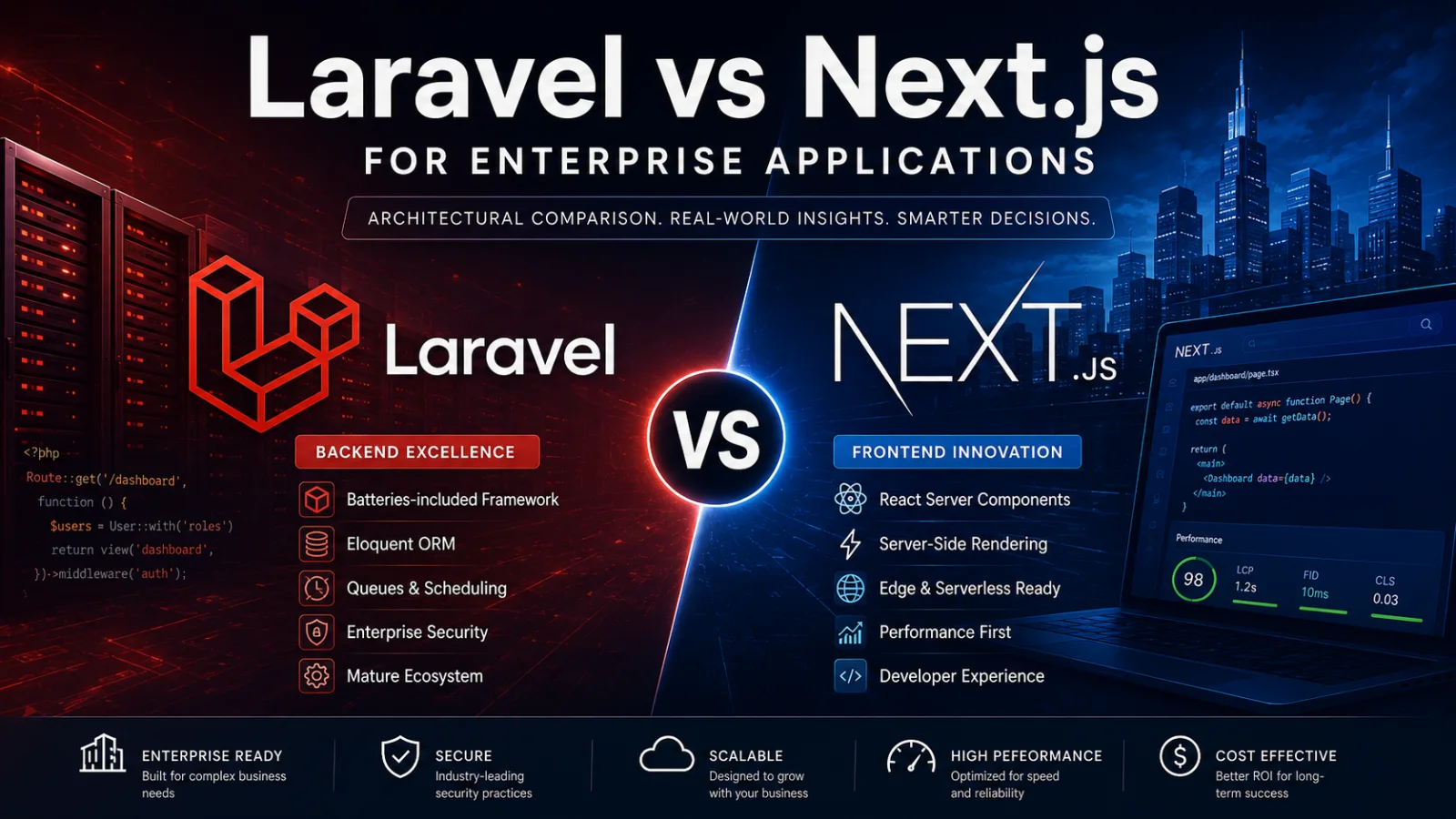
Selecting between Laravel and Next.js for enterprise systems isn't about deciding which tool is "better." It's a strategic evaluation between two distinct architectural paradigms:
-
A batteries-included, backend-first application ecosystem (Laravel).
-
A component-driven, UI-first meta-framework optimized for server-side React execution (Next.js).
Who Should Read This Guide?
This architectural assessment is designed for technical decision-makers evaluating long-term software investments:
-
CTOs & VPs of Engineering: Aligning stack choices with hiring pipelines, hosting budgets, and system maintainability.
-
Enterprise Software Architects: Designing resilient data flows, state boundaries, and background job pipelines.
-
Product Managers & Founders: Balancing initial time-to-market against future technical debt.
-
Engineering Leads: Deciding between unified full-stack monorepos vs. decoupled API architectures.
At a Glance: Executive Decision Matrix
If you need a quick assessment for an upcoming architectural review, this high-level matrix highlights the foundational differences:
| Operational Metric | Laravel (PHP 8.3+) | Next.js (App Router / Node) |
| Primary Architecture | Backend-centric MVC / API Engine | UI-centric, Server-Driven React |
| Runtime Model | Persistent Process (Octane / FrankenPHP) | Event Loop / Serverless Edge Functions |
| Core Database Engine | Native Eloquent ORM (Active Record) | Third-Party (Prisma, Drizzle, Kysely) |
| Background Queues | Built-in Queue System & Worker Schedulers | Requires external services (BullMQ, Trigger.dev) |
| Authentication System | Native (Sanctum, Passport, Fortify) | External Libraries / SaaS (Auth.js, Clerk) |
| Type Safety | Static Analysis (PHPStan / Larastan) | Native End-to-End TypeScript |
| Primary Deployment Footprint | Cloud Compute / Containers (EC2, Docker) | Managed Edge (Vercel) / Node.js Containers |
| Best Suited For | Complex data domains, ERPs, Fintech, Portals | Content platforms, Headless Commerce, SaaS UIs |
💡 Architectural Advisory: Evaluating technology stacks for a complex enterprise project? TechMamba’s senior engineers conduct deep-dive architecture assessments to help you validate data boundaries, queue requirements, and team workflows before writing a single line of code. Learn more about our Custom Software Development Services or schedule a discovery review today.
Core Framework Profiles
What is Laravel?
Laravel is an open-source, full-stack PHP framework created by Taylor Otwell in 2011. Built around classic Object-Oriented Programming (OOP) and Model-View-Controller (MVC) patterns, Laravel provides a complete enterprise foundation. Database migrations, ORM, multi-driver queue managers, memory caching, transactional mailers, task scheduling, and authorization gates come pre-configured out of the box and are maintained by the core framework team.
In modern enterprise environments, Laravel is rarely just a traditional request-response engine. Technologies like Laravel Octane (powered by Swoole or FrankenPHP) keep the application booted persistently in memory. This eliminates traditional PHP process startup overhead and delivers request throughput comparable to Go and Node.js runtimes.
Field Note / War Story:
"I've brought Laravel Octane with FrankenPHP into legacy enterprise PHP environments and bumped simple JSON API endpoints from 800 requests/sec to over 8,500 requests/sec on the exact same infrastructure—without rewriting a line of domain business logic. Never assume PHP is inherently slow until you've tested persistent in-memory execution."
What is Next.js?
Next.js is a full-stack React meta-framework maintained by Vercel. Introduced in 2016 to bring Server-Side Rendering (SSR) and Static Site Generation (SSG) to React, it has evolved through the App Router, React Server Components (RSC), and Server Actions into an integrated rendering and routing engine.
Instead of shipping a rigid, batteries-included backend structure, Next.js focuses on content streaming, component state management, and client-server boundaries. Core backend functions—such as persistent database connections, queue workers, and identity management—are handled by integrating third-party libraries (e.g., Prisma, Drizzle, Auth.js, BullMQ) or linking directly to headless external APIs.
Figure 1: Next.js App Router Component Boundary Topology depicting client-server state boundaries and RSC streaming payloads.
Architect's Tip:
Next.js shines brightest when viewed as a UI orchestration engine rather than a traditional monolithic application server. If your engineering team treats Next.js as a direct 1:1 substitute for Laravel, Django, or Spring Boot, you will end up custom-building the missing backend infrastructure pieces yourself.
Deep Architectural Comparison
1. State Management & Data Access Patterns
Laravel: Eloquent ORM
Laravel’s native database layer, Eloquent ORM, uses the Active Record pattern. Eloquent simplifies handling complex relational schemas, polymorphic mapping, eager loading optimization, soft deletes, and schema migrations.
// Complex enterprise relational query in Eloquent
$pendingClaims = PatientClaim::query()
    ->where('status', ClaimStatus::PENDING)
    ->with([
        'patient:id,first_name,last_name,insurance_id',
        'provider:id,npi_number,clinic_name'
    ])
    ->whereHas('coverage', fn ($query) => $query->where('is_active', true))
    ->orderByDesc('submitted_at')
    ->paginate(25);
Next.js: Modern Type-Safe ORMs
Next.js relies on third-party TypeScript ORMs such as Drizzle or Prisma. Drizzle has gained significant enterprise traction because it aligns closely with raw SQL while offering complete compile-time type safety across the entire stack.
// Type-safe relational query in Next.js using Drizzle ORM
import { db } from '@/db';
import { patientClaims, patients, coverages } from '@/db/schema';
import { eq, and, desc } from 'drizzle-orm';

const pendingClaims = await db
  .select({
    claimId: patientClaims.id,
    patientName: patients.firstName,
    insuranceId: patients.insuranceId,
  })
  .from(patientClaims)
  .innerJoin(patients, eq(patientClaims.patientId, patients.id))
  .innerJoin(coverages, eq(patients.id, coverages.patientId))
  .where(
    and(
      eq(patientClaims.status, 'PENDING'),
      eq(coverages.isActive, true)
    )
  )
  .orderBy(desc(patientClaims.submittedAt))
  .limit(25);
A mistake many teams make:
Deploying Next.js to serverless platforms (e.g., Vercel, AWS Lambda) without an intermediate database proxy layer (like AWS RDS Proxy, Prisma Accelerate, or Neon Serverless) often leads to connection pool exhaustion. Ephemeral functions spin up concurrently during traffic surges, creating hundreds of direct open connections that can crash relational databases like PostgreSQL. Laravel, when running on standard cloud compute instances, manages persistent, stable connection pools directly.
2. Execution Runtimes & Concurrency
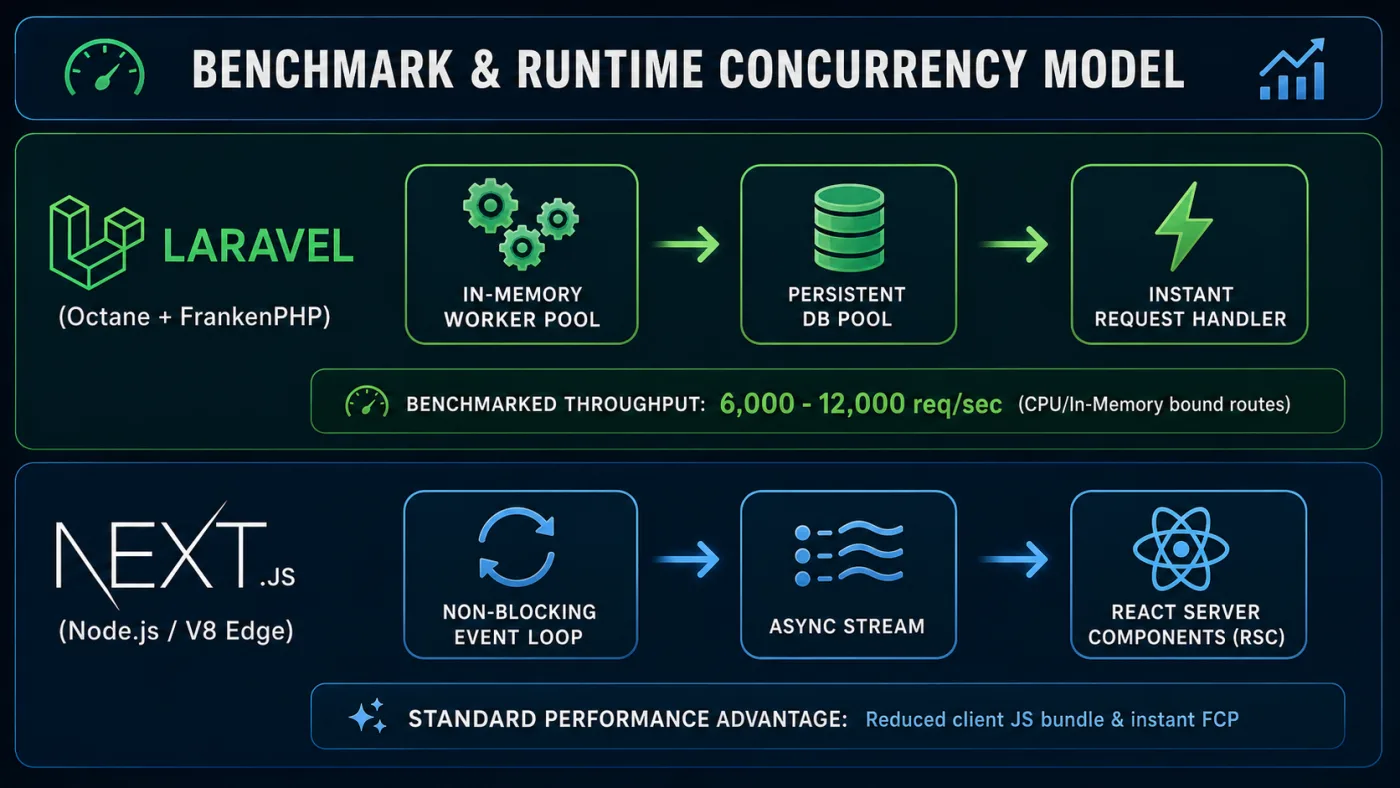
Evaluating framework speed requires separating network I/O throughput from UI rendering performance.
Benchmark Realities & Trade-offs
-
Backend Processing: Synthetic benchmarks measuring simple JSON serialization and in-memory routing show Laravel Octane (running on FrankenPHP or Swoole) achieving 6,000 to 12,000 requests per second on 8 vCPU cloud compute instances. However, in real-world enterprise production, applications are predominantly I/O bound (waiting on database queries, network sockets, or third-party webhooks). In these scenarios, both Laravel and Next.js perform similarly; bottlenecks stem from unindexed queries or slow microservices rather than framework execution overhead.
-
Frontend Core Web Vitals: Next.js holds a clear advantage in initial page load optimization. Its ability to mix Server Components (RSC), Static Site Generation (SSG), and Incremental Static Regeneration (ISR) significantly reduces the JavaScript bundle size sent to the browser. This directly improves First Contentful Paint (FCP) and Interaction to Next Paint (INP) scores on high-traffic, SEO-critical public platforms. If your engineering team is building complex SaaS portals with heavy API processing, explore our specialized SaaS Development Services to ensure your backend scale matches your frontend performance.
3. Security Frameworks & Access Control
Enterprise compliance standards (such as SOC2, HIPAA, and GDPR) require consistent security enforcement across every layer of the application.
Laravel Security Paradigm
Laravel applies security controls by default:
-
Automatic CSRF Token Protection: Active out of the box on all state-changing web routes.
-
Native Authorization Gates & Policies: A uniform system for evaluating resource permissions across controller methods and database operations.
-
Native Encodings: Built-in wrappers for AES-256 encryption and Argon2/Bcrypt password hashing.
// Laravel Policy enforcing explicit domain-level access control
namespace App\Policies;

use App\Models\User;
use App\Models\FinancialReport;

class FinancialReportPolicy
{
    public function view(User $user, FinancialReport $report): bool
    {
        return $user->hasPermission('reports.read')
            && $user->organization_id === $report->organization_id;
    }
}
Next.js Security Paradigm
Next.js provides built-in output escaping inside JSX to prevent Cross-Site Scripting (XSS). However, overall application security architecture rests largely on the engineering team.
When working with Server Actions, developers must explicitly authenticate and authorize every server mutation, as Server Actions act as open HTTP POST endpoints behind the scenes.
// Next.js Server Action requiring explicit inline auth and validation checks
'use server';

import { auth } from '@/auth';
import { db } from '@/lib/db';
import { z } from 'zod';

const DeleteReportSchema = z.object({ reportId: z.string().uuid() });

export async function deleteFinancialReport(formData: FormData) {
  // 1. Authenticate user session
  const session = await auth();
  if (!session?.user) {
    throw new Error('Unauthorized');
  }

  // 2. Validate incoming input schema
  const { reportId } = DeleteReportSchema.parse({
    reportId: formData.get('reportId'),
  });

  // 3. Perform explicit policy & authorization verification
  const report = await db.financialReport.findUnique({
    where: { id: reportId }
  });

  if (!report || report.organizationId !== session.user.organizationId) {
    throw new Error('Forbidden: Insufficient permissions');
  }

  // 4. Perform database operation
  await db.financialReport.delete({ where: { id: reportId } });
}
Field Note / War Story:
"During a security audit of a client's Next.js application, we discovered several public Server Actions that lacked session checks. The developers assumed that because the UI buttons were hidden from unauthenticated users, the server endpoints were safe. Server Actions are public endpoints—they must always be guarded with explicit server-side auth validation."
4. Background Processing & Asynchronous Jobs
High-scale systems rely heavily on background processing to keep web requests fast and responsive.
The Laravel Advantage
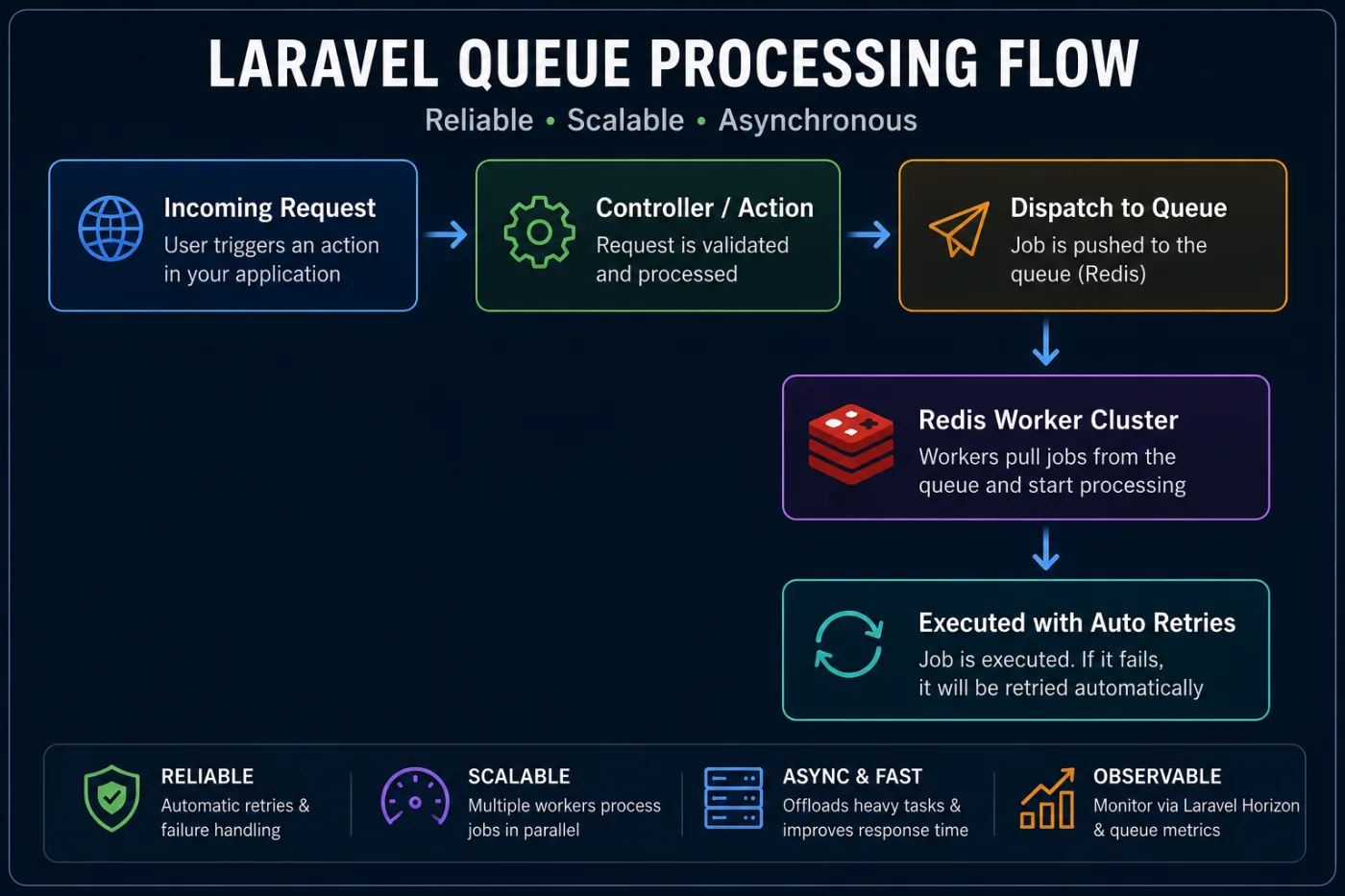
Laravel features a complete queue architecture out of the box. Jobs can be dispatched to Redis, Amazon SQS, or RabbitMQ with built-in support for retries, exponential backoffs, rate-limiting, and dead-letter queues.
Tools like Laravel Horizon provide real-time dashboards for monitoring queue health, throughput, and execution failures without requiring third-party monitoring subscriptions.
Figure 2: Laravel Horizon dashboard monitoring Redis worker queue throughput, active jobs, and failure retry traces.
// Enterprise background job in Laravel with automated retries and backoff
namespace App\Jobs;

use App\Models\Invoice;
use Illuminate\Bus\Queueable;
use Illuminate\Contracts\Queue\ShouldQueue;
use Illuminate\Foundation\Bus\Dispatchable;
use Illuminate\Queue\InteractsWithQueue;
use Illuminate\Queue\SerializesModels;

class ProcessEnterpriseInvoice implements ShouldQueue
{
    use Dispatchable, InteractsWithQueue, Queueable, SerializesModels;

    public int $tries = 5;
    public int $backoff = 60;

    public function __construct(public Invoice $invoice) {}

    public function handle(): void
    {
        // Long-running invoice generation and third-party API sync logic
    }
}
The Next.js Reality
Next.js serverless functions are designed for quick request-response cycles, often carrying execution timeouts (10 to 60 seconds on standard serverless tiers). As a result, long-running tasks cannot execute inside standard serverless handlers.
To process background jobs, teams using Next.js must build and manage external infrastructure—such as running BullMQ on separate Node.js worker nodes, or integrating third-party task platforms like Trigger.dev or Inngest. Designing robust distributed task pipelines is a core component of our API Development & Integration Services.
Real-World Migration Trade-off Case Study
Case Study: Re-introducing the Backend Core
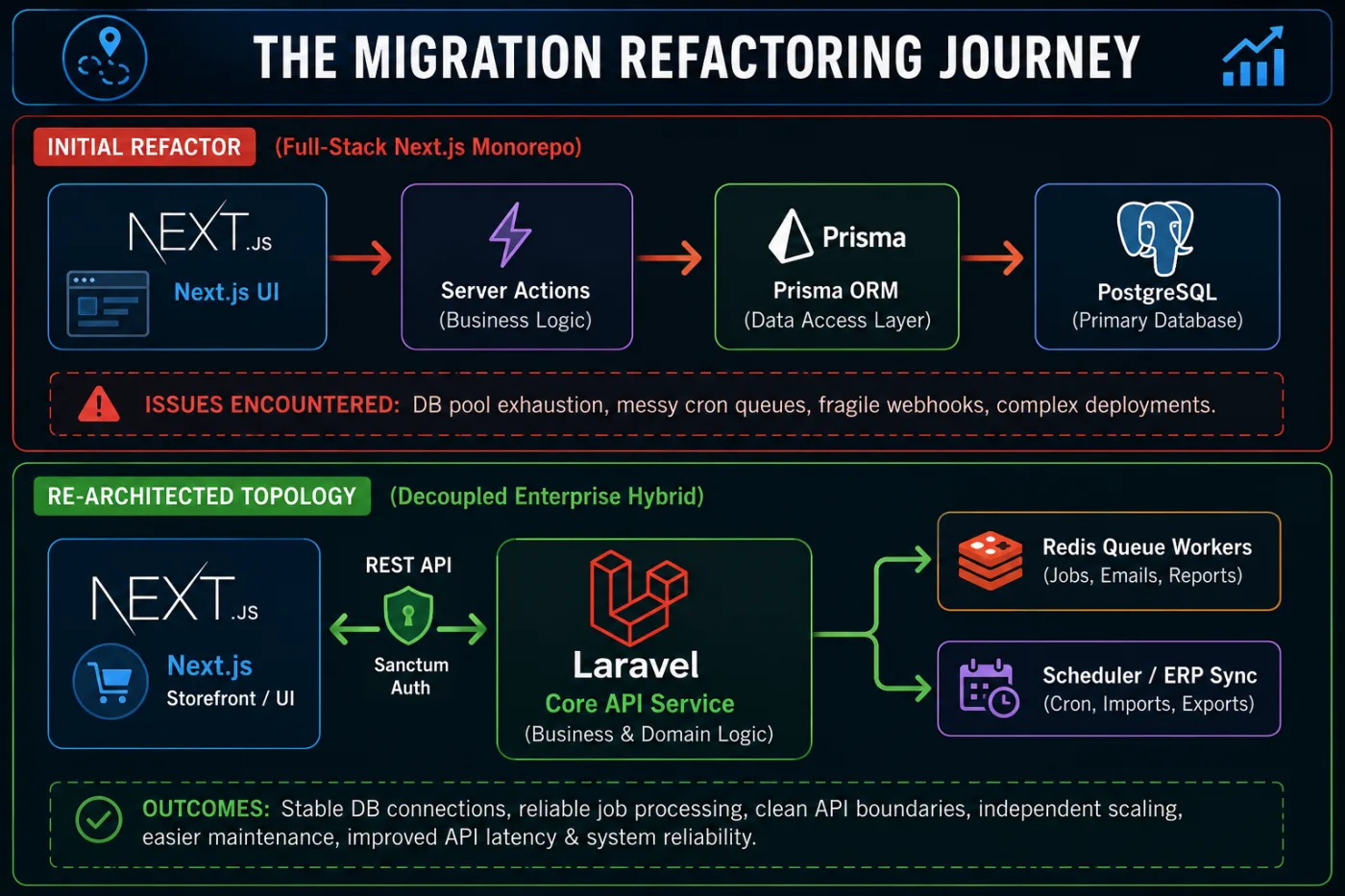
A fast-growing fintech client migrated their core web dashboard from a traditional backend to a full-stack Next.js (App Router) monorepo to consolidate their stack around TypeScript.
-
The Challenge: Within six months, as transaction volumes grew, the team encountered significant operational friction. Scheduled financial reconciliation tasks, nightly ERP data syncing, and multi-step PDF report generation struggled within serverless timeout limits. Furthermore, webhook listeners handling third-party payment notifications occasionally lost requests during cold-start spikes.
-
The Refactored Architecture: Instead of scrapping their Next.js UI investment, the team decoupled the system. They retained Next.js for the dynamic front-end client layer and introduced a dedicated Laravel API backend running on persistent cloud containers to handle database queries, payment queues, and background scheduled tasks.
-
The Result: System reliability improved instantly. API request latencies dropped by 45%, background job reliability reached 99.99%, and the frontend engineering team gained clear operational boundaries.
One pattern we've seen repeatedly:
Teams start with a pure Next.js monorepo because "single language full-stack" sounds efficient on paper. But as business domain requirements grow to include scheduled cron events, payment webhooks, batch PDF generation, and multi-step background notifications, the overhead of retrofitting backend infrastructure onto serverless Next.js functions becomes unbearable. Re-introducing a dedicated backend engine like Laravel isn't a retreat—it's standard enterprise domain separation.
Architectural Patterns: Monolith, Hybrid, or Decoupled?
When deciding on a stack, you don't always have to make a binary choice. Enterprise teams often combine these tools into flexible hybrid configurations based on their operational requirements.
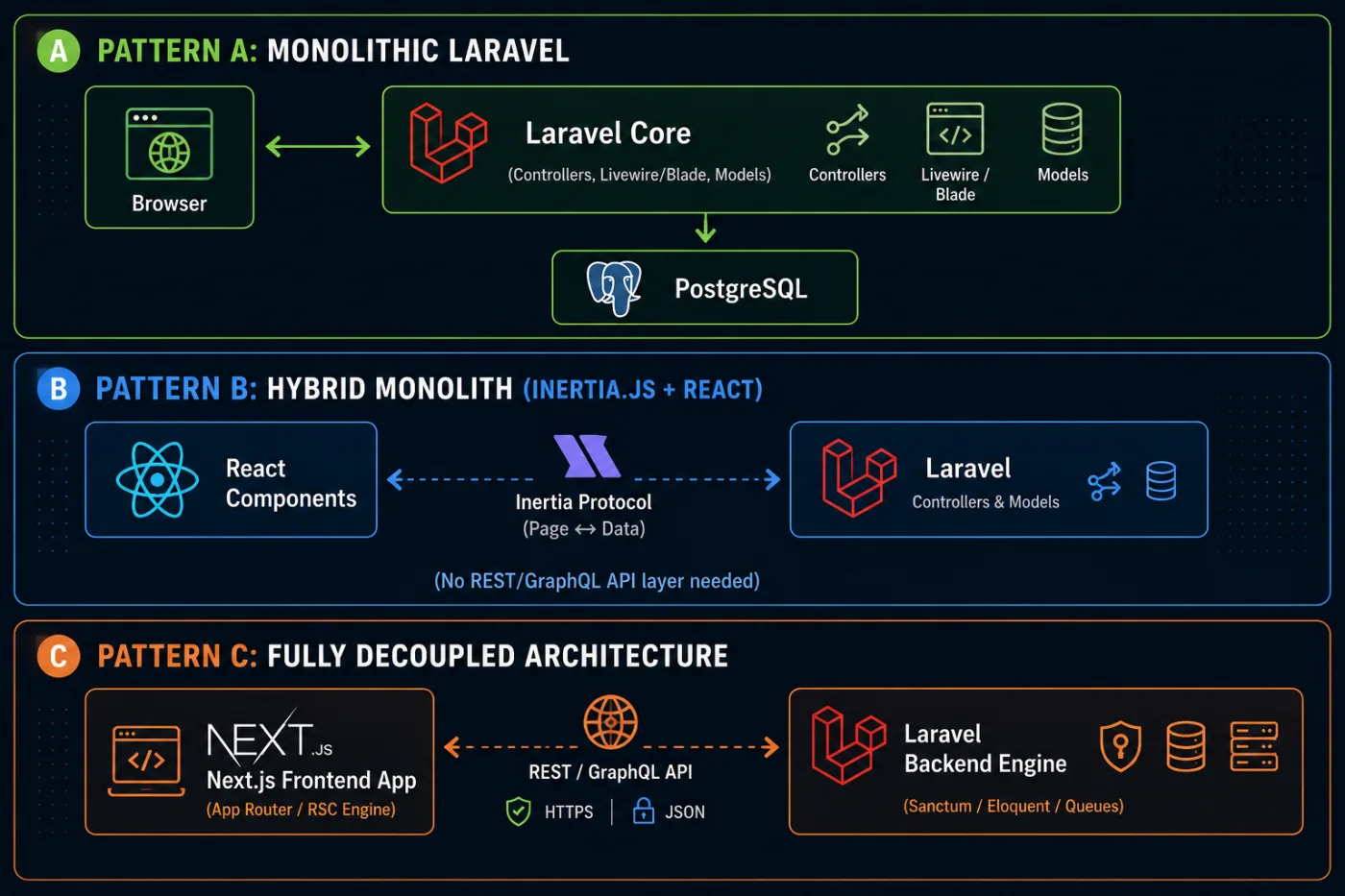
Pattern A: Monolithic Laravel (Blade or Livewire)
-
Best Suited For: Internal portals, B2B enterprise software, logistics dashboards, and admin systems where development speed and unified operational control take priority.
-
Trade-off: Harder to build complex, highly dynamic mobile-like interactive interfaces.
Pattern B: The Hybrid Monolith (Laravel + Inertia.js + React)
Inertia.js allows developers to build modern React user interfaces while keeping server-side Laravel routing, authorization, and data fetching models intact.
// React page component receiving data directly from Laravel via Inertia.js
import React from 'react';
import { Head } from '@inertiajs/react';

interface Props {
  userCount: number;
  systemStatus: string;
}

export default function Dashboard({ userCount, systemStatus }: Props) {
  return (
    <div className="p-8 max-w-4xl mx-auto">
      <Head title="Enterprise Command Center" />
      <h1 className="text-2xl font-bold text-gray-900">System Health: {systemStatus}</h1>
      <p className="mt-2 text-gray-600">Active Tenant Users: {userCount.toLocaleString()}</p>
    </div>
  );
}
-
Best Suited For: SaaS platforms that need a rich, modern React interface without the added overhead of maintaining a separate API layer.
-
Trade-off: The frontend relies on the Laravel application server for routing and view updates.
If I were designing this today for a mid-market SaaS:
Pattern B (Laravel + Inertia.js + React) is almost always where I start unless there's an explicit requirement for global edge-rendered public SEO pages. It gives your product team the rich React user interface end users expect while granting your backend engineers full access to Eloquent, native queues, and robust auth gates—without writing or maintaining thousands of lines of REST boilerplate.
Pattern C: Decoupled Architecture (Laravel Core API + Next.js Frontend)
-
Best Suited For: Global e-commerce platforms, multi-channel media engines, or applications with high public traffic requirements.
-
Trade-off: Higher operational complexity, managing cross-domain security (CORS), and maintaining separate deployment pipelines. Deploying and managing containerized multi-tier cloud infrastructures is supported by TechMamba.
Architectural Decision Blueprint
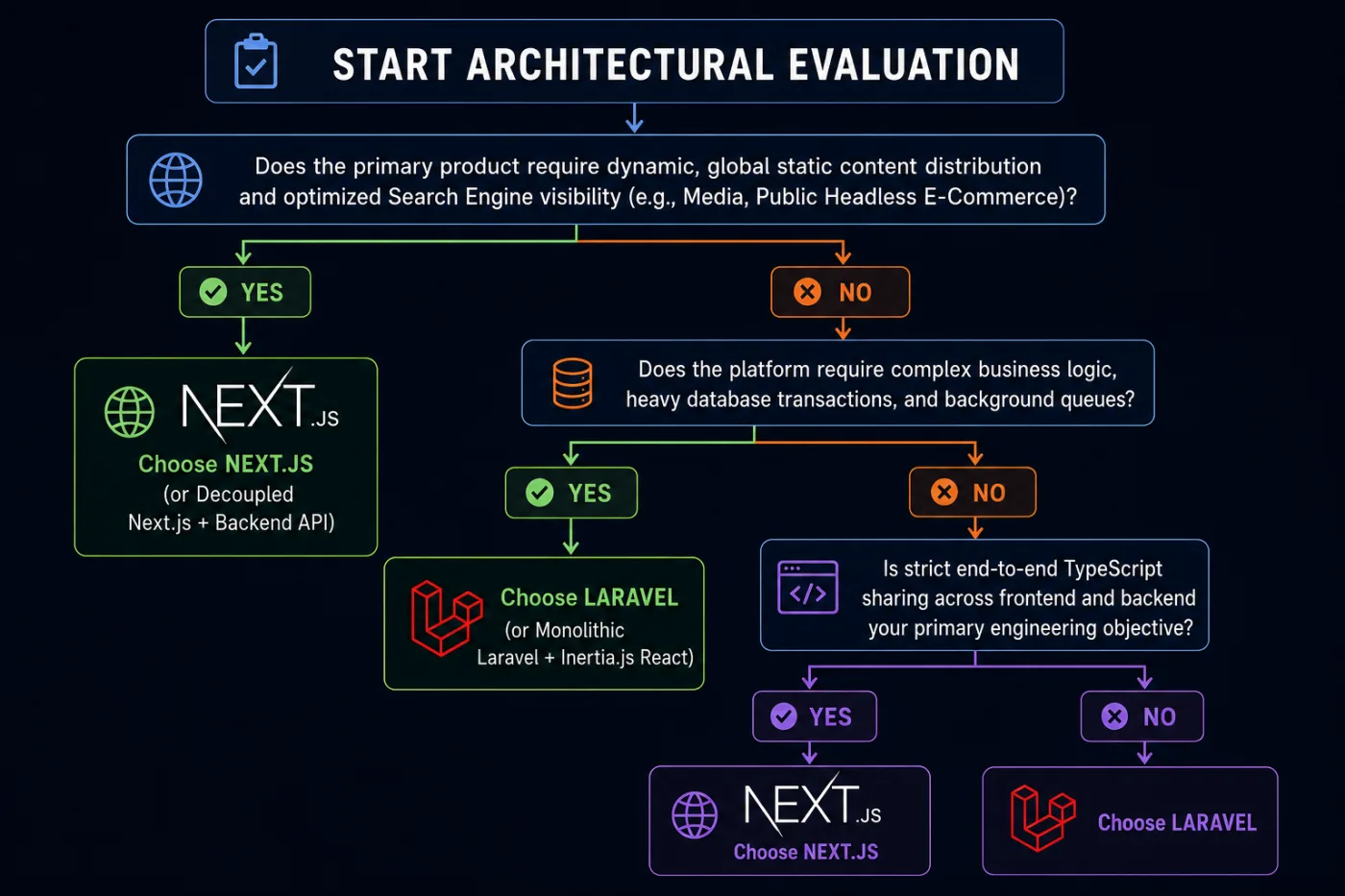
Downloadable Resource: Enterprise Checklist
Before committing your organization to a technology stack, review this architectural checklist with your team:
Enterprise Architectural Selection Checklist
1. Data Infrastructure & Storage Capabilities
-
Do you need long-running, multi-step background queue workers out of the box? (Points to Laravel)
-
Are you deploying to serverless environments that require relational database connection proxies? (Points to Next.js consideration)
-
Does the application rely heavily on relational database joins and multi-table transactions? (Points to Laravel)
2. Frontend & User Experience Requirements
-
Is public page render speed and Core Web Vitals optimization critical to search acquisition? (Points to Next.js)
-
Does the product require rich, highly interactive client-side components across every view? (Points to Next.js or Laravel + Inertia.js)
3. Team Resources & Maintenance
-
Does your engineering team prefer end-to-end TypeScript type sharing across the full stack? (Points to Next.js)
-
Is your team looking to reduce operational complexity and avoid maintaining separate API layers? (Points to Monolithic Laravel / Inertia.js)
Total Cost of Ownership (TCO) & Maintenance
Evaluating framework expenses requires looking beyond initial build speed to long-term hosting, infrastructure, and hiring costs.
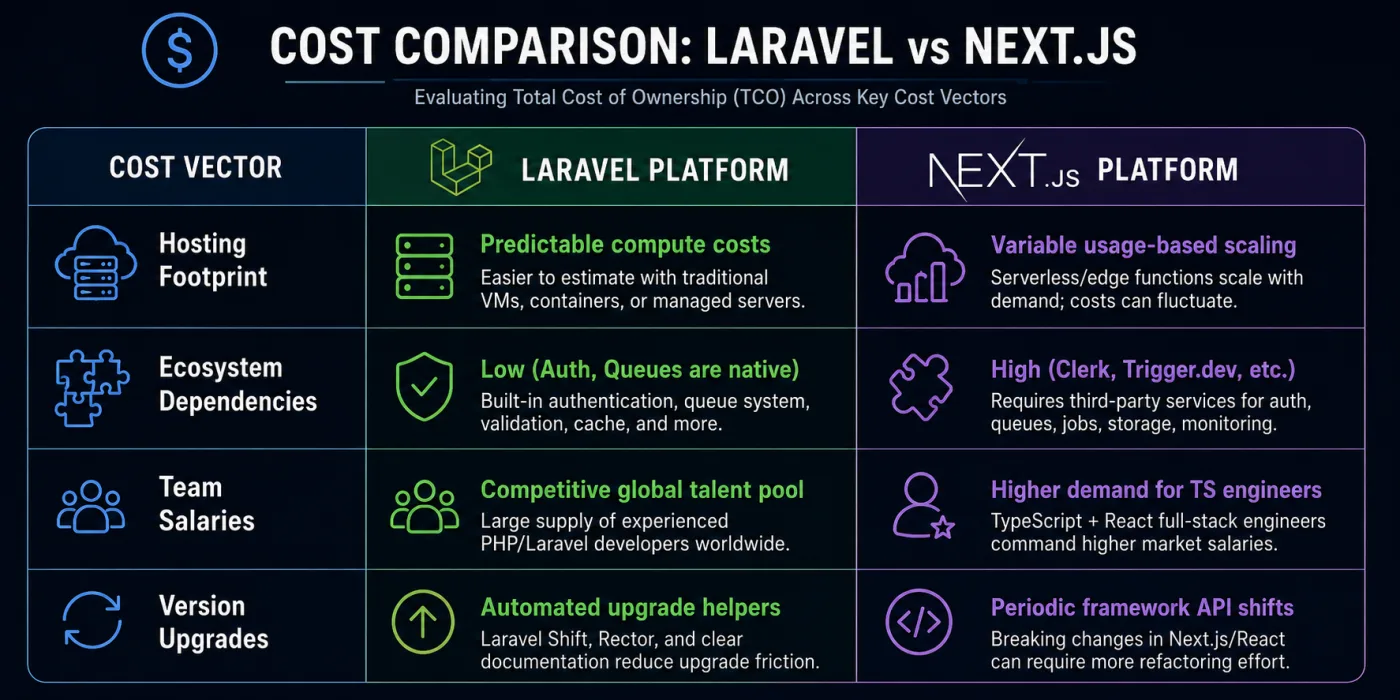
- Infrastructure Costs: Laravel running on standard cloud instances (AWS EC2, Hetzner, DigitalOcean) scales predictably using persistent workers. Next.js on managed serverless platforms (like Vercel) offers low entry costs, but high-traffic applications with heavy edge function usage can see variable monthly bills.
- Ecosystem Costs: Because Laravel includes authentication, queuing, and scheduled tasks natively, it minimizes reliance on external SaaS services. Building equivalent functionality in Next.js often involves combining third-party products (e.g., Clerk for Auth, Trigger.dev for Queues), which can increase recurring operational costs.
- Upgrade Paths: Laravel follows a predictable release cycle supported by automated upgrading tools like Laravel Shift. Next.js updates can require structural refactoring when core paradigms evolve (such as the shift from the Pages Router to the App Router).
Common Selection Pitfalls
-
Choosing Next.js strictly for single-language convenience: Teams often assume using TypeScript everywhere reduces system complexity. However, without strict architectural discipline, full-stack Next.js applications can end up mixing backend business logic with UI component routes.
-
Underestimating Serverless Connection Limits: Deploying a serverless Next.js app connected directly to a relational database can lead to pool exhaustion during traffic surges without an intermediate proxy layer.
-
Overlooking Background Queue Infrastructure: Engineering teams building feature-rich platforms in Next.js often realize late in the build that they need background job processing, forcing them to retrofit external queue runners onto their stack.
-
Ignoring Monolithic Options: Teams often split their system into separate frontend and backend applications when a hybrid monolith (like Laravel with Inertia.js) could deliver the required user experience with significantly lower operational overhead.
Framework Recommendations by Domain
Startups & Early-Stage SaaS
-
Recommendation: Laravel with Inertia.js or Next.js with Supabase.
-
Rationale: Focus on execution speed and quick iteration. Laravel with Inertia lets small teams ship full-featured React applications quickly without spending weeks building and maintaining separate API interfaces.
Small to Mid-Sized Enterprises (SMEs)
-
Recommendation: Monolithic Laravel or Decoupled Laravel Core API + React Frontend.
-
Rationale: Delivers predictable hosting costs, clear architectural conventions, and long-term codebase stability.
High-Scale Enterprise & FinTech Platforms
-
Recommendation: Decoupled Architecture (Laravel API Core + Next.js Frontend).
-
Rationale: Separates core business logic, background queues, and database operations from the presentation layer.
References & Independent Benchmarks
-
Laravel Benchmarks & Octane Specifications: Laravel Octane High-Throughput Documentation & FrankenPHP Execution Benchmarks. Available at:
https://laravel.com/docs/octaneandhttps://frankenphp.dev -
Vercel / Next.js Serverless Function Limits: Next.js Execution Models and Serverless Timeout Specifications. Available at: https://nextjs.org/docs and https://vercel.com/docs/functions
-
React Server Components Architecture: React Core Working Group RSC Specification and Hydration Overhead Reduction Analysis. Available at: https://react.dev/reference/rsc/server-components
-
OWASP Top 10 Web Application Security Security Risks: Server-Side Authorization and Access Control Validation Standards. Available at: https://owasp.org/Top10
-
The PHP Foundation & JetBrains State of Developer Ecosystem: Global PHP & Node.js Adoption in Enterprise Environments. Available at: https://the.php.foundation
Need Architectural Guidance for Your Platform Strategy?
Selecting the right technology stack requires matching your framework choice to your team's expertise, business goals, and operational requirements.
At TechMamba, our engineering team builds custom enterprise software, scalable SaaS platforms, and modern web architectures. Whether you need a high-scale Laravel backend, an optimized Next.js application, or a hybrid architecture, we can help you design and build a secure platform.
-
Explore Services: Learn more about TechMamba's Custom Software Development Services.
-
Work With Us: Speak with an engineer to schedule an architectural review of your software platform strategy.