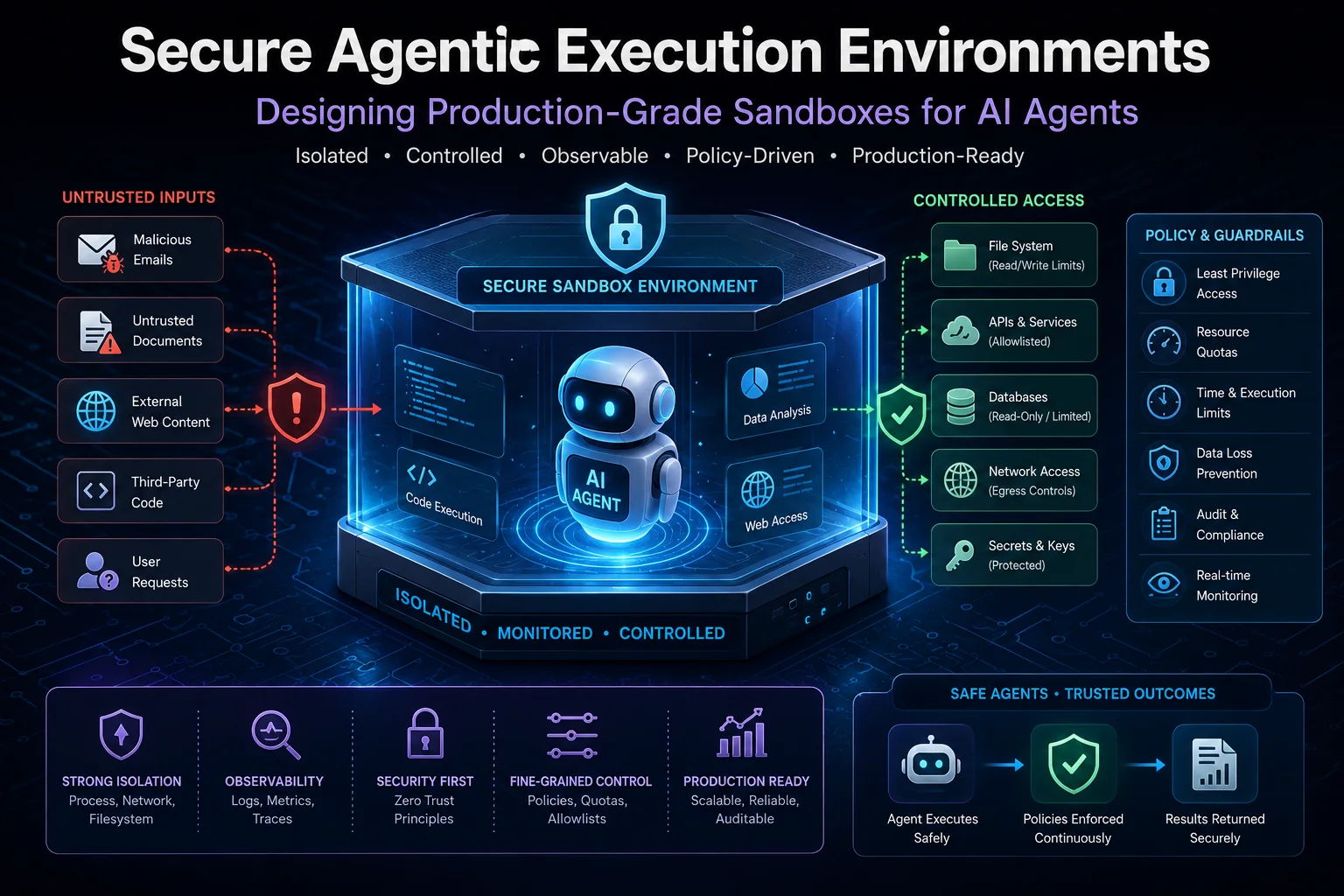
As autonomous AI agents shift from static text generation to dynamic runtime operations—such as executing arbitrary code, refactoring codebases, and executing shell commands—standard container-level virtualization breaks down. Traditional multi-tenant architectures sharing a single host Linux kernel expose enterprises to catastrophic container escape vulnerabilities (e.g.,
CVE-2024-21626) via untrusted LLM outputs. This guide details the technical blueprint for designing and deploying a multi-tenant, hardware-isolated, stateful code execution sandbox tailored for enterprise agent environments.
The Threat Model of Autonomous Code Execution
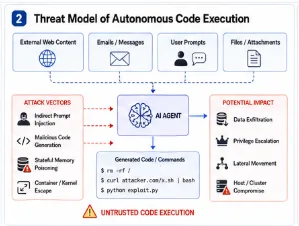
Traditional application security assumes a deterministic codebase audited at compile or deploy time. Autonomous agents, by contrast, dynamically compile and execute novel scripts at runtime based on real-time tool orchestration loops. This behavior introduces distinct attack vectors:
-
Indirect Prompt Injection Exploitation: An agent processing external web content or email strings can be manipulated into executing malicious bash scripts or Python data commands.
-
Stateful Memory Poisoning: Unlike isolated single-shot API wrappers, coding agents maintain ongoing stateful execution sessions across threads. Attackers can poison context memory arrays or local files to trigger execution exploits several cycles later.
-
Kernel & Host Co-location Risk: If an agent executes code natively inside a typical Docker container, any unpatched Linux kernel vulnerability allows the LLM-generated code to escape to the underlying host cluster infrastructure.
Infrastructure Isolation Matrix
To safely run unreviewed, model-generated code, infrastructure architects must separate tenant runtimes strictly below the shared operating system layer. The table below evaluates the three dominant isolation technologies used in 2026:
| Security Vector | Hardened OCI Containers (Docker/Podman) | User-Space Kernels (Google gVisor) | Hardware-Virtualized MicroVMs (AWS Firecracker) |
| Isolation Boundary | Linux Namespaces / cgroups | Intercepted Sentry Syscall Proxy | Dedicated Guest Linux Kernel per Session |
| Escape Surface Area | Extremely High (Shared Host Kernel) | Medium (Sentry bugs / compatibility fallbacks) | Low (Limited to KVM / Hypervisor API surface) |
| Cold Start Latency | Less than 50 milliseconds | 100 to 250 milliseconds | 5 to 30 milliseconds (with snapshot optimization) |
| Memory Footprint | Minimal (~15MB overhead) | Low (~30MB overhead) | Low-Medium (~50MB overhead per microVM instance) |
| Production Fit | Internal workflows with trusted datasets | Medium-risk web-scraping agents | High-risk autonomous code generation platforms |
High-Performance Architectural Topology
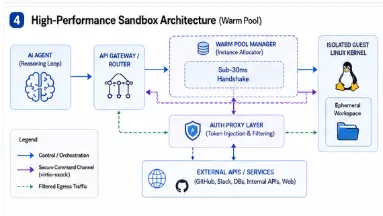
Building an enterprise sandbox layer requires a balance between bulletproof security and instant responsiveness. A naive approach spins up a microVM on-demand, causing an unacceptable 2-second user delay during agent reasoning loops. The high-performance solution leverages a Pre-provisioned Warm Pool Architecture combined with an external Authentication Credential Proxy.
[Agent Reasoning Loop]
       │
       ▼
 [API Gateway / Router] ───── (Claims Warm Sandbox Instance via Pool Allocator)
       │
       ├───► [Warm Pool Manager] ─── Sub-30ms Handshake ───┐
       │                                                   ▼
       ├───► [MicroVM Cluster (Firecracker)] ───► [Isolated Ephemeral Guest Kernel]
       │                                                   │
       ▼                                                   ▼
 [Auth Proxy Layer] ◄── Filtered Egress Network Traffic ───┘
 (Token injection happens here; no raw credentials enter the sandbox)
Key Subsystems:
-
The Allocator Engine: Maintains an inventory of paused or warm-booted guest kernels. When the orchestrator layer schedules a tool call, the instance is immediately bound to that specific agent session.
-
The Guest Runtime Agent: A lightweight Unix daemon running inside the guest filesystem that communicates with the host over a ring-buffered serial interface (
virtio-vsock). This bypasses the host networking stack entirely for command inputs and stdout/stderr responses. -
The Auth Proxy Filter: Agents frequently require external API access (e.g., GitHub, Slack, internal databases). Instead of mounting private keys or environment variables directly inside the guest environment where malicious code could dump them, all requests pass through a host-level proxy that injects temporary tokens downstream.
Production Reference Implementation
This production-ready blueprint demonstrates an orchestration subsystem designed to manage ephemeral MicroVM environments, allocate secure workspace parameters, apply strict resource constraints, and enforce syscall constraints.
import os
import sys
import json
import logging
import subprocess
import socket
from typing import Dict, Any, Optional

logging.basicConfig(level=logging.INFO, format="%(asctime)s - %(levelname)s - %(message)s")
logger = logging.getLogger("SandboxOrchestrator")

class MicroVMSandbox:
    """
    Manages the initialization, execution, and teardown of a hardware-isolated
    guest microVM runtime environment for executing agent-generated scripts.
    """
    def __init__(self, session_id: str, mem_mb: int = 512, cpu_count: int = 1):
        self.session_id = session_id
        self.mem_mb = mem_mb
        self.cpu_count = cpu_count
        self.chroot_base = f"/srv/sandboxes/{session_id}"
        self.socket_path = f"/var/run/firecracker-{session_id}.socket"
        self.is_active = False

    def provision_workspace(self) -> None:
        """Sets up the isolated root filesystem directory and ephemeral layers."""
        try:
            os.makedirs(self.chroot_base, exist_ok=True)
            os.makedirs(f"{self.chroot_base}/tmp", exist_ok=True)
            os.makedirs(f"{self.chroot_base}/workspace", exist_ok=True)

            # Write standard low-overhead cgroups limits profile for this session
            cgroup_path = f"/sys/fs/cgroup/unified/agent-sandboxes/{self.session_id}"
            os.makedirs(cgroup_path, exist_ok=True)

            with open(f"{cgroup_path}/memory.max", "w") as f:
                f.write(str(self.mem_mb * 1024 * 1024))

            logger.info(f"Workspace provisioned securely for session {self.session_id}")
        except OSError as e:
            logger.error(f"Failed to securely build sandbox workspace: {str(e)}")
            raise

    def configure_kernel_boot(self) -> Dict[str, Any]:
        """Returns the initialization configuration payload for the guest microVM."""
        return {
            "boot-source": {
                "kernel_image_path": "/var/lib/firecracker/kernels/vmlinux-5.10.bin",
                "boot_args": "console=ttyS0 reboot=k panic=1 pci=off ro"
            },
            "drives": [
                {
                    "drive_id": "rootfs",
                    "path_on_host": f"{self.chroot_base}/rootfs.ext4",
                    "is_root_device": True,
                    "is_read_only": False
                }
            ],
            "machine-config": {
                "vcpu_count": self.cpu_count,
                "mem_size_mib": self.mem_mb,
                "smt": False
            }
        }

    def execute_command_string(self, script_contents: str, timeout_seconds: int = 15) -> Dict[str, Any]:
        """
        Pipes agent code down the secure virtual serial interface channel.
        Applies host-enforced process containment wrappers.
        """
        self.provision_workspace()

        # In a real environment, configure_kernel_boot payload is submitted to the Firecracker API socket
        # For execution simulation within the isolation container boundary:
        target_payload = os.path.join(self.chroot_base, "workspace", "agent_script.py")

        with open(target_payload, "w") as script_file:
            script_file.write(script_contents)

        # Hardened operational execution profile wrapper via bubblewrap/seccomp
        sandbox_wrapper = [
            "bwrap",
            "--ro-bind", "/usr", "/usr",
            "--ro-bind", "/lib", "/lib",
            "--ro-bind", "/lib64", "/lib64",
            "--dir", "/tmp",
            "--dir", "/var",
            "--bind", f"{self.chroot_base}/workspace", "/workspace",
            "--unshare-all",
            "--uid", "1000",
            "--gid", "1000",
            "--chdir", "/workspace",
            "python3", "agent_script.py"
        ]

        try:
            logger.info(f"Launching execution routine for session {self.session_id}...")
            execution_result = subprocess.run(
                sandbox_wrapper,
                capture_output=True,
                text=True,
                timeout=timeout_seconds
            )

            return {
                "exit_code": execution_result.returncode,
                "stdout": execution_result.stdout,
                "stderr": execution_result.stderr,
                "status": "COMPLETED"
            }

        except subprocess.TimeoutExpired:
            logger.warning(f"Session {self.session_id} exceeded structural time allocation window.")
            return {
                "exit_code": -1,
                "stdout": "",
                "stderr": f"Execution aborted: Timeout limit of {timeout_seconds}s reached.",
                "status": "TIMEOUT_EXCEEDED"
            }
        except Exception as general_err:
            return {
                "exit_code": -99,
                "stdout": "",
                "stderr": f"Sandbox supervisor failure: {str(general_err)}",
                "status": "INFRASTRUCTURE_ERROR"
            }

    def purge_runtime_environment(self) -> None:
        """Destroys all ephemeral state layers and ensures zero memory leaks."""
        try:
            cleanup_cmd = ["rm", "-rf", self.chroot_base]
            subprocess.run(cleanup_cmd, check=True)
            logger.info(f"Successfully swept and purged session context {self.session_id}")
        except subprocess.CalledProcessError:
            logger.error(f"Critical error: Cleanup failed for workspace path {self.chroot_base}")

# Operational Integration Verification Run
if __name__ == "__main__":
    test_session = "agent_session_88912"
    orchestrator = MicroVMSandbox(session_id=test_session)

    # Example containing potentially dangerous operations targeting system extraction
    untrusted_agent_code = """
import os
import sys

print("Hello from inside the secure virtual workspace context!")
try:
    # Attempting an illegal write to access the base system context
    with open('/usr/bin/malicious_binary', 'w') as exploit:
        exploit.write('malicious footprint')
except Exception as err:
    print(f"Trapped write attempt successfully: {str(err)}", file=sys.stderr)
"""

    try:
        execution_summary = orchestrator.execute_command_string(untrusted_agent_code)
        print("\n=== Sandbox Output Logs ===")
        print(json.dumps(execution_summary, indent=2))
    finally:
        orchestrator.purge_runtime_environment()
Advanced Isolation Strategies
Kernel Call Interception (Seccomp profiles)
To prevent agent-generated scripts from exploiting deep kernel bugs, developers must block non-essential syscalls. Standard computing environments require access to roughly 300+ syscall actions. An AI execution sandbox should restrict this footprint down to a minimal allowlist using Secure Computing Mode (seccomp).
Any execution trace requesting prohibited calls—such as sys_kexec_load (reloading kernels) or sys_ptrace (tracing other processes)—is terminated by the Linux host kernel before execution occurs.
Dual-Level Resource Constraining
Runaway agent algorithms can inadvertently execute infinite processing loop patterns or write huge telemetry logs that fill up local storage arrays. Runtimes rely on cgroups v2 mapping hierarchies to enforce explicit thresholds:
# Production Cgroup Allocation Threshold Constraints
/sys/fs/cgroup/unified/agent-sandboxes/
  ├── memory.max = 536870912          # Hard capping at 512 Megabytes
  ├── cpu.max = 20000 100000          # Maximum utilization budget capped at 20% of 1 core
  └── io.max = "8:0 rbps=10485760"    # Strict limitation of disk read speeds to 10MB/s
Network Containment Best Practices
By default, runtime spaces must enforce a Default-Deny Egress Policy. If an agent requires access to a public package repository (e.g., pip or npm) to evaluate a problem, the access path must navigate a specialized proxy filter:
-
DNS Blocklisting: Resolves only verified domain names, immediately dropping connections to unknown or raw IP addresses.
-
Dynamic Packet Tracing: Monitors outbound packet counts via
eBPFhooks. If data transmissions spike above 5MB within 10 seconds, the sandbox execution thread is frozen to mitigate potential data exfiltration attempts.
Integrating the Sandbox into the Agent Loop
To see how this component fits into a broader multi-agent setup, look at the architectural models in our guide on AI Agent Architecture Explained and our comprehensive review of Enterprise AI Security in 2026.
When building persistent agents that manage long-running data workflows, you must link these ephemeral sandboxes directly to the agent's long-term context databases. This ensures state transfers correctly without exposing the raw memory infrastructure. For more on handling these state handoffs, check out AI Agent Memory Explained.
Furthermore, standardizing these runtime environment handshakes across different model providers is simplified by adopting the unified client-server interface principles discussed in the Model Context Protocol (MCP) Explained architectural analysis.
Sandbox Operations: Step-by-Step Lifecycle
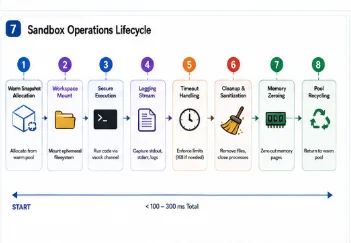
The lifecycle of an agent execution environment requires clean state transitions to maintain performance under heavy multi-tenant workloads. The following sequence outlines the transition path of a single sandbox container instance:
Continuous Monitoring & Threat Forensic Strategy
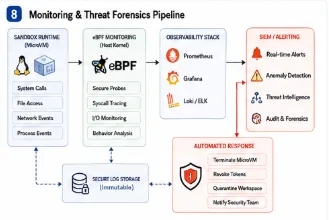
Even within an isolated sandbox, real-time logging is necessary to catch anomalous behaviors before they consume excessive cloud resources.
[Sandbox Guest Runtime] ── Syscall Event ──► [Host Linux Kernel Ring Buffer]
                                                       │
                                            eBPF Filter Interception
                                                       │
                                                       ▼
                                            [SIEM / Telemetry Aggregator]
                                            (Alerts triggered if write paths
                                             violate baseline constraints)
Production environments leverage eBPF programs attached to the host kernel to monitor guest behavior without introducing performance overhead. If an agent-generated script attempts a rapid sequence of fork operations (a potential fork-bomb denial-of-service attack) or queries restricted network ranges, the system routes an alert to the orchestration layer to instantly terminate the microVM session.
This continuous monitoring framework ensures that as agents become more autonomous, your underlying cloud infrastructure remains secure, reliable, and isolated.
Choosing the Right Sandbox Technology
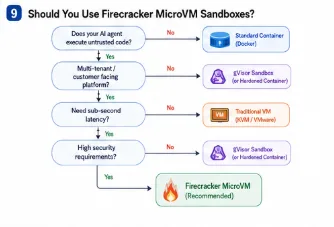
Selecting the right execution environment is one of the most critical architectural decisions when building autonomous AI agents. The ideal sandbox depends on several factors, including the level of trust in the executed code, required security guarantees, latency expectations, infrastructure costs, and operational complexity. While traditional Docker containers offer excellent performance for trusted internal workloads, they share the host kernel and therefore present a larger attack surface when executing model-generated or user-supplied code. Technologies such as gVisor improve isolation by intercepting system calls in user space, making them suitable for medium-risk workloads. However, for production-grade AI coding agents that execute arbitrary or untrusted code in multi-tenant environments, Firecracker MicroVMs provide the strongest balance between hardware-level isolation, low startup latency, and efficient resource utilization.
The decision flowchart below serves as a practical architecture guide. By evaluating factors such as untrusted code execution, multi-tenancy, latency requirements, and security needs, engineering teams can determine whether a lightweight container, a user-space kernel, a traditional virtual machine, or a Firecracker MicroVM is the most appropriate choice for their AI platform. Rather than treating one technology as universally superior, the framework encourages selecting the solution that best aligns with the application's risk profile and operational requirements.
For a deeper dive into how LLMs explore virtual sandbox environments to solve complex, non-coding tasks via reinforcement learning, watch the research analysis in LLM-in-Sandbox Elicits General Agentic Intelligence. This video provides valuable context on how agentic intelligence scales when granted access to file management and real-time execution environments.